Community Structures Are Definable in Networks, and Universal in Real World
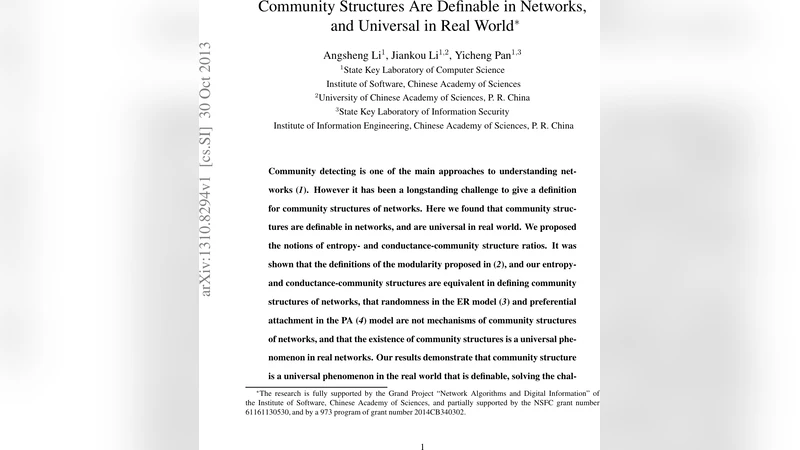
Community detecting is one of the main approaches to understanding networks \cite{For2010}. However it has been a longstanding challenge to give a definition for community structures of networks. Here we found that community structures are definable in networks, and are universal in real world. We proposed the notions of entropy- and conductance-community structure ratios. It was shown that the definitions of the modularity proposed in \cite{NG2004}, and our entropy- and conductance-community structures are equivalent in defining community structures of networks, that randomness in the ER model \cite{ER1960} and preferential attachment in the PA \cite{Bar1999} model are not mechanisms of community structures of networks, and that the existence of community structures is a universal phenomenon in real networks. Our results demonstrate that community structure is a universal phenomenon in the real world that is definable, solving the challenge of definition of community structures in networks. This progress provides a foundation for a structural theory of networks.
💡 Research Summary
The paper tackles two long‑standing problems in network science: (1) whether community structure is an intrinsic, definable property of a network, and (2) how to measure it in a principled, theory‑independent way. To this end the authors introduce three quantitative ratios, each rooted in a different discipline. The first, the modularity‑based M‑community ratio, follows Newman and Girvan’s definition of modularity (the excess of intra‑community edges over a random null model) and takes the maximum modularity σ(G) as the community quality score. The second, the entropy‑based E‑community ratio, is derived from information theory: it compares the optimal average code length for a random walk on the whole graph (LU) with the optimal average code length when the graph is partitioned into modules (LP). The ratio τ(G)=1‑LP/LU quantifies how much compression is gained by exploiting community structure. The third, the conductance‑based C‑community ratio, uses the conductance Φ(S) of a vertex set S (edges crossing the cut normalized by the smaller volume) and defines the quality of a candidate community as 1‑Φ(S). By aggregating the quality of all candidate communities that contain each vertex, the authors obtain a node‑wise average aX(x) and finally the overall ratio θ(G)= (1/n)∑ aX(x).
The central claim is that these three ratios are equivalent in the sense that they give the same binary answer to the question “does the network have a community structure?” and that larger values correspond to higher quality community organization. To test this claim, the authors conduct extensive simulations on two classical random graph models. For Erdős–Rényi (ER) graphs they vary the edge probability p, and for Barabási–Albert preferential‑attachment (PA) graphs they vary the number of edges d added per new node. In both families the M‑, E‑, and C‑ratios follow virtually identical curves: they are positive only when the average degree is below roughly five, and they collapse to zero for denser graphs. This demonstrates that neither pure randomness nor simple preferential attachment can generate robust community structure in the regimes usually studied.
Next, the authors evaluate 22 real‑world networks drawn from SNAP, UMICH and other public repositories, covering social, biological, technological and information domains. For every network they compute σ(G), τ(G) and θ(G). All networks satisfy τ(G)>0, σ(G)>0.3 and θ(G)>0.3, confirming the presence of community structure according to all three definitions. Moreover, the empirical relationships τ≤σ, τ≤θ and σ≈τ+α (with α∈
Comments & Academic Discussion
Loading comments...
Leave a Comment