A construction of relatively pure submodules
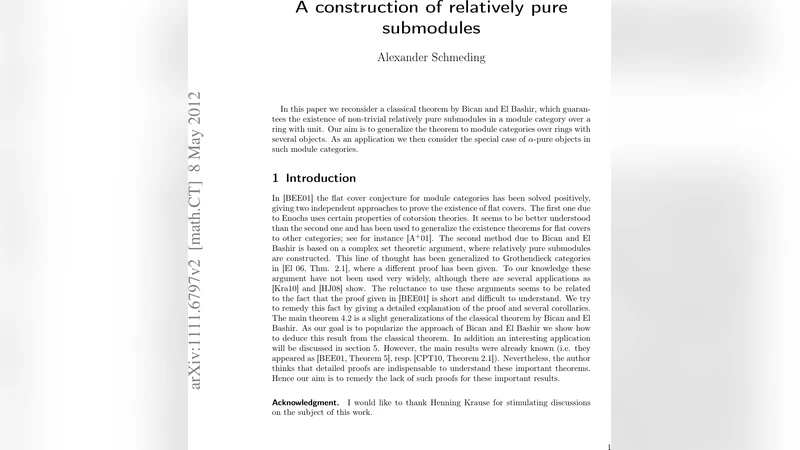
We reconsider a classical theorem by Bican and El Bashir, which guarantees the existence of non-trivial relatively pure submodules in a module category over a ring with unit. Our aim is to generalize the theorem to module categories over rings with several objects. As an application we then consider the special case of alpha-pure objects in such module categories.
💡 Research Summary
The paper revisits the classical Bican‑El Bashir theorem, which guarantees that every non‑zero module over a unital ring contains a non‑trivial relatively pure submodule, and extends this result to module categories over rings with several objects—that is, to functor categories Mod‑𝔖 where 𝔖 is a small pre‑additive category. The authors first set up the appropriate exact structure on Mod‑𝔖: they define an 𝔖‑exact structure by specifying a class of short exact sequences that are “𝔖‑pure” in the sense that they remain exact after applying any representable functor Hom𝔖(?,X). With this exact structure in place, a morphism is called 𝔖‑pure if it fits into an 𝔖‑exact sequence, and a submodule N⊂M is 𝔖‑relatively pure when the inclusion N→M is 𝔖‑pure.
The central theorem (Theorem 3.1) states that for any non‑zero object M in Mod‑𝔖 there exists a non‑zero subobject N⊂M such that the inclusion is 𝔖‑pure. The proof follows a transfinite construction reminiscent of the original Bican‑El Bashir argument but adapted to the categorical setting. One chooses a sufficiently large regular cardinal κ and well‑orders the underlying set of M. At each stage α<κ a subobject Nα is built; if the inclusion Nα→M fails to be 𝔖‑pure, the authors identify a “purity defect” using the kernel and cokernel of the relevant 𝔖‑pure test maps. By adjoining a carefully selected set of elements (of cardinality ≤κ) that kill this defect, they obtain Nα+1. The construction is κ‑continuous, and the union N=⋃α<κ Nα is shown to be 𝔖‑pure in M. A crucial technical point is that the class of 𝔖‑pure test maps is small relative to κ, which guarantees that the transfinite induction does not exceed κ steps.
Having established the existence of relatively pure submodules in Mod‑𝔖, the authors turn to α‑pure objects. For a regular cardinal α, a morphism f:X→Y is α‑pure if it remains monic after taking any α‑directed colimit; equivalently, f is a filtered colimit of split monomorphisms indexed by an α‑directed poset. The paper defines α‑pure monomorphisms in Mod‑𝔖 and shows that the 𝔖‑pure monomorphisms constructed above are automatically α‑pure for any sufficiently large α (in particular, for α larger than the cardinality of the set of test maps). Consequently, every non‑zero module M in Mod‑𝔖 contains a non‑zero α‑pure submodule. This result generalizes the classical α‑purity theory from ordinary module categories to the multi‑object setting.
The final sections illustrate the theory with examples. When 𝔖 is a finite‑object Artin algebra, the 𝔖‑pure submodules coincide with the usual pure submodules, confirming that the new framework recovers known results. For infinite quiver algebras, the construction yields non‑trivial α‑pure subrepresentations, which are of interest in representation theory and model theory of modules. The authors also discuss potential extensions, such as investigating the relationship between 𝔖‑purity and Ext‑groups, or applying the construction to higher homological algebra (e.g., derived categories of functor categories).
In summary, the paper successfully lifts the Bican‑El Bashir theorem to the setting of rings with several objects, provides a transparent transfinite construction of relatively pure submodules in functor categories, and demonstrates that these submodules are also α‑pure. This broadens the toolbox for researchers working with locally presentable abelian categories, representation theory of algebras, and model‑theoretic aspects of module categories.
Comments & Academic Discussion
Loading comments...
Leave a Comment