Greedy Graph Colouring is a Misleading Heuristic
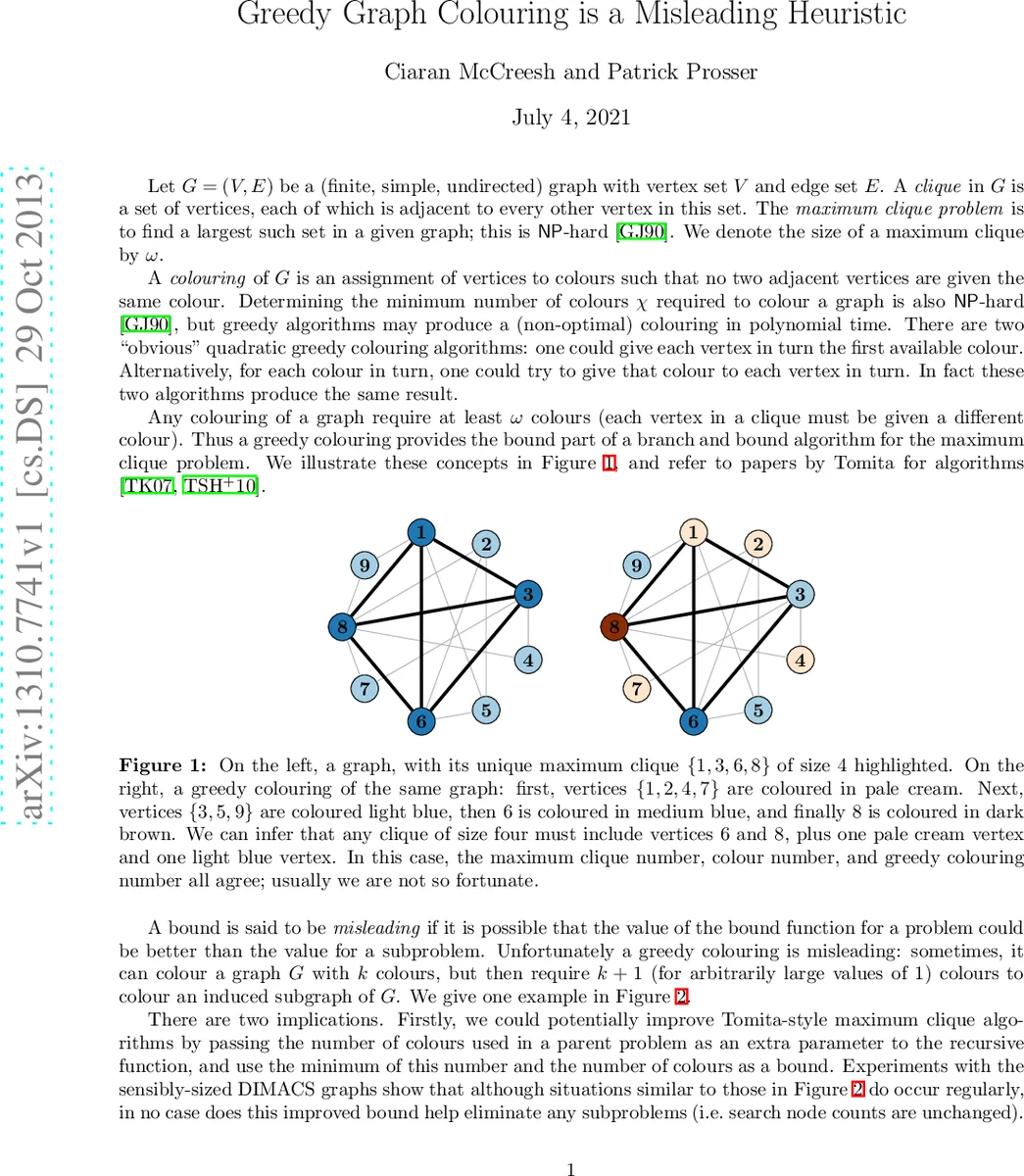
State of the art maximum clique algorithms use a greedy graph colouring as a bound. We show that greedy graph colouring can be misleading, which has implications for parallel branch and bound.
💡 Research Summary
The paper investigates a subtle but important flaw in the use of greedy graph colouring as a bound within branch‑and‑bound (B&B) algorithms for the maximum clique problem. The authors begin by recalling that the size ω of a maximum clique provides a lower bound on the chromatic number χ of a graph, and that a greedy colouring can be computed in polynomial time, yielding an upper bound on ω that is often used to prune the search tree. Two standard quadratic greedy colourings – assigning the first available colour to each vertex in a fixed order, or iterating over colours and assigning them to vertices – are shown to be equivalent.
The central contribution is the definition of a “misleading” bound: a bound B(P) for a problem P is misleading if there exists a sub‑problem Q of P such that B(Q) > B(P). The authors demonstrate that greedy colourings can be misleading by constructing a simple example (Figure 2). In the full graph, greedy colouring in the natural numerical order uses only two colours. After removing the first vertex, the same order forces a third colour, even though the sub‑graph is strictly smaller. Consequently, the bound for the subtree is worse than the bound for its parent node.
This phenomenon has two practical implications. First, it suggests a possible improvement to Tomita‑style maximum‑clique algorithms: pass the number of colours used for the parent problem as an additional parameter to the recursive routine, and use the minimum of the parent colour count and the current greedy colour count as the bound. Experiments on a suite of DIMACS benchmark graphs show that while the misleading situation occurs frequently, the refined bound never reduces the number of explored nodes; search‑node counts remain unchanged.
Second, and more critically, a non‑misleading bound is a prerequisite for avoiding anomalies in parallel B&B, as identified in earlier work (Li & Wah 1986; Trïnekens 1990; Bruin et al. 1995). In parallel implementations, work is distributed among sub‑trees based on their bounds; if a sub‑tree’s bound becomes larger than its parent’s, the scheduler may allocate excessive resources to a branch that should have been pruned, leading to load imbalance and performance degradation. The authors therefore argue that parallel maximum‑clique solvers such as those by McCreesh & Prosser (2013) and De Polla et al. (2013) should be adapted to guard against this “anomaly”.
The paper concludes that greedy colourings remain a valuable heuristic but must be used with awareness of their limitations. When designing parallel B&B algorithms, developers should either ensure that the colouring heuristic is non‑misleading (for example by employing dynamic vertex ordering strategies like degree‑descending or saturation‑degree) or incorporate additional checks that detect when a sub‑problem’s colour bound exceeds that of its ancestor. Such safeguards would preserve the expected monotonicity of bounds, maintain efficient load balancing, and avoid the slowdown associated with anomalous sub‑tree expansions. The insights are not limited to the maximum‑clique problem; any combinatorial optimisation technique that relies on greedy colourings for bounding can benefit from the same careful treatment.
Comments & Academic Discussion
Loading comments...
Leave a Comment