Translating Labels to Hypersequents for Intermediate Logics with Geometric Kripke Semantics
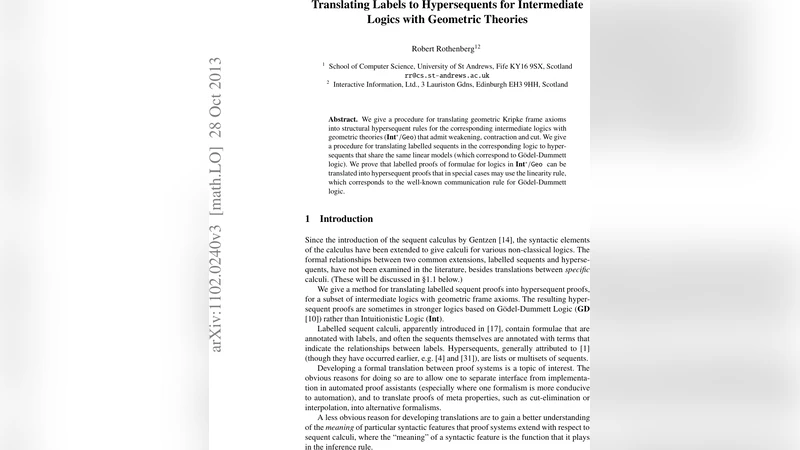
We give a procedure for translating geometric Kripke frame axioms into structural hypersequent rules for the corresponding intermediate logics in Int^/Geo that admit weakening, contraction and in some cases, cut. We give a procedure for translating labelled sequents in the corresponding logic to hypersequents that share the same linear models (which correspond to G"odel-Dummett logic). We prove that labelled proofs Int^/Geo can be translated into hypersequent proofs that may use the linearity rule, which corresponds to the well-known communication rule for G"odel-Dummett logic.
💡 Research Summary
The paper presents a systematic method for translating geometric Kripke frame axioms into structural hypersequent rules, thereby bridging labelled sequent calculi and hypersequent calculi for a family of intermediate logics denoted Int∗/Geo. These logics sit between intuitionistic and classical logic and are characterized by additional axioms that can be expressed as geometric implications of the form ∀ x̄.(A⊃B). The authors first recall the labelled sequent system G3I, where formulas are annotated with labels and relational atoms (e.g., x≤y) encode the underlying Kripke accessibility relation. They show that adding geometric rules derived from frame axioms to G3I preserves the admissibility of weakening, contraction, and cut.
The core contribution is a five‑step translation procedure that converts a geometric rule into a hypersequent rule. The steps are: (1) obtain the labelled rule and close its relational atoms under transitivity; (2) create a base schematic hypersequent by assigning each principal label a distinct component Γₓ⇒Δₓ; (3) for each relational atom x≤y, add Γₓ to the antecedent of the component for y and Δ_y to the succedent of the component for x (merging components when the relation is symmetric); (4) repeat the process for each premise, adding fresh components for fresh labels but no new variables; (5) eliminate duplicate variables and duplicate components. This construction faithfully mirrors the inclusion relationships among Kripke worlds as inclusion among hypersequent components.
Through this translation, any labelled proof in Int∗/Geo can be turned into a hypersequent proof that may employ the linearity (communication) rule. The linearity rule corresponds to frame axioms such as (A⊃B)∨(B⊃A) for Gödel‑Dummett logic, which in the labelled setting become x≤y ∨ y≤x. In the hypersequent setting the same effect is achieved by the external contraction (EC) rule, showing that the hypersequent calculus captures the same linear models as the labelled calculus.
The paper also discusses the practical implications of this correspondence. Labelled calculi make relational information explicit, which is advantageous for search and automation, while hypersequents provide a more compact, component‑wise view that simplifies structural reasoning. The translation thus enables the transfer of meta‑theoretic results—such as cut‑elimination, interpolation, and proof‑complexity analyses—between the two formalisms.
Related work on S5, Abelian logic, Łukasiewicz logic, and other modal systems is surveyed, highlighting that previous translations were ad‑hoc and limited to specific logics. The authors’ method applies uniformly to any intermediate logic whose frame axioms can be rewritten as ∀ x̄.(A₀⊃∃ ȳ.(A₁∨…∨Aₙ)), covering well‑known systems like Jan, BD₂, and classical logic. Consequently, the procedure can be automated to generate hypersequent rules directly from geometric frame specifications.
In conclusion, the paper provides a robust bridge between labelled sequents and hypersequents for a broad class of intermediate logics, preserving structural rules and capturing essential properties such as linearity. This bridge opens avenues for implementing hybrid proof assistants, transferring proof‑theoretic results across formalisms, and extending the approach to other non‑classical logics in future work.
Comments & Academic Discussion
Loading comments...
Leave a Comment