Computer Models Design for Teaching and Learning using Easy Java Simulation
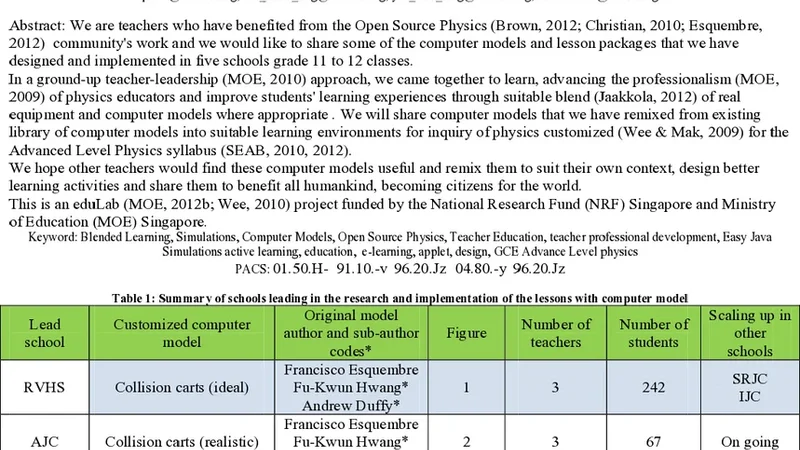
We are teachers who have benefited from the Open Source Physics (Brown, 2012; Christian, 2010; Esquembre, 2012) community’s work and we would like to share some of the computer models and lesson packages that we have designed and implemented in five schools grade 11 to 12 classes. In a ground-up teacher-leadership (MOE, 2010) approach, we came together to learn, advancing the professionalism (MOE, 2009) of physics educators and improve students’ learning experiences through suitable blend (Jaakkola, 2012) of real equipment and computer models where appropriate . We will share computer models that we have remixed from existing library of computer models into suitable learning environments for inquiry of physics customized (Wee & Mak, 2009) for the Advanced Level Physics syllabus (SEAB, 2010, 2012). We hope other teachers would find these computer models useful and remix them to suit their own context, design better learning activities and share them to benefit all humankind, becoming citizens for the world. This is an eduLab (MOE, 2012b; Wee, 2010) project funded by the National Research Fund (NRF) Singapore and Ministry of Education (MOE) Singapore.
💡 Research Summary
This paper reports on an eduLab project funded by Singapore’s National Research Fund (NRF) and Ministry of Education (MOE) that aimed to improve senior‑secondary physics teaching through the creation and dissemination of computer‑based simulation models built with Easy Java Simulations (EJS). The authors, who are practicing physics teachers, leveraged the Open Source Physics (OSP) community’s extensive library of existing Java‑based simulations, remixing and customizing them to align with the Singapore Advanced Level Physics syllabus (SEAB, 2010, 2012).
The work was organized around a teacher‑leadership approach endorsed by MOE’s professional development policies (MOE 2009, 2010). First, a needs‑analysis was conducted across five schools (grades 11‑12) to identify curricular gaps, equipment constraints, and pedagogical challenges. Based on this analysis, the team selected relevant OSP models and systematically re‑engineered them: variables were adjusted to match syllabus outcomes, user interfaces were redesigned for classroom usability, and data‑logging features were added to support inquiry‑based activities.
A series of collaborative workshops provided participating teachers with hands‑on training in EJS authoring, script editing, and instructional design. These sessions fostered a community of practice in which teachers co‑created lesson packages that blended real laboratory apparatus with virtual experiments, thereby achieving a “blended learning” environment that capitalizes on the strengths of both physical and digital resources.
Implementation took place in authentic classroom settings. Teachers integrated the customized simulations into laboratory sessions, allowing students to manipulate parameters, observe immediate visual feedback, and record results for analysis. Qualitative feedback collected through student interviews and teacher reflections indicated several benefits: enhanced conceptual understanding of abstract physics phenomena, increased confidence in experimental design, and heightened motivation to engage in scientific inquiry. The simulations also mitigated practical issues such as limited equipment availability, safety concerns, and time constraints, enabling a broader range of experiments to be explored within the standard class period.
All simulation files, source code, and accompanying instructional materials have been uploaded to an open‑access eduLab repository. The authors explicitly encourage other educators to remix these resources to suit local contexts, thereby contributing to a global commons of physics teaching tools. This open‑source philosophy aligns with the project’s broader vision of fostering “citizens for the world” who share knowledge for the benefit of humanity.
In conclusion, the study demonstrates that teacher‑driven development of EJS‑based simulations can effectively bridge curriculum requirements, resource limitations, and pedagogical goals in senior‑secondary physics. The authors suggest future work should include quantitative assessments of learning gains, adaptation of the models for diverse learning styles, and expansion of the approach to other science disciplines. By documenting the design process, implementation experience, and community‑building outcomes, the paper provides a replicable model for other education systems seeking to integrate open‑source simulations into science curricula.