Quantum Locally Testable Codes
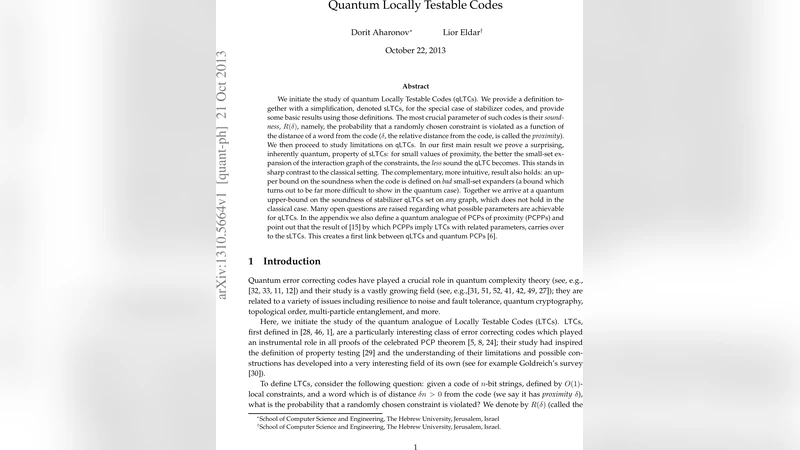
We initiate the study of quantum Locally Testable Codes (qLTCs). We provide a definition together with a simplification, denoted sLTCs, for the special case of stabilizer codes, together with some basic results using those definitions. The most crucial parameter of such codes is their soundness, $R(\delta)$, namely, the probability that a randomly chosen constraint is violated as a function of the distance of a word from the code ($\delta$, the relative distance from the code, is called the proximity). We then proceed to study limitations on qLTCs. In our first main result we prove a surprising, inherently quantum, property of sLTCs: for small values of proximity, the better the small-set expansion of the interaction graph of the constraints, the less sound the qLTC becomes. This phenomenon, which can be attributed to monogamy of entanglement, stands in sharp contrast to the classical setting. The complementary, more intuitive, result also holds: an upper bound on the soundness when the code is defined on poor small-set expanders (a bound which turns out to be far more difficult to show in the quantum case). Together we arrive at a quantum upper-bound on the soundness of stabilizer qLTCs set on any graph, which does not hold in the classical case. Many open questions are raised regarding what possible parameters are achievable for qLTCs. In the appendix we also define a quantum analogue of PCPs of proximity (PCPPs) and point out that the result of Ben-Sasson et. al. by which PCPPs imply LTCs with related parameters, carries over to the sLTCs. This creates a first link between qLTCs and quantum PCPs.
💡 Research Summary
The paper initiates the study of quantum locally testable codes (qLTCs), which are the quantum analogue of classical locally testable codes (LTCs). A qLTC is defined as a quantum error‑correcting code whose code space is the zero‑energy subspace of a local Hamiltonian H = ∑_{i=1}^{m} Π_i, where each Π_i is a projector (a “constraint”). The central quality parameter is the soundness function R(δ): for any state ψ that lies at Hamming distance at least δ n from the code space, the average energy ⟨ψ|H|ψ⟩/m is at least R(δ). This quantity plays the same role as the probability that a random constraint is violated in the classical setting.
Because stabilizer codes are the most studied family of quantum codes, the authors introduce a simplified definition for stabilizer LTCs (sLTCs). An sLTC is specified by a set of commuting Pauli generators; a Pauli error “violates” a generator if it anticommutes with it. The paper proves (Claim 3) that this definition coincides with the general qLTC definition when restricted to stabilizer codes, thereby providing a convenient framework for the rest of the work.
Two main theorems give strong limitations on the achievable soundness of qLTCs.
Theorem 1 (Small‑set expander upper bound).
Consider a good stabilizer code on n d‑dimensional qudits, with each qudit participating in D_L = O(1) local generators of locality k = O(1). Let the bipartite interaction graph (qudits on the left, generators on the right) be an ε‑small‑set expander: every set of O(1) qudits is incident to at least (1 − ε)·k·|S| constraints. For any proximity δ smaller than a constant δ₀ (essentially min{1/(k³·D_L), ½·dist(C)}), the relative soundness r(δ) = R(δ)/(k·δ) satisfies r(δ) ≤ 2ε. In words, the better the expansion, the worse the soundness. The proof exploits the fact that on a good expander two generators intersect on at most one qudit, and that a Pauli error can be chosen to commute with the majority of generators acting on each qudit, thereby violating only a small fraction of constraints while still having large weight modulo the stabilizer’s centralizer. This phenomenon is rooted in the monogamy of entanglement: a qudit cannot simultaneously satisfy many commuting constraints without becoming trivial for the code.
The theorem sharply contrasts with the classical situation, where good expanders are used to construct LTCs with excellent soundness for small δ. The authors exhibit a classical construction (Sipser‑Spielman codes combined with lossless expanders) whose relative soundness approaches 1, underscoring the quantum‑specific limitation.
Theorem 2 (Universal upper bound).
For any good stabilizer code with k‑local generators (k ≥ 4) on d‑dimensional qudits, where each qudit participates in O(1) generators, the relative soundness for any constant proximity δ < δ₀ (with δ₀ = Ω(1)) is bounded by α(d)·(1 − γ_gap). Here α(d) = 1 − 1/d² is a trivial alphabet‑size bound, while γ_gap > 0 depends only on (k,d) and captures a genuinely quantum restriction. This bound holds regardless of the underlying interaction graph, showing that even on poorly expanding graphs qLTCs cannot achieve arbitrarily high soundness. The proof builds on the observation that any error of weight proportional to δ n must violate a non‑negligible fraction of generators because of the non‑commuting structure of stabilizer groups.
The paper also discusses concrete examples. The 2‑D toric code has extremely poor soundness: a string‑like error of length Θ(√n) violates only two plaquette/star checks, giving R(δ) ≤ 1/√n for δ ≈ 1/√n. Quantum Reed‑Muller codes, constructed via the CSS paradigm from classical Reed‑Muller codes, inherit good soundness from one of the constituent classical codes but suffer from very low rate and distance, illustrating the trade‑offs inherent in CSS constructions.
In the appendix the authors define quantum proofs of proximity (qPCPPs) and show that the classical reduction from PCPPs to LTCs (Ben‑Sasson et al.) carries over to the quantum setting, yielding a construction that turns a qPCPP for a code C into an sLTC C′ with related parameters. While this establishes a syntactic connection between qLTCs and quantum PCPs, the deeper implications for the quantum PCP conjecture remain open.
Overall, the work establishes that quantum locally testable codes are fundamentally constrained by quantum entanglement properties. Good small‑set expansion, which is a boon for classical LTCs, actually degrades soundness in the quantum regime. Moreover, even without any expansion assumptions, a universal upper bound on relative soundness exists, a phenomenon absent classically. These insights link qLTCs to major open problems such as the quantum PCP conjecture and the design of self‑correcting quantum memories, suggesting that any future construction of high‑performance qLTCs must navigate the monogamy of entanglement and the non‑commuting nature of stabilizer generators.
Comments & Academic Discussion
Loading comments...
Leave a Comment