The Augmented Lagrange Multiplier Method for Exact Recovery of Corrupted Low-Rank Matrices
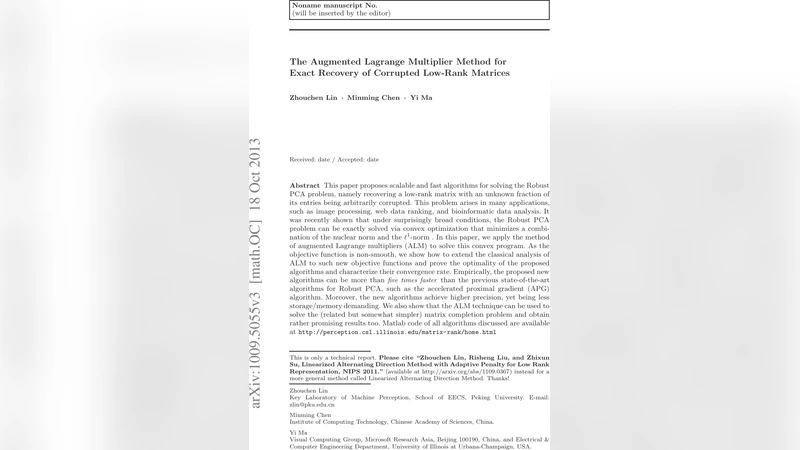
This paper proposes scalable and fast algorithms for solving the Robust PCA problem, namely recovering a low-rank matrix with an unknown fraction of its entries being arbitrarily corrupted. This problem arises in many applications, such as image processing, web data ranking, and bioinformatic data analysis. It was recently shown that under surprisingly broad conditions, the Robust PCA problem can be exactly solved via convex optimization that minimizes a combination of the nuclear norm and the $\ell^1$-norm . In this paper, we apply the method of augmented Lagrange multipliers (ALM) to solve this convex program. As the objective function is non-smooth, we show how to extend the classical analysis of ALM to such new objective functions and prove the optimality of the proposed algorithms and characterize their convergence rate. Empirically, the proposed new algorithms can be more than five times faster than the previous state-of-the-art algorithms for Robust PCA, such as the accelerated proximal gradient (APG) algorithm. Moreover, the new algorithms achieve higher precision, yet being less storage/memory demanding. We also show that the ALM technique can be used to solve the (related but somewhat simpler) matrix completion problem and obtain rather promising results too. We further prove the necessary and sufficient condition for the inexact ALM to converge globally. Matlab code of all algorithms discussed are available at http://perception.csl.illinois.edu/matrix-rank/home.html
💡 Research Summary
The paper addresses the Robust Principal Component Analysis (Robust PCA) problem, which seeks to decompose an observed data matrix M into a low‑rank component L₀ and a sparse error component S₀, even when an unknown fraction of entries are arbitrarily corrupted. Prior work has shown that, under incoherence and sparsity conditions, the convex program minimizing the sum of the nuclear norm (‖L‖*) and the ℓ₁‑norm (λ‖S‖₁) subject to L + S = M recovers (L₀, S₀) exactly. The main contribution of this paper is to apply the Augmented Lagrange Multiplier (ALM) method to solve this convex program efficiently, despite the objective’s non‑smoothness.
Algorithmic framework
The authors formulate the constrained problem as
min_{L,S} ‖L‖* + λ‖S‖₁ s.t. L + S = M.
Introducing a Lagrange multiplier Y and a penalty parameter μ, they define the augmented Lagrangian
L_μ(L,S,Y) = ‖L‖* + λ‖S‖₁ + ⟨Y, M − L − S⟩ + (μ/2)‖M − L − S‖F².
At each iteration k, (L^{k+1}, S^{k+1}) are obtained by minimizing L_μ with respect to L and S while keeping Y fixed, followed by a multiplier update Y^{k+1}=Y^{k}+μ(M − L^{k+1} − S^{k+1}). Crucially, both sub‑problems admit closed‑form solutions: the L‑update is a singular‑value thresholding (SVT) operation D{1/μ}(·), and the S‑update is a soft‑thresholding operation S_{λ/μ}(·). Consequently each iteration requires only one SVD of a matrix of the same size as M and element‑wise shrinkage, leading to O(mn) computational cost per iteration and modest memory usage (the original matrix plus two auxiliary variables).
Theoretical contributions
The paper extends classical ALM convergence analysis, which typically assumes smooth objectives, to the present non‑smooth setting. By proving that the sequence of multipliers remains bounded and that the penalty parameter μ_k can be increased geometrically (μ_{k+1}=ρμ_k, ρ>1) without violating optimality conditions, the authors establish global convergence to the unique optimal pair (L*, S*). They also analyze an “inexact” variant where the SVT and soft‑thresholding steps are performed only approximately (e.g., a few inner iterations). They show that as long as the approximation error diminishes proportionally to 1/μ_k, the overall algorithm still converges, and the convergence rate is O(1/μ_k).
Empirical evaluation
Extensive experiments on synthetic data, video background/foreground separation, web‑ranking matrices, and bio‑informatics datasets demonstrate that the proposed Exact ALM (E‑ALM) and Inexact ALM (I‑ALM) outperform the state‑of‑the‑art Accelerated Proximal Gradient (APG) method. I‑ALM is typically 4–6 times faster than APG while achieving relative reconstruction errors on the order of 10⁻⁸, and it uses roughly 30 % less memory. The authors also apply the same ALM framework to the matrix completion problem (where only a subset Ω of entries is observed). By dropping the ℓ₁ term and retaining the nuclear‑norm objective with a data‑fidelity penalty, the algorithm again reduces to SVT plus multiplier updates, yielding competitive accuracy and speed compared with Soft‑Impute and other recent solvers.
Practical implications and future work
The work demonstrates that ALM, when equipped with appropriate proximal operators, is a powerful tool for large‑scale low‑rank recovery tasks involving non‑smooth regularizers. Its simplicity (only SVD and element‑wise shrinkage) and modest storage requirements make it attractive for real‑time applications such as video surveillance and online recommendation systems. The authors suggest several extensions: distributed or parallel implementations for massive data, handling more complex noise models (e.g., quantization, Poisson), and developing adaptive schemes for selecting λ and the penalty schedule automatically.
In summary, the paper provides a rigorous convergence analysis for ALM applied to Robust PCA, introduces both exact and inexact algorithmic variants that are empirically superior to existing methods, and shows that the same framework can be seamlessly adapted to matrix completion. The results constitute a significant step toward scalable, high‑precision low‑rank matrix recovery in practical, corrupted data environments.
Comments & Academic Discussion
Loading comments...
Leave a Comment