📝 Original Info
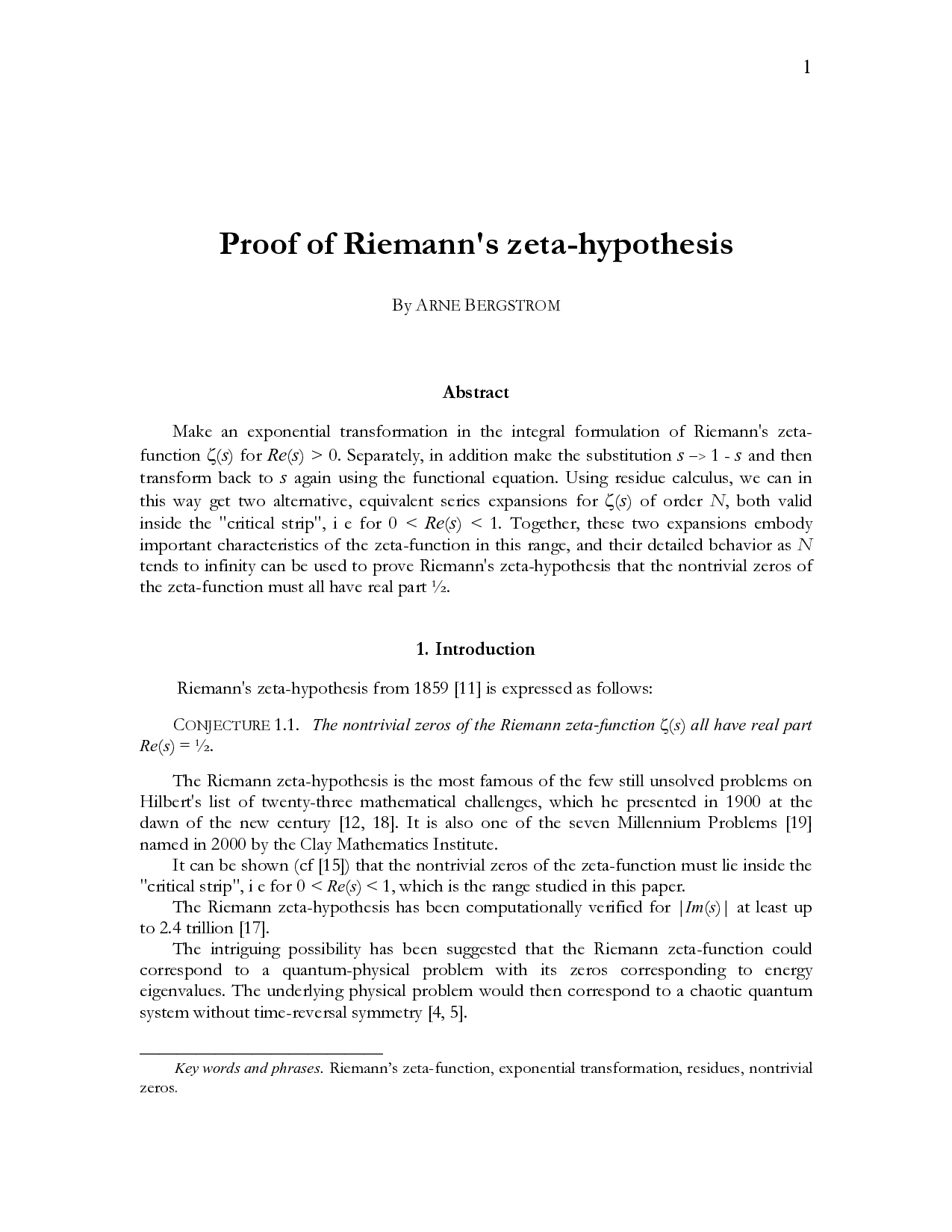
- Title: Proof of Riemanns zeta-hypothesis
- ArXiv ID: 0809.5120
- Date: 2013-10-15
- Authors: ** Arne Bergstrom **
📝 Abstract
Make an exponential transformation in the integral formulation of Riemann's zeta-function zeta(s) for Re(s) > 0. Separately, in addition make the substitution s -> 1 - s and then transform back to s again using the functional equation. Using residue calculus, we can in this way get two alternative, equivalent series expansions for zeta(s) of order N, both valid inside the "critical strip", i e for 0 < Re(s) < 1. Together, these two expansions embody important characteristics of the zeta-function in this range, and their detailed behavior as N tends to infinity can be used to prove Riemann's zeta-hypothesis that the nontrivial zeros of the zeta-function must all have real part 1/2. In addition to the preprint, the arXiv file also contains a discussion of some forty Frequently Asked Questions from readers. Further questions not adequately dealt with in the existing FAQ are welcome.
💡 Deep Analysis
Deep Dive into Proof of Riemanns zeta-hypothesis.
Make an exponential transformation in the integral formulation of Riemann’s zeta-function zeta(s) for Re(s) > 0. Separately, in addition make the substitution s -> 1 - s and then transform back to s again using the functional equation. Using residue calculus, we can in this way get two alternative, equivalent series expansions for zeta(s) of order N, both valid inside the “critical strip”, i e for 0 < Re(s) < 1. Together, these two expansions embody important characteristics of the zeta-function in this range, and their detailed behavior as N tends to infinity can be used to prove Riemann’s zeta-hypothesis that the nontrivial zeros of the zeta-function must all have real part 1/2. In addition to the preprint, the arXiv file also contains a discussion of some forty Frequently Asked Questions from readers. Further questions not adequately dealt with in the existing FAQ are welcome.
📄 Full Content
Proof of Riemann’s zeta-hypothesis
Arne Bergstrom
Paper
pages 1 – 21
FAQ
pages 22 – 85
1
Proof of Riemann's zeta-hypothesis
By ARNE BERGSTROM
Abstract
Make an exponential transformation in the integral formulation of Riemann's zeta-
function ζ(s) for Re(s) > 0. Separately, in addition make the substitution s −> 1 - s and then
transform back to s again using the functional equation. Using residue calculus, we can in
this way get two alternative, equivalent series expansions for ζ(s) of order N, both valid
inside the "critical strip", i e for 0 < Re(s) < 1. Together, these two expansions embody
important characteristics of the zeta-function in this range, and their detailed behavior as N
tends to infinity can be used to prove Riemann's zeta-hypothesis that the nontrivial zeros of
the zeta-function must all have real part ½.
1. Introduction
Riemann's zeta-hypothesis from 1859 [11] is expressed as follows:
CONJECTURE 1.1. The nontrivial zeros of the Riemann zeta-function ζ(s) all have real part
Re(s) = ½.
The Riemann zeta-hypothesis is the most famous of the few still unsolved problems on
Hilbert's list of twenty-three mathematical challenges, which he presented in 1900 at the
dawn of the new century [12, 18]. It is also one of the seven Millennium Problems [19]
named in 2000 by the Clay Mathematics Institute.
It can be shown (cf [15]) that the nontrivial zeros of the zeta-function must lie inside the
"critical strip", i e for 0 < Re(s) < 1, which is the range studied in this paper.
The Riemann zeta-hypothesis has been computationally verified for |Im(s)| at least up
to 2.4 trillion [17].
The intriguing possibility has been suggested that the Riemann zeta-function could
correspond to a quantum-physical problem with its zeros corresponding to energy
eigenvalues. The underlying physical problem would then correspond to a chaotic quantum
system without time-reversal symmetry [4, 5].
__________________________
Key words and phrases. Riemann’s zeta-function, exponential transformation, residues, nontrivial
zeros.
2
With (σ and t are real)
=
s
+
σ
i t
Riemann's zeta-function ζ(s) can be defined as the following series, convergent for σ > 1,
=
( )
ζ s
∑
=
n
1
∞
1
ns
This Dirichlet series can also be expressed as follows (for σ > 1),
=
(
)
−
1
2
(
)
−s
( )
ζ s
∑
=
n
1
∞
1
(
)
−
2 n
1 s
In Sects 2 through 5 below a modification of this latter series will be derived, giving the
equivalent pair (9) and (11), which are valid also inside the critical strip. Although it will be
shown that (9) and/or (11) are somewhat similar to previous results found in the literature,
the approach described in the following permits a more detailed analysis, leading to a proof
of Conjecture 1.1.
The proof of Riemann’s zeta-hypothesis given in this paper is based on the following two
fundamental properties of the Riemann zeta-function:
the integral representation (1), valid for Re(s) > 0 [10, 14],
=
(
)
−
1
2
(
)
−
1
s
( )
Γ s
( )
ζ s
d
⌠
⌡
⎮⎮⎮⎮⎮
0
∞
w
(
)
−
s
1
+
ew
1
w
(1)
the functional equation (2), valid for all s [7, 13],
( )
ζ s
2s π
(
)
−
s
1
⎛
⎝⎜⎜
⎞
⎠⎟⎟
sin 1
2 s π
(
)
Γ −
1
s
(
)
ζ
−
1
s
w
eu
i e
(
)
−
1
2
(
)
−
1
s
( )
Γ s
( )
ζ s
d
⌠
⌡
⎮⎮⎮⎮⎮⎮⎮
−∞
∞
(
)
eu s
+
e
(
)
eu
1
u
(3)
3
The integration variable w in (1) being real, we can also set u real. Then
(
)
−
1
2
(
)
−
1
s
( )
Γ s
( )
ζ s
d
⌠
⌡
⎮⎮⎮⎮⎮⎮
−∞
∞
e
(
)
s u
+
e
(
)
eu
1
u
(4)
Consider the integrand
( )
F u
e
(
)
s u
+
e
(
)
eu
1
(5)
and extend u to the entire complex plane,
u
+
x
i y
Extended over the complex plane, F(u) is an analytic (meromorphic) function.
3. Poles and residues
We next calculate the poles of F(u) above, i e we want to find all u that satisfy the
equation
e
(
)
eu
1
0
which can be verified to have the following solutions (m and n are integers, n > 1),
u
+
(
)
ln π (
)
−
2 n
1
i π ⎛
⎝⎜⎜
⎞
⎠⎟⎟
+
1
2
m
The poles are thus all situated in the half-plane x > 0, and are symmetric around the real
axis in conjugate pairs at half-integer values of π in the positive and negative imaginary
directions. The residues of F(u) corresponding to these poles are given by the following
expression
(
)
Res
,n m
i (
)
-1 m (
)
−
2 n
1
(
)
−
s
1 π
(
)
−
s
1 e
(
)
i (
)
+
/1 2
m s π
Let SN be the sum of the residues in the strip 0 < y < 2 π (i e for m = 0 and m = 1), and
from n = 1 up to and including the pair of residues at x = ln((2N-1) π). Then
SN
2
⎛
⎝⎜⎜
⎞
⎠⎟⎟
sin 1
2 s π e
(
)
i s π π
(
)
−
s
1 ⎛
⎝
⎜⎜⎜
⎞
⎠
⎟⎟⎟
∑
n
1
N
(
)
−
2 n
1
(
…(Full text truncated)…
📸 Image Gallery
Reference
This content is AI-processed based on ArXiv data.