Characterizing the Life Cycle of Online News Stories Using Social Media Reactions
This paper presents a study of the life cycle of news articles posted online. We describe the interplay between website visitation patterns and social media reactions to news content. We show that we can use this hybrid observation method to characterize distinct classes of articles. We also find that social media reactions can help predict future visitation patterns early and accurately. We validate our methods using qualitative analysis as well as quantitative analysis on data from a large international news network, for a set of articles generating more than 3,000,000 visits and 200,000 social media reactions. We show that it is possible to model accurately the overall traffic articles will ultimately receive by observing the first ten to twenty minutes of social media reactions. Achieving the same prediction accuracy with visits alone would require to wait for three hours of data. We also describe significant improvements on the accuracy of the early prediction of shelf-life for news stories.
💡 Research Summary
The paper investigates how the life cycle of online news articles can be better understood and predicted by jointly analyzing website visitation patterns and social‑media reactions. Using a three‑week dataset from Al Jazeera English (606 articles published between 8 Oct and 29 Oct 2012), the authors collected minute‑level page‑view logs together with Facebook shares and Twitter activity (approximately 3.6 M total visits, 155 K Facebook shares, and 80 K tweets).
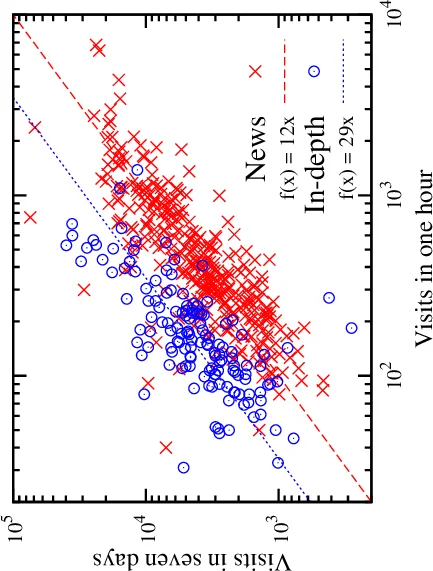
First, the authors identify two fundamental article categories: “breaking news,” which exhibits a sharp, short‑lived traffic peak and low tweet entropy (indicating concentrated discussion), and “in‑depth” pieces, which show a more gradual peak, longer shelf‑life, and higher tweet entropy with a larger proportion of unique tweets. By examining the temporal shape of both visits and social signals, they further define four short‑term audience response profiles—decreasing, steady, increasing, and rebounding—each of which can be recognized within the first 10–20 minutes after publication.
The core contribution lies in predictive modeling. Traditional models that rely solely on early page‑view counts need at least three hours of data to achieve reasonable accuracy when forecasting total visits and the article’s “half‑life” (the time by which half of all eventual visits have occurred). In contrast, the authors augment these models with early Twitter metrics such as tweet volume, entropy, fraction of unique tweets, and corporate retweet rate. Using linear regression and random‑forest ensembles, the hybrid models reduce mean absolute error by roughly 15 % and can predict long‑term traffic (up to seven days) after only ten to twenty minutes of observation.
Practically, the findings suggest that news organizations can monitor social‑media reactions in real time to allocate editorial resources, schedule re‑shares, and tailor promotion strategies much earlier than previously possible. The study also quantifies cases where social platforms substitute for direct site visits (e.g., Facebook video views), highlighting the need for platform‑specific content strategies.
Overall, the research demonstrates that integrating social‑media signals with traditional web analytics provides a more nuanced characterization of article life cycles and enables significantly earlier and more accurate traffic forecasts, offering valuable guidance for data‑driven decision‑making in digital news operations.
Comments & Academic Discussion
Loading comments...
Leave a Comment