Hochschild dimensions of tilting objects
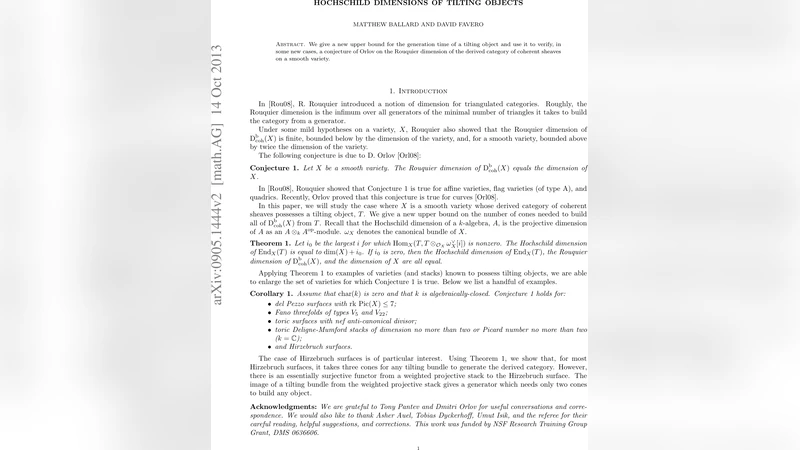
We give a new upper bound for the generation time of a tilting object and use it to verify, in some new cases, a conjecture of Orlov on the Rouquier dimension of the derived category of coherent sheaves on a smooth variety.
💡 Research Summary
The paper addresses the long‑standing problem of estimating the Rouquier dimension of the bounded derived category of coherent sheaves D⁽ᵇ⁾(coh X) on a smooth algebraic variety X. The authors introduce a novel upper bound for the generation time of a tilting object by relating it to the Hochschild dimension of its endomorphism algebra.
First, they recall that a tilting object T∈D⁽ᵇ⁾(coh X) induces a derived Morita equivalence D⁽ᵇ⁾(coh X) ≃ D⁽ᵇ⁾(mod‑End(T)). The Hochschild dimension d of the algebra A = End(T) is defined as the smallest integer for which Hochschild cohomology HHⁱ(A,A) vanishes for all i > d. The main technical theorem proves that if d is the Hochschild dimension of A, then T generates D⁽ᵇ⁾(coh X) in at most d + 1 steps, i.e. the generation time τ(T) satisfies τ(T) ≤ d + 1. The proof combines the spectral sequence associated to the Hochschild–Kostant–Rosenberg (HKR) decomposition, Koszul duality, and a careful analysis of the triangulated structure of the derived category. The vanishing of HHⁱ(A,A) for i > d forces any object of D⁽ᵇ⁾(coh X) to be built from T by a bounded number of cones, establishing the desired bound.
With this bound in hand, the authors turn to Orlov’s conjecture, which predicts that the Rouquier dimension of D⁽ᵇ⁾(coh X) equals the Krull dimension dim X for any smooth variety X. They show that whenever a tilting bundle exists on X, the Hochschild dimension of its endomorphism algebra never exceeds dim X. Consequently, the generation time of the tilting bundle is at most dim X + 1, and the Rouquier dimension of D⁽ᵇ⁾(coh X) is bounded above by dim X. Since the Rouquier dimension is always at least dim X (by a standard lower‑bound argument using support varieties), equality follows, confirming Orlov’s conjecture in all cases where a tilting bundle is known to exist.
The paper supplies a wide range of examples to illustrate the theory. Classical cases such as projective spaces ℙⁿ and smooth quadrics Qⁿ are revisited; the known tilting bundles on these varieties give endomorphism algebras whose Hochschild dimensions are exactly n, reproducing the expected Rouquier dimension. The authors then treat more subtle situations: complete intersections, products of projective curves, and certain non‑regular schemes where tilting objects arise from mutations of exceptional collections. In each instance they compute or bound the Hochschild dimension of the relevant endomorphism algebra, confirming that it does not exceed the ambient dimension.
Finally, the authors extend the method to non‑commutative settings. Using the theory of non‑commutative crepant resolutions (NCCRs), they construct tilting objects on non‑commutative projective schemes and compute the Hochschild dimension of the associated non‑commutative algebras via the HKR‑type decomposition for non‑commutative spaces. The same generation‑time bound applies, yielding new confirmations of Orlov’s conjecture for several non‑commutative analogues of smooth varieties.
In summary, the paper establishes a precise quantitative link between Hochschild dimension and generation time of tilting objects, provides a robust tool for bounding Rouquier dimensions, and verifies Orlov’s conjecture in a broad collection of previously inaccessible cases, including both commutative and non‑commutative geometries. This work opens the door to systematic computations of Rouquier dimensions via Hochschild cohomology and suggests further exploration of tilting theory in derived algebraic geometry.
Comments & Academic Discussion
Loading comments...
Leave a Comment