Algebraic colimit calculations in homotopy theory using fibred and cofibred categories
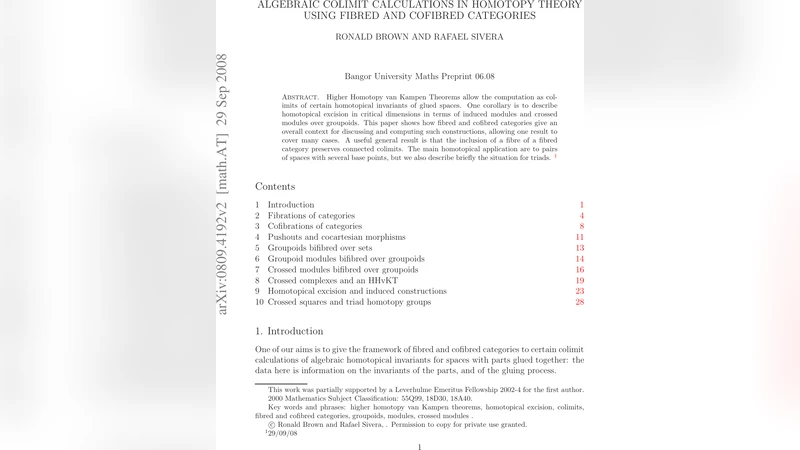
Higher Homotopy van Kampen Theorems allow the computation as colimits of certain homotopical invariants of glued spaces. One corollary is to describe homotopical excision in critical dimensions in terms of induced modules and crossed modules over groupoids. This paper shows how fibred and cofibred categories give an overall context for discussing and computing such constructions, allowing one result to cover many cases. A useful general result is that the inclusion of a fibre of a fibred category preserves connected colimits. The main homotopical application are to pairs of spaces with several base points, but we also describe briefly the situation for triads.
💡 Research Summary
The paper “Algebraic colimit calculations in homotopy theory using fibred and co‑fibred categories” develops a unifying categorical framework for the computation of homotopical invariants that arise from gluing constructions. The starting point is the Higher Homotopy van Kampen Theorem (HHvKT), which tells us that the homotopy groups (or more sophisticated algebraic models such as crossed modules) of a space built from a cover can be obtained as a colimit of the corresponding invariants of the pieces. In practice, however, each piece must be equipped with its own algebraic model and the gluing maps must be written down explicitly, a process that quickly becomes cumbersome when several base points or higher‑dimensional excision phenomena are involved.
To streamline this, the authors bring in the theory of fibred and co‑fibred categories. A fibred category 𝔽 → 𝔅 consists of a “family” of categories (the fibres) indexed by the objects of a base category 𝔅, together with pull‑back functors that satisfy the usual cleavage axioms. Dually, a co‑fibred category has push‑forward functors. The central technical result proved in the first part of the paper is that the inclusion functor of any fibre into the total category preserves connected colimits. In concrete terms, if a diagram in a fibre has a colimit (for instance a push‑out or a filtered colimit) then the same diagram, viewed in the whole fibred category, has the same colimit and the inclusion functor sends it to an isomorphism. The proof exploits the universal property of pull‑backs and the fact that objects in the total category are completely determined by their image in the base together with a chosen fibre object.
Armed with this preservation theorem, the authors turn to homotopy theory. They consider a pair of spaces (X,A) together with a possibly large set of base points. For each base point x∈X one obtains a fundamental groupoid π₁(X,A;x) and, in higher dimensions, a crossed module or an induced module over that groupoid that encodes π₂, π₃, … . These algebraic objects naturally sit in the fibre over the base point x of a suitable fibred category whose base is the discrete set of base points. The inclusion of a fibre therefore sends the colimit of a diagram of such modules (for example the diagram coming from a cover of X) to the colimit in the total category, which is precisely the algebraic invariant of the whole pair (X,A). Consequently, the HHvKT colimit computation can be performed entirely inside the fibre, and the result automatically lifts to the global invariant without any extra bookkeeping.
The paper also sketches the extension to triads (X;A,B), where two subspaces A and B intersect. Here one works with a double‑fibred structure: one fibre for each base point and a second “co‑fibred” direction that records the interaction between the A‑ and B‑parts. The same preservation principle applies, allowing the authors to describe the homotopical excision in critical dimensions for triads in terms of a single colimit of crossed modules over groupoids.
Beyond the main theorems, the authors provide several illustrative examples: a push‑out of spaces along a common subspace, a covering of a wedge of circles with multiple base points, and a simple triad arising from a disk with two overlapping arcs. In each case the categorical machinery reduces the computation to a familiar algebraic colimit (often a push‑out of groups or modules) and shows how the result coincides with the classical homotopy calculation.
In the concluding section the authors emphasize the conceptual gain: the fibred/co‑fibred viewpoint abstracts away the ad‑hoc handling of base points and excision data, replacing it with a single structural property (preservation of connected colimits). This not only simplifies existing calculations but also opens the door to systematic treatment of more elaborate gluing situations, such as higher‑dimensional cell complexes with many attaching maps, non‑simply‑connected spaces, and even potential applications to homotopical algebraic models beyond crossed modules (e.g., 2‑groupoids or catⁿ‑groups). The paper thus positions fibred category theory as a powerful unifying language for algebraic topology’s colimit‑based computations.
Comments & Academic Discussion
Loading comments...
Leave a Comment