Active and Cooperative Learning Paths in the Pigelletos Summer School of Physics
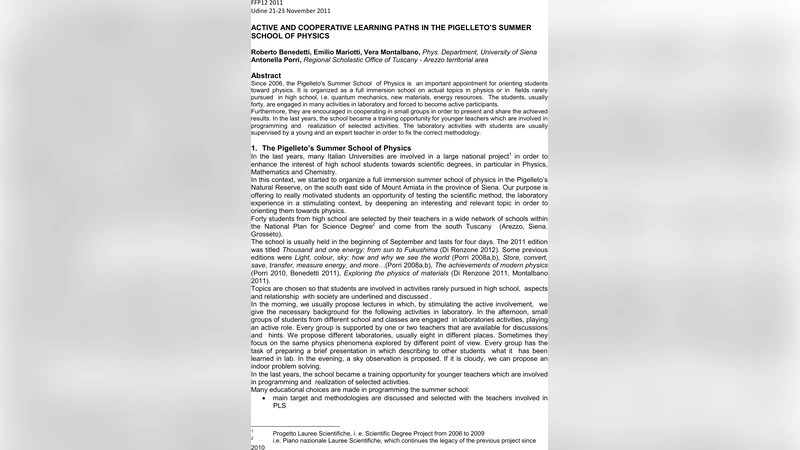
Since 2006, the Pigelleto’s Summer School of Physics is an important appointment for orienting students toward physics. It is organized as a full immersion school on actual topics in physics or in fields rarely pursued in high school, i.e. quantum mechanics, new materials, energy resources. The students, usually forty, are engaged in many activities in laboratory and forced to become active participants. Furthermore, they are encouraged in cooperating in small groups in order to present and share the achieved results. In the last years, the school became a training opportunity for younger teachers which are involved in programming and realization of selected activities. The laboratory activities with students are usually supervised by a young and an expert teacher in order to fix the correct methodology.
💡 Research Summary
The Pigelleto Summer School of Physics, inaugurated in 2006, is an intensive, week‑long immersion program that selects about forty high‑school students each year to explore advanced topics rarely covered in standard curricula, such as quantum mechanics, novel materials, and renewable energy sources. The pedagogical design deliberately departs from conventional lecture‑centric instruction and embraces two complementary pillars: active learning and cooperative learning.
In the active‑learning component, students receive a concise theoretical briefing before entering well‑equipped laboratories where they design, conduct, and analyze experiments themselves. This hands‑on approach forces them to grapple with the full scientific method—hypothesis formulation, experimental setup, data acquisition, error analysis, and interpretation—thereby cementing conceptual understanding through concrete experience.
Cooperative learning is operationalized through small groups of four to five participants. Within each team, roles are distributed (e.g., experimental designer, data recorder, analyst, presenter), and the group iteratively discusses findings, refines procedures, and prepares a final presentation in poster or oral format. Peer feedback and instructor critique after each presentation promote metacognitive reflection and foster communication, critical‑thinking, and collective problem‑solving skills.
A distinctive feature of the school is its dual‑mentor teacher model. Younger teachers are recruited as program designers and facilitators, while seasoned educators act as expert mentors. This pairing serves two purposes: it provides novice teachers with authentic professional development—exposure to cutting‑edge content, modern laboratory techniques, and student‑centered pedagogy—and it ensures that instructional quality remains high through the guidance of experienced mentors. Teacher training is further reinforced by systematic data collection (pre‑ and post‑tests, surveys, observational logs) that informs iterative curriculum refinement.
Empirical outcomes indicate substantial gains. Qualitative feedback reveals heightened scientific curiosity, increased confidence in presenting research, and a stronger inclination toward STEM careers. Quantitatively, pre‑ to post‑program assessments show an average improvement of over 20 % in conceptual mastery and problem‑solving ability, with the most pronounced gains in the notoriously difficult quantum‑mechanics module. Moreover, a noticeable rise in university applications to physics and engineering programs, as well as subsequent research internship placements, suggests lasting impact on participants’ academic trajectories.
Nevertheless, the program faces scalability challenges. The limited cohort size restricts broader outreach, and the reliance on specialized equipment raises sustainability concerns. Geographic and socioeconomic barriers may also limit access for under‑represented students. To mitigate these issues, the organizers propose expanding digital learning modules, forging partnerships with regional schools, and seeking external sponsorships for equipment. Additionally, longitudinal studies are needed to rigorously evaluate the long‑term effects of teacher training and student outcomes.
In summary, the Pigelleto Summer School exemplifies a successful implementation of active and cooperative learning principles in secondary‑level physics education. By integrating authentic laboratory work, structured teamwork, and a robust mentor‑based teacher development system, it not only elevates students’ scientific competencies but also cultivates a pipeline of future physicists and educators. Future research should focus on scaling the model, optimizing resource allocation, and measuring enduring educational impacts to inform broader adoption in high‑school science curricula worldwide.
Comments & Academic Discussion
Loading comments...
Leave a Comment