Injective objects and retracts of Fra"isse limits
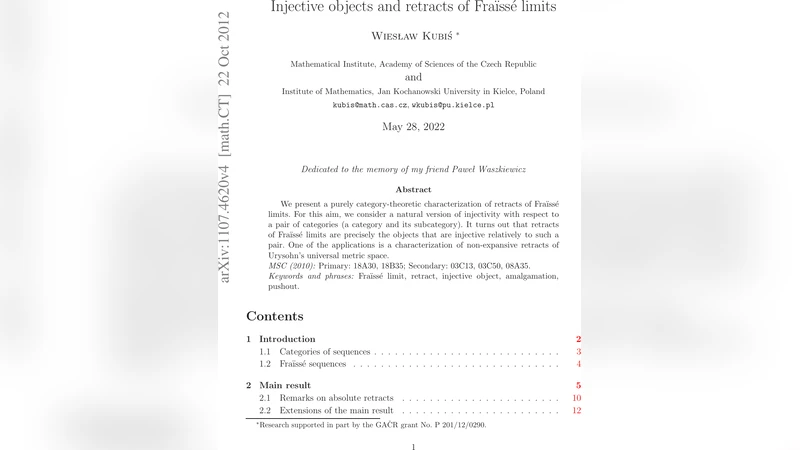
We present a purely category-theoretic characterization of retracts of Fra"iss'e limits. For this aim, we consider a natural version of injectivity with respect to a pair of categories (a category and its subcategory). It turns out that retracts of Fra"iss'e limits are precisely the objects that are injective relatively to such a pair. One of the applications is a characterization of non-expansive retracts of Urysohn’s universal metric space.
💡 Research Summary
The paper provides a purely categorical description of the retracts (retractions) of Fraïssé limits. The author works with a pair of categories (K\subseteq L) that share the same objects: (K) contains only “embeddings’’ (typically monomorphisms) while (L) allows all homomorphisms. Four structural conditions, labelled (H0)–(H3), are imposed on the pair. (H0) simply records that the objects coincide. (H1) requires that (K) has the joint‑embedding and amalgamation properties, the usual Fraïssé hypotheses. (H2) (mixed amalgamation) demands that whenever one arrow belongs to (K) and the other to (L) there is a common amalgam in which the roles of the two categories are swapped. (H3) (amalgamated extension) asks that any commuting square built from (K)‑arrows can be completed by an (L)‑arrow in a way that respects the original (K)‑structure. When these hold we say that the pair has property (H).
Next the author introduces the “sequence categories’’ (\sigma(K)) and (\sigma(L)). An object of (\sigma(K)) is a countable chain (a functor (\omega\to K)), and a morphism is a natural transformation after possibly re‑indexing the source by an increasing function (\psi:\omega\to\omega). The mixed category (\sigma(K,L)) has the same objects as (\sigma(K)) but its morphisms are taken from (\sigma(L)). Within this framework a notion of relative injectivity is defined: an object (A\in\sigma(K)) is (K)-injective in (\sigma(K,L)) if for every (K)-arrow (i:a\to b) and every (\sigma(K,L))-arrow (f:a\to A) there exists a (\sigma(K,L))-arrow (\tilde f:b\to A) with (\tilde f\circ i=f). This is a direct analogue of the classical injective object definition, but the “test’’ arrows come from the smaller subcategory (K) while the extensions are allowed to be any (L)-arrow.
A useful criterion (Proposition 2.3) shows that (K)-injectivity of a sequence (X) is equivalent to the following concrete condition: for every index (n) and every (K)-arrow (f:x_n\to y) there exist a later index (m>n) and an (L)-arrow (g:y\to x_m) such that (g\circ f) equals the canonical transition (x_m\to x_n). Because a Fraïssé sequence (U) in (K) satisfies the joint‑embedding and amalgamation properties, this condition holds automatically; thus any Fraïssé sequence is (K)-injective in (\sigma(K,L)) (Proposition 2.4).
The central technical result (Lemma 2.6) states that if the pair ((K,L)) has property (H) and (A) is a (K)-injective object, then every (\sigma(K,L))-map (F:X\to A) from an arbitrary (\sigma(K))-object (X) factors through the Fraïssé sequence (U): there exist a (\sigma(K))-morphism (J:X\to U) and a (\sigma(K,L))-morphism (G:U\to A) with (G\circ J=F). The proof builds a triangular matrix of objects and arrows, using the mixed amalgamation and amalgamated extension properties to successively lift maps and keep commutativity. This lemma shows that (U) is a “universal’’ (K)-injective object: any map into a (K)-injective target can be mediated by (U).
From Lemma 2.6 the main theorem follows: an object (A\in\sigma(K)) is a retract of the Fraïssé limit (i.e. there exist morphisms (r:U\to A) and (s:A\to U) with (r\circ s=\mathrm{id}_A)) if and only if (A) is (K)-injective in (\sigma(K,L)). In other words, the class of retracts of a Fraïssé limit coincides exactly with the class of relatively injective objects for the pair ((K,L)).
The paper then illustrates the theorem with several concrete families:
-
Algebraically closed models – For a classical Fraïssé class of finite structures, the algebraically closed countable models are precisely the (K)-injective objects, reproducing Dolinka’s earlier result without the finiteness assumptions on the class.
-
Homomorphism‑homogeneous structures – By taking (K) as embeddings and (L) as all homomorphisms, the theorem recovers the known characterization of structures that are homogeneous with respect to homomorphisms.
-
Urysohn universal metric space – The category (K) consists of finite metric spaces with rational distances and isometric embeddings; (L) allows all non‑expansive maps. The Fraïssé limit of (K) is the rational Urysohn space, and the theorem shows that any non‑expansive retract of the full (real‑valued) Urysohn space is exactly a (K)-injective object, giving a clean categorical description of such retracts.
-
Banach spaces – Using linear isometric embeddings for (K) and all bounded linear maps for (L), the theorem identifies absolute retracts among separable Banach spaces as the (K)-injective objects.
-
Linear orders – With order‑preserving embeddings as (K) and arbitrary order‑preserving maps as (L), the retracts of the dense countable linear order without endpoints are precisely the (K)-injective orders.
Each application demonstrates how a seemingly diverse collection of “retract” results can be unified under the single categorical notion of relative injectivity.
In summary, the paper establishes a robust bridge between Fraïssé theory and categorical injectivity. By formulating a pair of categories satisfying a modest set of amalgamation‑type axioms, it shows that the retracts of any Fraïssé limit are exactly the objects that are injective relative to that pair. This not only generalizes earlier model‑theoretic characterizations but also provides a versatile tool for analyzing retracts in metric, Banach, order‑theoretic, and other algebraic contexts. The approach is elegant, conceptually clear, and opens the way for further exploration of relative injectivity in other categorical settings.
Comments & Academic Discussion
Loading comments...
Leave a Comment