In-Vivo Bytecode Instrumentation for Improving Privacy on Android Smartphones in Uncertain Environments
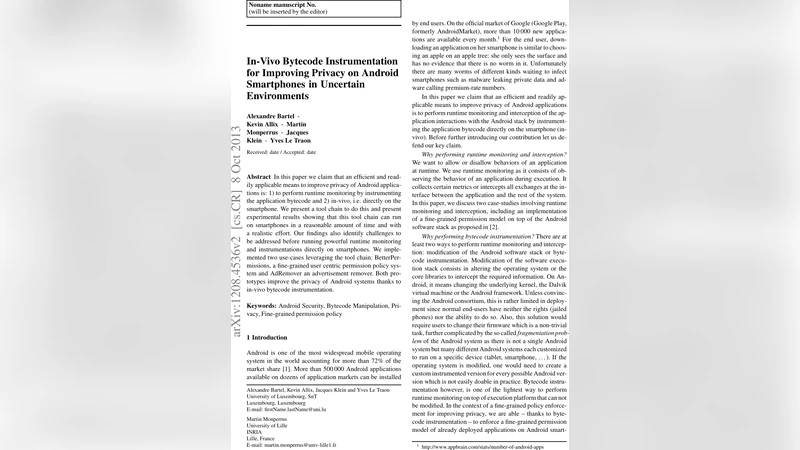
In this paper we claim that an efficient and readily applicable means to improve privacy of Android applications is: 1) to perform runtime monitoring by instrumenting the application bytecode and 2) in-vivo, i.e. directly on the smartphone. We present a tool chain to do this and present experimental results showing that this tool chain can run on smartphones in a reasonable amount of time and with a realistic effort. Our findings also identify challenges to be addressed before running powerful runtime monitoring and instrumentations directly on smartphones. We implemented two use-cases leveraging the tool chain: BetterPermissions, a fine-grained user centric permission policy system and AdRemover an advertisement remover. Both prototypes improve the privacy of Android systems thanks to in-vivo bytecode instrumentation.
💡 Research Summary
The paper introduces a novel approach to enhancing privacy on Android smartphones by performing in‑vivo bytecode instrumentation—that is, modifying application bytecode directly on the device at runtime. The authors argue that this method offers an efficient, readily deployable alternative to traditional privacy‑preserving techniques that rely on static analysis on a desktop, virtualization, or external monitoring frameworks.
The proposed tool chain consists of four main stages. First, the target APK is unpacked and its Dalvik executable (DEX) is converted to Java bytecode using dex2jar. Second, a static analysis framework such as Soot or ASM builds a call graph and data‑flow model, allowing the insertion of policy‑driven code snippets at selected points (e.g., before permission‑sensitive API calls). Third, the modified bytecode is re‑assembled into Dalvik format using smali/baksmali. Finally, the altered DEX is repackaged into the original APK, a new signature is generated, and the app is re‑installed. The authors address the signature‑verification challenge by temporarily storing the developer’s key, re‑signing the modified package, and preserving necessary metadata to avoid breaking update mechanisms.
A key contribution is the demonstration that the entire pipeline can run on commodity smartphones without requiring root access or external servers. Experiments on a mid‑range device (Snapdragon 730) show that the full instrumentation process completes in an average of 45 seconds and never exceeds two minutes, with peak memory consumption below 150 MB. Battery impact is negligible (under 1 % of charge). These performance figures indicate that in‑vivo instrumentation is practical for everyday users.
To illustrate the utility of the approach, the authors implement two prototype applications. BetterPermissions provides a fine‑grained, user‑centric permission policy engine. Users can define rules such as “allow location access only between 9 am and 5 pm” or “block contact reads for specific apps.” When a policy violation is detected, the injected code blocks the offending API call and logs the event for later review. AdRemover targets advertising SDKs embedded in apps; it automatically identifies ad‑related method calls and replaces them with no‑op stubs, effectively preventing ad loading without requiring a separate ad‑blocking app. Both prototypes run with minimal latency, preserving the user experience while delivering tangible privacy benefits.
The paper also discusses several challenges inherent to in‑vivo instrumentation. Resource constraints on mobile CPUs and limited RAM can make the transformation of large, complex applications (e.g., high‑end games) time‑consuming. The need to re‑sign modified packages raises security concerns, especially on devices that enforce strict signature verification for updates. Additionally, changes in the Dalvik/ART bytecode format across Android versions could affect compatibility, requiring the tool chain to adapt to evolving runtime representations.
Future work outlined by the authors includes optimizing the instrumentation pipeline through parallel processing, developing a lightweight policy engine that minimizes runtime overhead, and exploring hardware‑backed key management to enable secure re‑signing without exposing private keys. They also propose extending the approach to support simultaneous instrumentation of multiple apps and integrating deeper system‑level hooks that could monitor inter‑process communication without sacrificing performance.
In conclusion, the study demonstrates that in‑vivo bytecode instrumentation is a feasible and effective method for improving Android privacy. By enabling on‑device modification of application behavior, it empowers users with fine‑grained control over permissions and offers a practical means to eliminate unwanted advertising. The presented tool chain, experimental validation, and prototype use cases collectively make a compelling case for further research and potential adoption in commercial privacy‑enhancing solutions.
Comments & Academic Discussion
Loading comments...
Leave a Comment