Growth of scale-free networks under heterogeneous control
Real-life networks often encounter vertex dysfunctions, which are usually followed by recoveries after appropriate maintenances. In this paper we present our research on a model of scale-free networks whose vertices are regularly removed and put back. Both the frequency and length of time of the disappearance of each vertex depend on the degree of the vertex, creating a heterogeneous control over the network. Our simulation results show very interesting growth pattern of this kind of networks. We also find that the scale-free property of the degree distribution is maintained in the proposed heterogeneously controlled networks. However, the overall growth rate of the networks in our model can be remarkably reduced if the inactive periods of the vertices are kept long.
💡 Research Summary
The paper introduces a novel growth model for scale‑free networks that incorporates periodic deactivation and reactivation of vertices, thereby mimicking real‑world situations such as server maintenance, power‑grid outages, or logistics hub downtimes. The model builds on the classic Barabási‑Albert (BA) preferential‑attachment mechanism but adds two key parameters: a maximum active time α and a maximum inactive time β. Vertices are dynamically ranked by degree and placed into one of n tiers; a vertex in tier i receives an active period of α / i and an inactive period of β / i. Consequently, high‑degree vertices experience shorter downtimes, while low‑degree vertices may stay offline longer, reflecting heterogeneous control policies often observed in practice.
Algorithmically, the network starts with m₀ disconnected nodes, each assigned t₁ = α. At each discrete time step the algorithm checks every vertex’s remaining status time. If an active vertex’s timer expires, the vertex and all its incident edges are removed. If an inactive vertex’s timer expires, the vertex and its previously attached edges are restored simultaneously. After a status change the vertex is re‑ranked, its tier is recomputed, and new timers (α / i for active, β / i for inactive) are assigned. Then a new vertex is added, bringing m new edges that attach to existing active vertices with the usual preferential probability (P_s = k_s / \sum_j k_j). This process repeats indefinitely.
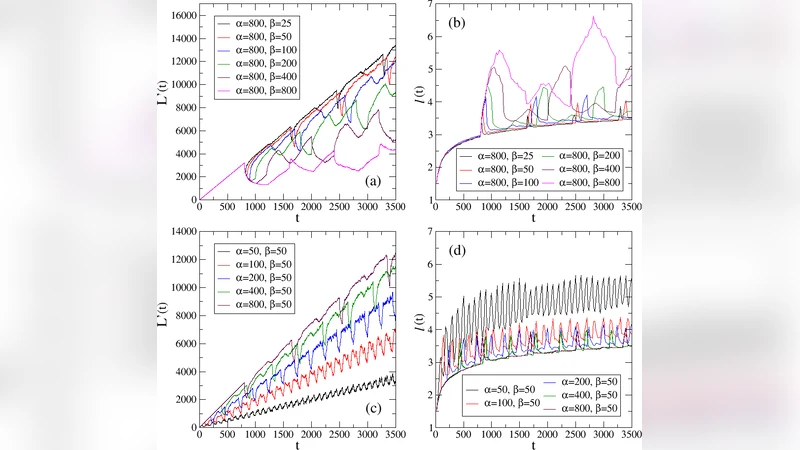
The authors conduct extensive simulations with m₀ = m = 4, varying the number of tiers (n = 1, 2, 3) and exploring different α/β ratios. Three principal observables are examined: (1) the total number of edges L₀(t), (2) the average geodesic distance ℓ(t) between randomly chosen node pairs, and (3) a normalized growth rate (\bar{k}=k/k_0), where k is the slope of L₀(t) and k₀ = m is the slope of the BA model’s edge count L(t).
When α = β = 800, the simulations reveal that L₀(t) exhibits a step‑like growth pattern whose periodicity becomes richer as n increases. Each tier’s reactivation causes a sudden surge in edge count; for n = 3, simultaneous reactivation of tiers 2 and 3 produces the earliest and largest jump. The average distance ℓ(t) mirrors this behavior: it spikes when many vertices are offline and drops sharply when they return.
The study then focuses on the more realistic case α > β, reflecting that network operators generally prefer short downtimes. By fixing α and increasing β (or vice‑versa), the authors find that the normalized growth rate (\bar{k}) approaches 1 as the ratio α/β grows, and ℓ(t) gradually aligns with the logarithmic growth characteristic of the BA model. Conversely, when α ≤ β, (\bar{k}) remains well below 1 (≈ 0.5–0.7), indicating a markedly slower overall expansion. A systematic sweep over α and β (with 1000 realizations per point) confirms that (\bar{k}) is essentially a monotonic function of α/β: larger ratios yield higher growth rates, while larger β relative to α suppresses growth.
Analytically, the authors approximate the sum of degrees over active vertices as (\sum_{j\in V} k_j \approx 2m\bar{k}t) for large t. Substituting this into the preferential‑attachment probability leads to the differential equation (\partial k_i / \partial t = \frac{k_i}{2\bar{k}t}), whose solution is (k_i(t) = m (t/t_i)^{\beta_0}) with (\beta_0 = 1/(2\bar{k})). Using the continuum approach of Barabási and Albert, they derive the degree distribution (P(k) \sim k^{-\gamma}) with exponent (\gamma = 2\bar{k}+1). Because (\bar{k}<1) in all simulated regimes, the exponent is always smaller than the BA value of 3, producing a slightly heavier tail. Simulation results corroborate this prediction: for α = 500, β = 100, and n = 2 or 3, the empirical degree distributions follow a power law over several decades, with measured γ values around 2.6–2.8, largely independent of the tier count.
In summary, the proposed heterogeneously controlled growth model demonstrates that (i) the overall edge count and average path length can exhibit complex periodicities dictated by the tier structure, (ii) the long‑term growth rate can be tuned continuously by adjusting the α/β ratio, and (iii) despite the intermittent removal of vertices, the network retains a scale‑free degree distribution, albeit with an exponent γ < 3. The findings suggest practical implications for designing maintenance schedules in communication, power, and transportation networks: by ensuring that high‑degree nodes have short inactive periods (large α relative to β), one can preserve near‑BA growth dynamics and maintain low average distances, while still allowing for realistic downtime. The authors propose future work on clustering coefficient evolution and alternative tier‑assignment rules to further bridge the gap between theoretical models and real‑world network management.
Comments & Academic Discussion
Loading comments...
Leave a Comment