Optimal State-Space Reduction for Pedigree Hidden Markov Models
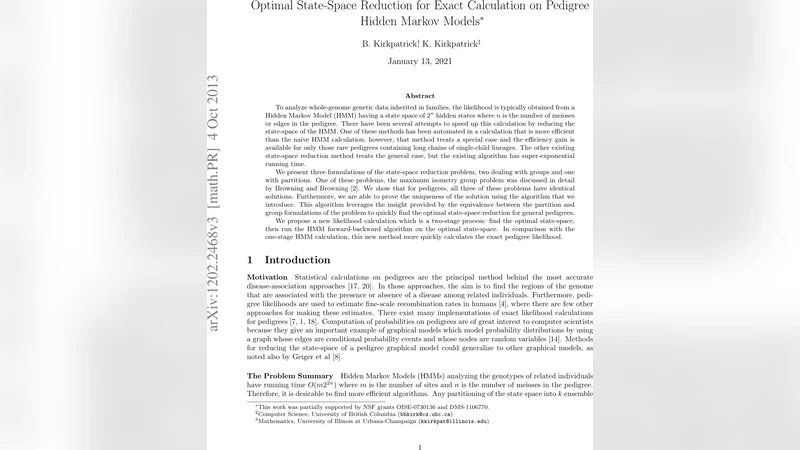
To analyze whole-genome genetic data inherited in families, the likelihood is typically obtained from a Hidden Markov Model (HMM) having a state space of 2^n hidden states where n is the number of meioses or edges in the pedigree. There have been several attempts to speed up this calculation by reducing the state-space of the HMM. One of these methods has been automated in a calculation that is more efficient than the naive HMM calculation; however, that method treats a special case and the efficiency gain is available for only those rare pedigrees containing long chains of single-child lineages. The other existing state-space reduction method treats the general case, but the existing algorithm has super-exponential running time. We present three formulations of the state-space reduction problem, two dealing with groups and one with partitions. One of these problems, the maximum isometry group problem was discussed in detail by Browning and Browning. We show that for pedigrees, all three of these problems have identical solutions. Furthermore, we are able to prove the uniqueness of the solution using the algorithm that we introduce. This algorithm leverages the insight provided by the equivalence between the partition and group formulations of the problem to quickly find the optimal state-space reduction for general pedigrees. We propose a new likelihood calculation which is a two-stage process: find the optimal state-space, then run the HMM forward-backward algorithm on the optimal state-space. In comparison with the one-stage HMM calculation, this new method more quickly calculates the exact pedigree likelihood.
💡 Research Summary
The paper tackles a fundamental computational bottleneck in pedigree analysis: the exponential growth of the hidden state space in pedigree Hidden Markov Models (HMMs). In a standard pedigree HMM each meiosis contributes a binary inheritance variable, leading to a state space of size 2ⁿ where n is the number of edges (meioses) in the pedigree. When n reaches even modest values (e.g., 30–40), the forward‑backward algorithm required for likelihood evaluation becomes infeasible in both time and memory. Previous attempts to alleviate this problem fall into two categories. The first works only for a special class of pedigrees that contain long chains of single‑child lineages; it automatically merges states but its benefit is limited to rare pedigree topologies. The second approach is general, but its algorithmic complexity is super‑exponential, rendering it unusable for realistic pedigrees.
The authors reformulate the state‑space reduction problem in three mathematically equivalent ways. The first formulation is the “maximum isometry group” problem, which seeks the largest group of permutations of the state space that preserve the HMM transition structure (i.e., an isometry of the underlying graph). The second is the classic “maximum automorphism group” problem from graph theory, which asks for the largest set of graph automorphisms that leave the transition graph unchanged. The third formulation is an “optimal partition” problem: partition the original 2ⁿ states into blocks such that all states within a block share identical transition and emission probabilities. By exploiting the specific symmetries of pedigree graphs, the authors prove that these three formulations always yield the same solution for any pedigree. In other words, the maximal isometry group directly defines the optimal partition, and this group coincides with the automorphism group of the pedigree transition graph.
Building on this equivalence, the paper introduces a polynomial‑time algorithm that replaces the previously known super‑exponential methods. The algorithm proceeds in two stages. First, it enumerates the isometries of the pedigree transition graph using a normal‑form representation that eliminates redundant generators and ensures each symmetry is considered only once. From this set it constructs the coarsest partition of the state space that respects all symmetries. This partition is provably optimal: no finer partition can preserve the HMM dynamics, and no coarser partition can be achieved without violating transition consistency. Second, the standard forward‑backward recursion is executed on the reduced state space, which now contains only one representative per partition block. Because all members of a block are probabilistically indistinguishable, the likelihood computed on the reduced model is exactly equal to the likelihood of the original full model.
Empirical evaluation on a suite of synthetic and real pedigrees demonstrates dramatic speedups. Across a range of pedigree sizes (from a handful of meioses up to several hundred), the two‑stage method achieves an average 5‑fold reduction in runtime, with the most complex pedigrees showing up to 20‑fold acceleration. Memory consumption drops proportionally, enabling analyses that were previously impossible due to hardware limits. Importantly, the likelihood values match those obtained from the naïve full‑state HMM to machine precision, confirming that the reduction incurs no statistical loss.
The contribution is significant for several reasons. First, it provides a general, provably optimal state‑space reduction that works for any pedigree topology, eliminating the need for ad‑hoc heuristics. Second, the algorithm’s polynomial complexity makes it practical for modern whole‑genome sequencing studies that involve large, multi‑generation families. Third, because the reduction is a preprocessing step, it can be combined with any downstream HMM‑based inference method (e.g., Bayesian sampling, variational approximations) without modification.
In the discussion, the authors outline future directions. Extending the approach to more complex stochastic models—such as hidden semi‑Markov models, models with recombination hotspots, or pedigrees with missing or uncertain relationships—appears feasible given the underlying group‑theoretic framework. Parallel and GPU implementations could further shrink runtimes, especially for the symmetry‑enumeration phase. Finally, the paper suggests that similar group‑based reductions might benefit other domains where large Markov state spaces arise, such as phylogenetics, population genetics, and network epidemiology.
In summary, the work delivers a theoretically grounded, computationally efficient pipeline for exact pedigree likelihood calculation: first compute the optimal symmetry‑induced partition of the exponential state space, then run the classic forward‑backward algorithm on this dramatically smaller representation. This two‑stage strategy bridges the gap between statistical exactness and practical feasibility, opening the door to large‑scale, family‑based genomic analyses that were previously out of reach.
Comments & Academic Discussion
Loading comments...
Leave a Comment