Cubic and quartic transformations of the sixth Painleve equation in terms of Riemann-Hilbert correspondence
A starting point of this paper is a classification of quadratic polynomial transformations of the monodromy manifold for the 2x2 isomonodromic Fuchsian systems associated to the Painleve VI equation. Up to birational automorphisms of the monodromy ma…
Authors: Marta Mazzocco, Raimundas Vidunas
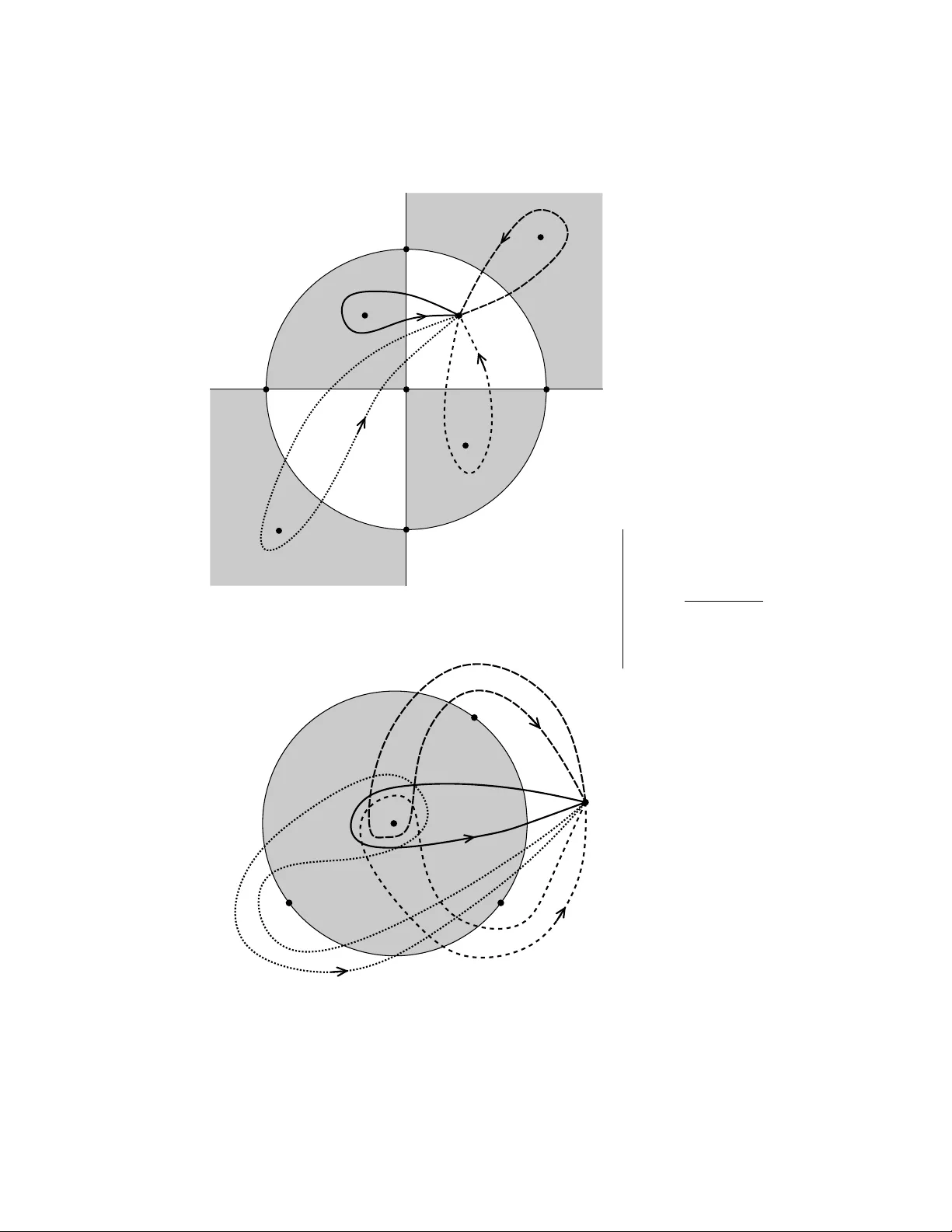
CUBIC AND QUAR TIC TRANSF ORMA TIONS OF THE SIXTH P AINLEV ´ E EQUA TION IN TERMS OF RIEMANN–HILBER T CORRESPONDENCE MAR T A MAZZOCCO AND RAIMUNDAS VIDUNAS Abstract. A starting p oint of this paper is a classification of quadratic poly- nomial transformations of the monodromy manifold for the 2 × 2 isomon- odromic F uchsian systems asso ciated to the P ainlev´ e VI equation. Up to birational automorphisms of the monodromy manifold, we find three trans- formations. Two of them are identified as the action of known quadratic or quartic transformations of the P ainlev ´ e VI equation. The third transformation of the mono drom y manifold gives a new transformation of degree 3 of Picard’s solutions of Painlev ´ e VI. Contents 1. In tro duction 1 2. Classification of quadratic transformations on the monodromy manifold 6 2.1. P oisson structure on the mono dromy manifold 6 2.2. Pro of of Theorem 1.1 6 3. Kitaev’s quadratic transformation on the mono dromy manifold 11 4. Quartic transformation on the mono drom y manifold. 15 5. Picard case: pro of of Theorem 1.5 20 App endix A Isomono dromic deformations asso ciated to the sixth Painlev ´ e equation 23 A.1. Riemann-Hilb ert corresp ondence and mono drom y manifold 23 App endix B Hamiltonian structure and Ok amoto birational transformations 24 References 25 1. Introduction In this pap er w e consider the sixth Painlev ´ e equation PVI [7, 25, 8] ¨ q = 1 2 1 q + 1 q − 1 + 1 q − t ˙ q 2 − 1 t + 1 t − 1 + 1 q − t ˙ q + + q ( q − 1)( q − t ) t 2 ( t − 1) 2 α + β t q 2 + γ t − 1 ( q − 1) 2 + δ t ( t − 1) ( q − t ) 2 , (1.1) as the isomono dromic deformation equation of a general linear 2 × 2 F uc hsian system with 4 singularities 0 , t, 1 , ∞ (see App endix 5). Lo cally , solutions of the sixth Painlev ´ e equation (up to Ok amoto birational transformations) are in one-to- one corresp ondence, the so called Riemann–Hilb ert c orr esp ondenc e, with p oints on the mono drom y manifold asso ciated to such F uchsian system. 1 2 MAR T A MAZZOCCO AND RAIMUND AS VIDUNAS Let us briefly recall this setting. Denote b y M 0 , M t , M 1 , M ∞ ∈ S L (2 , C ) the mono drom y matrices around the singularities 0 , t, 1 , ∞ with resp ect to the basis of loops depicted in Figure 1. Their traces are determined b y the parameters ( θ 0 , θ t , θ 1 , θ ∞ ) such that (1.2) α = ( θ ∞ − 1) 2 2 , β = − θ 2 0 2 , γ = θ 2 1 2 , δ = 1 − θ 2 t 2 . Let a denote the v ector ( a 0 , a t , a 1 , a ∞ , a 0 t , a 01 , a t 1 ) with a i := T r( M i ) = 2 cos( π θ i ) , for i ∈ { 0 , t, 1 , ∞} , (1.3) a 0 t = T r ( M 0 M t ) , a 01 = T r ( M 0 M 1 ) , a t 1 = T r ( M t M 1 ) . (1.4) As describ ed in App endix A.1, the mono drom y manifold [14] is represented by the follo wing affine cubic surface in C 3 : (1.5) Q := C [ a 0 t , a 01 , a t 1 ] / h a 2 0 t + a 2 01 + a 2 t 1 + a 0 t a 01 a t 1 − ω 0 t a 0 t − ω 01 a 01 − ω t 1 a t 1 + ω ∞ = 0 i . Here ω 0 t , ω 01 , ω t 1 and ω ∞ are given by ω ij := a i a j + a k a ∞ , k 6 = i, j, and i, j, k ∈ { 0 , 1 , t } , (1.6) ω ∞ = a 2 0 + a 2 t + a 2 1 + a 2 ∞ + a 0 a t a 1 a ∞ − 4 . The following birational automorphisms of the mono dromy manifold are known: • p erm utations of the coordinates a 0 t , a 01 , a t 1 , and the same p ermutation of the co efficien ts ω 0 t , ω 01 , ω t 1 ; • c hanges of tw o signs, say ( ω 0 t , ω 01 , ω t 1 ) 7→ ( − ω 0 t , − ω 01 , ω t 1 ) and ( a 0 t , a 01 , a t 1 ) 7→ ( − a 0 t , − a 01 , a t 1 ); • action of the braid group with these generators: β 1 ( a 0 t , a 01 , a t 1 ) = ( a 0 t , a t 1 , ω 01 − a 01 − a 0 t a t 1 ) , β 2 ( a 0 t , a 01 , a t 1 ) = ( a 01 , ω 0 t − a 0 t − a 01 a t 1 , a t 1 ) . The first tw o corresp ond to Ok amoto transformations, as recalled in the App endix A.1, while the braid group action describ es analytic con tin uation of PVI solutions around the critical p oin ts [4, 11]. There are also other transformations acting on the solutions of the sixth P ainle ´ e equation: quadratic and quartic transformations of the Painlev ´ e VI equation are kno wn [17, 19, 24, 27], though the corresponding action on the mono dromy manifold has not b een presented y et in the literature. This pap er shows that these actions are giv en b y quadratic p olynomial transformations on the coordinates a 0 t , a 01 , a t 1 of the mono drom y manifold. More generally , we classify all quadratic polynomial transformations of the cubic surface (1.5) and identify the corresp onding transformations of the sixth Painlev ´ e equation. As a result, we find a new cubic transformation of the sixth P ainlev´ e equation. Our classification result is summarised in the following theorem: Theorem 1.1. Up to the bir ational automorphisms of the mono dr omy manifold (1.5), the only tr ansformations of the form ˜ a 0 t = X 1 ( a 0 t , a 01 , a t 1 ) , ˜ a 01 = X 2 ( a 0 t , a 01 , a t 1 ) , ˜ a t 1 = X 3 ( a 0 t , a 01 , a t 1 ) , wher e X 1 , X 2 , X 3 ar e p olynomials of de gr e e 2 in a 0 t , a 01 , a t 1 , which tr ansform the cubic surfac e (1.5) with given p ar ameters ω 0 t , ω 01 , ω t 1 to a cubic surfac e of the same form with p ar ameters ˜ ω 0 t , ˜ ω 01 , ˜ ω t 1 b elong to the fol lowing list: CUBIC AND QUAR TIC TRANSFORMA TIONS OF PVI 3 • T r ansformation mapping the cubic surfac e (1.5) with p ar ameters ω 0 t = ω 01 = 0 to the cubic surfac e (1.5) with p ar ameters ˜ ω 0 t = 2 ω t 1 , ˜ ω 01 = ω ∞ +4 , ˜ ω t 1 = 2 ω t 1 , ˜ ω ∞ = ω 2 t 1 + 2 ω ∞ + 4 : ( a 0 t , a 01 , a t 1 ) 7→ ( ω t 1 − a 0 t a 01 − a t 1 , 2 − a 2 01 , a t 1 ) • T r ansformation mapping the cubic surfac e (1.5) with p ar ameters ω 0 t = ω 01 = ω 1 t = 0 to the cubic surfac e (1.5) with p ar ameters ˜ ω 0 t = ˜ ω 01 = ˜ ω t 1 = 2 ω ∞ + 8 , ˜ ω ∞ = ω 2 ∞ + 12 ω ∞ + 8 : ( a 0 t , a 01 , a t 1 ) 7→ (2 − a 2 0 t , 2 − a 2 01 , 2 − a 2 t 1 ) . • The tr ansformation mapping the cubic surfac e with p ar ameters ω 0 t = ω 01 = 0 , ω ∞ = − 4 to itself: ( a 0 t , a 01 , a t 1 ) 7→ ( − a 0 t − a 01 a t 1 , − a 01 − a 0 t a t 1 , − a t 1 − a 01 a 0 t ) . The proof of this theorem is based on the properties of the P oisson brack ets (2.2) on the monodromy mani fold, aided by some geometric insigh ts and use of computer algebra. The next set of results of this pap er concerns the interpretation of each element in the list of Theorem 1.1 in terms of P ainlev ´ e six transformations. W e show that the first item in the list corresp onds to a quadratic transformation, the second one corresp onds to a quartic transformation, while the last item is a new cubic transformation of the Picard case of the sixth P ainlev ´ e equation. Let us explain these results in more detail. W e start from the quadratic transformations. Recall that quadratic transforma- tions apply to the sixth P ainlev´ e equation with restricted parameters. Here is the list of quadratic transformations that app eared in the literature: Kitaev [17]: 1 2 , θ t , θ 1 , ± 1 2 → ( θ 1 , θ t , θ 1 , θ t ) , (1.7) Manin [19]: ( θ 1 , θ t , θ 1 , θ t + 1) → (2 θ 1 , 0 , 0 , 2 θ t + 1) , (1.8) R.G.T. [24]: ( θ 1 , θ t , θ t , θ 1 + 1) → (0 , 2 θ 1 , 2 θ t , 1) , (1.9) T.O.S. [27]: ( θ 1 , θ t , θ t , θ 1 + 1) → (0 , 2 θ t , 0 , 2 θ 1 + 1) , (1.10) where R.G.T. is the abbreviation of Ramani, Grammaticos and T amizhami, while T.O.S. is the abbreviation of Tsuda, Ok amoto and Sak ai. These transformations are all related among eac h other by Ok amoto’s birational transformations. (The fact that the last three are related b y Ok amoto symmetries is v ery easy to pro v e, the equiv alence b et w een the first one and the last three is a little more tricky and w as carried out explicitly in [12]). Here w e recall the explicit formula of the simplest (in our view), which is the T.O.S..: (1.11) q ( t ) , t 7→ ˜ q ( ˜ t ) , ˜ t , ˜ q = ( q + √ t ) 2 4 q √ t , ˜ t = ( √ t + 1) 2 4 √ t . Note that the v ariable t changes under this transformation. W e pro ve the follo wing: Theorem 1.2. The Tsuda-Okamoto-Sakai tr ansformation (1.10) acts on the ve ctor a as fol lows: a = ( a 0 , a t , a t , − a 0 , a 0 t , a 01 , a t 1 ) → → ˜ a = (2 , a 2 t − 2 , 2 , 2 − a 2 0 , a t 1 , 2 − a 2 01 , a 2 t − a 2 0 − a 0 t a 01 − a t 1 ) . 4 MAR T A MAZZOCCO AND RAIMUND AS VIDUNAS Let us now concentrate on the quartic transformations. All quartic transforma- tions known so far are related b y Ok amoto’s birational canonical transformations to the folding transformation ψ [4] V I due to Tsuda, Ok amoto and Sak ai [27]: ψ (4) V I : P V I ( ϑ, ϑ, ϑ, ϑ + 1) → P V I (0 , 0 , 0 , 4 ϑ + 1) ( q , t ) → ˜ q , ˜ t where ˜ t = t and ˜ q = ( q 2 − t ) 2 4 q ( q − 1)( q − t ) . W e prov e the following: Theorem 1.3. The folding tr ansformation ψ [4] V I acts on a as fol lows: (1.12) a = ( a 0 , a 0 , a 0 , − a 0 , a 0 t , a 01 , a t 1 ) → ˜ a = (2 , 2 , 2 , 4 a 2 0 − 2 − a 4 0 , 2 − a 2 0 t , 2 − a 2 01 , 2 − a 2 t 1 ) . This theorem can be pro v ed as a Corollary of Theorem 1.2 by choosing the parameters θ t and θ 1 in (1.10) in suc h a w ay that we can apply tw o quadratic transformations - up to Ok amoto’s birational canonical transformations. Here, w e presen t a more forthrigh t pro of following Kitaev’s [17] approach of constructing a direct RS-pullback transformation on the isomono dromic F uc hsian system and deducing the transformation on the mono dromy matrices (see Section 4). The reason for publishing this proof is that the transformation a ij → 2 − a 2 ij holds true in a m uc h more general setting and w as used in [2] to sho w that the algebra of geo desic–length–functions on a disk with n orbifold p oin ts coincides with the Dubro vin–Ugaglia algebra [28] of the Stokes data appearing in F rob enius Manifold theory . Another adv an tage of this pro of is that it gives a direct RS-transformation for the quartic P ainlev´ e VI transformation, simpler than a composition of t w o Kitaev’s RS-transformations. Picard’s case of the sixth Painlev ´ e equation is giv en b y θ 0 = θ t = θ 1 = 0, θ ∞ = 1, or equiv alently , α = β = γ = 0 , δ = 1 2 in (1.1). In this sp ecial case, t wo quadratic transformations can b e composed in an alternative w ay to produce a degree 4 transformation. Prop osition 1.4. If q ( t ) is a solution of Pic ar d’s c ase of the sixth Painlev´ e e qua- tion, then ˜ q ˜ t with ˜ q = − 4 √ t + 1 4 q q + √ t 2 ( q − 1) ( q − t ) ( q − √ t ) 2 , ˜ t = 4 √ t + 1 4 4 √ t − 1 4 is a solution of the same Painlev´ e e quation as wel l. As is known, Hitc hin’s case θ 0 = θ t = θ 1 = θ ∞ = 1 2 of the sixth P ainlev´ e equation [9] is an Ok amoto transformation of Picard’s case. But the corresponding quadratic and quadric transformations are more complicated for Hitchin’s case; see Prop osition 3.1 to get an impression. The last item in the list of Theorem 1.1 gives a new cubic transformation of the same Picard case. Theorem 1.5. L et us p ar ameterise the indep endent variable t ∈ C in terms of a new indep endent variable s ∈ C by imp osing t = s 3 ( s + 2) 2 s + 1 . CUBIC AND QUAR TIC TRANSFORMA TIONS OF PVI 5 then the tr ansformation ( q , t ) 7→ ( ˜ q , ˜ t ) ˜ t = s ( s + 2) 3 (2 s + 1) 3 , ˜ q = q ( q + s ( s + 2)) 2 ((2 s + 1) q + s 2 ) 2 pr eserves the Pic ar d c ase α = β = γ = 0 , δ = 1 2 of the sixth Painlev´ e e quation. Note that the t -v ariable changes under this transformation, similarly as in Ki- taev’s (etc) quadratic transformation. This theorem is prov ed using the explicit form of Picard’s solutions of PVI in terms of the W eierstrass ℘ -function (Section 5). In fact, we pro ve that the action of the cubic transformation on the PVI solution q ( t ) coincides with an isogeny of degree 3 of the underlying Legendre’s elliptic curves: w 2 = q ( q − 1)( q − t ) . More precisely , we recall that an elliptic curve is a smo oth, pro jective algebraic curv e of genus one, on which there is a sp ecified p oin t O [26]. Poin ts on the elliptic curv e hav e a structure of an abelian group (isomorphic to the Jacobian v ariety of the genus 1 curve), and O is assigned to b e the neutral element of the group. An iso geny b et ween elliptic curv es is an morphism b et w een the genus 1 curv es that identifies the identit y elemen ts, and is therefore a group homomorphism. The cubic isogeny is a group homomorphism with the kernel isomorphic to Z / 3 Z . The transformation b et ween t and ˜ t iden tifies the generic family of Legendre elliptic curv es connected by a cubic isogen y . Over C , the p erio d lattices of the isogenous curv es are sublattices of each other (of index 3) up to homothety . The action on the PVI solution of the cubic transformation coincides with the action of the cubic isogen y on the q -co ordinate of the Legendre curve. It is clear that isogenies of an y degree will act in the similar w a y . F or example the quadratic transformations applied to Picard’s case correspond to degree 2 isogenies, and the quadric transformation ψ [4] V I corresp onds to multiplication b y 2 map on the elliptic curv es. The quartic transformation of Prop osition 1.4 corresponds to degree 4 isogenies that are not multiplication b y 2 maps. More generally , an isogeny of degree n of Legendre’s elliptic curve will pro duce a p olynomial transformation of the mono drom y data ( a 0 t , a 01 , a t 1 ) on the Marko v cubic: C [ a 0 t , a 01 , a t 1 ] / h a 2 0 t + a 2 01 + a 2 t 1 + a 0 t a 01 a t 1 − 4 i . W e conjecture that, apart from higher order isogenies, our list in Theorem 1.1 is complete, without restricting the order of the p olynomials X 1 , X 2 , X 3 . This conjecture is suggested by the fact that as we go do wn the list, the parameters for whic h the transformations are defined b ecome more and more sp ecialised: for the quadratic transformations on needs to fix t wo parameters, for the quartic one three, for the cubic all four parameters need to be fixed. This paper is organised as follows: in Section 2 w e prov e our classification the- orem. In Section 3 w e prov e Theorem 1.2. In Section 4 we deal with the quartic transformation. In Section 5 we discuss the Picard case of PVI and prov e Theorem 1.5. In Appendix A we remind a few facts ab out the isomono dromic deformation problem asso ciated to the sixth Painlev ´ e equation and the mono drom y manifold. In App endix B we recall Ok amoto’s birational transformations and their action on the mono drom y manifold. 6 MAR T A MAZZOCCO AND RAIMUND AS VIDUNAS Ac kno wledgemen ts. The authors are grateful to Alexander Kitaev for his helpful suggestions and remarks, and to Leonid Chekho v, Davide Guzzetti, and Masatoshi Noumi for useful con v ersations. This research was supp orted by the EPSRC ARF EP/D071895/1 and JSPS 20740075. 2. Classifica tion of quadra tic transforma tions on the monodromy manifold In this section w e pro v e theorem 1.1. The pro of relies hea vily on some prop erties of the Poisson structure (2.2) on the mono drom y manifold, which we recall in the next subsection. 2.1. P oisson structure on the mono drom y manifold. Given an y p olynomial C ∈ C [ a 0 t , a 01 , a t 1 ], the following formulae define a P oisson brack et on C [ a 0 t , a 01 , a t 1 ]: (2.1) { a 0 t , a 01 } = ∂ C ∂ a t 1 , { a 01 , a t 1 } = ∂ C ∂ a 0 t , { a t 1 , a 0 t } = ∂ C ∂ a 01 , and C itself is a central elemen t for this brack et, so that the quotient space Q := C [ a 0 t , a 01 , a t 1 ] / h C =0 i inherits the Poisson algebra structure [6]. In the case of the cubic Q defined by (1.5), the natural Poisson brack ets in the Painlev ´ e six m onodromy manifold are giv en by { a 0 t , a t 1 } = a 0 t a t 1 + 2 a 01 − ω 01 , { a t 1 , a 01 } = a t 1 a 01 + 2 a 0 t − ω 0 t , (2.2) { a 01 , a 0 t } = a 0 t a 01 + 2 a t 1 − ω t 1 . Therefore, any p olynomial transformation (1.5) of the form ˜ a 0 t = X 1 ( a 0 t , a 01 , a t 1 ) , ˜ a 01 = X 2 ( a 0 t , a 01 , a t 1 ) , ˜ a t 1 = X 3 ( a 0 t , a 01 , a t 1 ) , whic h preserves the mono drom y manifold must also preserve the Poisson structure (2.2) up to a constant factor. This fact pla ys a key role in the pro of of Theorem 1.1. 2.2. Pro of of Theorem 1.1. First of all, since we wish to classify all transforma- tions up to birational automorphisms of the cubic (1.5), to simplify notations w e call the v ariables a 01 , a 0 t , a 1 t b y x 1 , x 2 , x 3 , and analogously the constants ω 01 , ω 0 t , ω 1 t are called u 0 , u 1 , u 2 , u 3 while the new ˜ ω 01 , ˜ ω 0 t , ˜ ω 1 t are called v 1 , v 2 , v 3 . In these new notations, the mono drom y manifold (1.5) is defined by the p olynomial (2.3) C = x 2 1 + x 2 2 + x 2 3 + x 1 x 2 x 3 − u 1 x 1 − u 2 x 2 − u 3 x 3 + u 0 . W e are lo oking for the quadratic transformations of the general form: X 1 = η 1 x 2 1 + η 2 x 1 x 2 + η 3 x 2 2 + η 4 x 1 x 3 + η 5 x 2 x 3 + η 6 x 2 3 + η 7 x 1 + η 8 x 2 + η 9 x 3 + η 0 , X 2 = κ 1 x 2 1 + κ 2 x 1 x 2 + κ 3 x 2 2 + κ 4 x 1 x 3 + κ 5 x 2 x 3 + κ 6 x 2 3 + + κ 7 x 1 + κ 8 x 2 + κ 9 x 3 + κ 0 , (2.4) X 3 = ξ 1 x 2 1 + ξ 2 x 1 x 2 + ξ 3 x 2 2 + ξ 4 x 1 x 3 + ξ 5 x 2 x 3 + ξ 6 x 2 3 + ξ 7 x 1 + ξ 8 x 2 + ξ 9 x 3 + ξ 0 CUBIC AND QUAR TIC TRANSFORMA TIONS OF PVI 7 where η 0 , η 1 , . . . , η 9 , κ 0 , κ 1 , . . . , κ 9 are constants, that transform the P oisson brac ket (2.2) { x 1 , x 2 } = x 1 x 2 + 2 x 3 − u 3 , { x 2 , x 3 } = x 2 x 3 + 2 x 1 − u 1 , (2.5) { x 3 , x 1 } = x 1 x 3 + 2 x 2 − u 2 on the cubic surface C = 0, to the Poisson brack et: { X 1 , X 2 } = K ( X 1 X 2 + 2 X 3 − v 3 ) , (2.6) { X 2 , X 3 } = K ( X 2 X 3 + 2 X 1 − v 1 ) , (2.7) { X 3 , X 1 } = K ( X 1 X 3 + 2 X 2 − v 2 ) (2.8) with K 6 = 0. Let us introduce the following polynomials of degree 4: E 1 := 3 X i,j =1 ∂ X 1 ∂ x i ∂ X 2 ∂ x j { x i , x j } − K ( X 1 X 2 + 2 X 3 − v 3 ) , E 2 := 3 X i,j =1 ∂ X 2 ∂ x i ∂ X 3 ∂ x j { x i , x j } − K ( X 2 X 3 + 2 X 1 − v 1 ) , E 3 := 3 X i,j =1 ∂ X 3 ∂ x i ∂ X 1 ∂ x j { x i , x j } − K ( X 1 X 3 + 2 X 2 − v 2 ) , where X 1 , X 2 , X 3 are given by (2.4). These three polynomials must b e identically zero functions on the cubic (2.3). A p olynomial in C [ x 1 , x 2 , x 3 ] is zero on the cubic (2.3) if and only if it is a p olynomial m ultiple of C . Alternatively , its normal form with resp ect to a Gr¨ obner basis (consisting only of the p olynomial C ) must ha v e all its co efficients equal to zero. T o recognise zero functions w e thus must divide in C [ x 1 , x 2 , x 3 ] by C with resp ect to a term order. Division with resp ect to a total degree order (or most generally , with xy z as the leading term) has the following geometric interpretation. The cubic (2.3) intersects the infinit y of P 3 at the three lines: (2.9) L 1 : x 1 = 0 , L 2 : x 2 = 0 , L 3 : x 3 = 0 . These lines intersect each other at the 3 infinite points: (2.10) P 1 : x 2 = x 3 = 0 , P 2 : x 1 = x 3 = 0 , P 3 : x 1 = x 2 = 0 . The highest degree terms of a p olynomial f ∈ C [ x 1 , x 2 , x 3 ] that are not divisible b y xy z determine the restrictions of f onto the lines L 1 , L 2 , L 3 . P articularly , the terms with x d 1 , x d 2 , x d 3 with d = deg f give the v alues of f at P 1 , P 2 , P 3 . T ypically , we reduce p olynomial functions f on C of degree 4. The first steps of our division pro cess are: • Step P4: w e require that the v alues of f at the p oin ts P 1 , P 2 , P 3 to b e zero; • Step L4: we require that the restrictions of f to the lines L 0 , L 1 , L 2 m ust zero functions; • Step D4: w e reduce the degree of f by 1 with a single division as all highest degree terms are divisible by xy z . 8 MAR T A MAZZOCCO AND RAIMUND AS VIDUNAS After p erforming these three steps, the degree of f is reduced to (at most) 3. T o reduce f further to a quadratic or linear p olynomial, w e rep eat the same three steps as describ ed, but refer to them as P3, L3, D3, resp ectiv ely , to stress that the highest degree is 3. W e wan t to pro duce a classification up to the follo wing symmetries: ( S 1 ) the cyclic p erm utations of ( x 1 , x 2 , x 3 ); ( S 2 ) an o dd p erm utation of ( x 1 , x 2 , x 3 ) com bined with an o dd p erm utation of ( X 1 , X 2 , X 3 ); ( S 3 ) an o dd permutation of ( x 1 , x 2 , x 3 ) or an o dd p erm utation of ( X 1 , X 2 , X 3 ), (in this case the sign of K c hanges); ( S 4 ) the sign change of tw o v ariables within { x 1 , x 2 , x 3 } or { X 1 , X 2 , X 3 } . Here are the basic facts that help us to simplify our classification search. Lemma 2.1. If two of the X j ’s ar e line ar then ( X 1 , X 2 , X 3 ) is either a p ermutation of ( x 1 , x 2 , x 3 ) or a br aid gr oup tr ansformation. Pr o of. Let us assume that X 1 , X 2 are linear. W e can express X 3 using (2.6). Then (2.7)–(2.8) b ecome {{ X 1 , X 2 } , X 2 } = K 2 X 1 X 2 2 − 4 X 1 − v 3 X 2 + 2 v 1 , (2.11) { X 1 , { X 1 , X 2 }} = K 2 X 2 1 X 2 − v 3 X 1 − 4 X 2 + 2 v 2 . (2.12) Since the left-hand sides here do not hav e the x 3 1 , x 3 2 , x 3 3 terms, the co efficien ts η 7 κ 7 = η 8 κ 8 = η 9 κ 9 m ust b e 0. W e assume that tw o linear co efficien ts of X 1 are zero, say η 8 = η 9 = 0. Then η 7 6 = 0, κ 7 = 0, and (2.12) has the terms ( K 2 − 1) η 2 7 x 2 1 ( κ 8 x 2 + κ 9 x 3 ) + K 2 η 2 7 κ 0 x 2 1 + 2 K 2 η 0 x 1 ( κ 8 x 2 + κ 9 x 3 ) + . . . , and no xy z term. Since w e do not wan t b oth κ 8 , κ 9 to b e zero, w e hav e K = ± 1 and η 0 = κ 0 = 0. W e adjust the (2.11) with η 7 κ 8 κ 9 C to kill the xy z term, and get the co efficien t to x 2 equal to ( K 2 + 2) η 7 κ 8 κ 9 . Hence κ 8 κ 9 = 0, and X 1 , X 2 are symmetric. W e use this symmetry to assume K = 1, and then κ 8 = 0 leads to the displa yed braid group transformation with ( v 1 , v 2 , v 3 ) = ( u 1 , u 3 , u 2 ), while κ 9 = 0 leads to the identit y transformation. Lemma 2.2. L et us c onsider the matrix (2.13) M 1 = η 1 η 3 η 6 κ 1 κ 3 κ 6 ξ 1 ξ 3 ξ 6 • In any c olumn of the matrix M 1 ther e is at most one non-zer o entry. • In any r ow of the matrix M 1 ther e is at most one non-zer o entry. Pr o of. Step P4 giv es the following terms of degree 4 in each v ariable x 1 , x 2 , x 3 of E 1 , E 2 , E 3 : E 1 = K η 1 κ 1 x 4 1 + K η 3 κ 3 x 4 2 + K η 6 κ 6 x 4 3 + . . . , E 2 = K κ 1 ξ 1 x 4 1 + K κ 3 ξ 3 x 4 2 + K κ 6 ξ 6 x 4 3 + . . . , E 3 = K η 1 ξ 1 x 4 1 + K η 3 ξ 3 x 4 2 + K η 6 ξ 6 x 4 3 + . . . . The display ed co efficien ts must b e zero, and the first claim follo ws. CUBIC AND QUAR TIC TRANSFORMA TIONS OF PVI 9 T o show the last statement, let us assume by con tradiction that tw o entries in the first row are non-zero, η 1 6 = 0, η 3 6 = 0. Therefore κ 1 = κ 3 = ξ 1 = ξ 3 = 0 by the first statement. Here are some relev ant terms for Step L4: E 1 =( K + 2) η 3 κ 2 x 1 x 3 2 + ( K + 2) η 1 κ 4 x 3 1 x 3 + K η 4 κ 4 + ( K + 4) η 1 κ 6 x 2 1 x 2 3 + ( K − 2) η 1 κ 2 x 3 1 x 2 + ( p − 2) η 3 κ 5 x 3 2 x 3 + . . . , E 3 =( K + 2) η 1 ξ 2 x 3 1 x 2 + ( K + 2) η 3 ξ 5 x 3 2 x 3 + K η 5 ξ 5 + ( K + 4) η 3 ξ 6 x 2 2 x 2 3 + ( K − 2) η 3 ξ 2 x 1 x 3 2 + ( K − 2) η 1 ξ 4 x 3 1 x 3 + . . . . W e still hav e the freedom of p ermuting X 2 , X 3 , so we assume < ( K ) ≥ 0. Then we immediately hav e κ 2 = κ 4 = ξ 2 = ξ 5 = 0, and then κ 6 = ξ 6 = 0. If K 6 = 2, then κ 5 = ξ 4 = 0 and X 2 , X 3 are linear in x 1 , x 2 , x 3 th us leading to the contradiction that η 1 , η 3 = 0. Hence K = 2. Then E 2 − κ 5 ξ 4 x 3 C is of degree 3, and the co efficien t to x 3 3 is κ 5 ξ 4 . The v ariables κ 5 , ξ 4 are still symmetric by ( S 2 ) , so w e assume κ 5 6 = 0 , ξ 4 = 0. Now E 3 is ready for Step P3: it has the terms 2 κ 5 x 2 x 2 3 ( η 5 x 2 +2 η 6 x 3 ), giving η 5 = η 6 = 0. W e now p erform Step 1 on E 3 : E 3 = 2 η 1 ξ 7 x 3 1 + 2 η 3 ξ 8 x 3 2 + 4 η 3 ξ 9 x 2 2 x 3 + . . . . Hence ξ 7 = ξ 8 = ξ 9 = 0, and X 3 reduces to a trivial constan t, which is not allo wed. Up to the symmetries, we can assume that all non-zero en tries of M 1 lie on the main diagonal. Lemma 2.2 then sets η 3 = η 6 = κ 1 = κ 6 = ξ 1 = ξ 3 = 0, and the p olynomials E 1 , E 2 , E 3 are ready for Step L4: E 1 =( K + 2)( η 1 κ 4 x 3 1 x 3 + η 5 κ 3 x 3 2 x 3 ) + ( K − 2)( η 1 κ 2 x 3 1 x 2 + η 2 κ 3 x 1 x 3 2 ) + K ( η 4 κ 4 x 2 1 x 2 3 + η 5 κ 5 x 2 2 x 2 3 ) + K η 2 κ 2 + ( K − 4) η 1 κ 3 x 2 1 x 2 2 + . . . , E 2 =( K + 2)( κ 3 ξ 2 x 1 x 3 2 + κ 4 ξ 6 x 1 x 3 3 ) + ( K − 2)( κ 3 ξ 5 x 3 2 x 3 + κ 5 ξ 6 x 2 x 3 3 ) (2.14) + K ( κ 2 ξ 2 x 2 1 x 2 2 + κ 4 ξ 4 x 2 1 x 2 3 ) + K κ 5 ξ 5 + ( K − 4) κ 3 ξ 6 x 2 2 x 2 3 + . . . , E 3 =( K + 2)( η 1 ξ 2 x 3 1 x 2 + η 5 ξ 6 x 2 x 3 3 ) + ( K − 2)( η 1 ξ 4 x 3 1 x 3 + η 4 ξ 6 x 1 x 3 3 ) + K ( η 2 ξ 2 x 2 1 x 2 2 + η 5 ξ 5 x 2 2 x 2 3 ) + K η 4 ξ 4 + ( K − 4) η 1 ξ 6 x 2 1 x 2 3 + . . . . W e split the pro of into a few cases, and indicate a computational path to the results of Theorem 1.1. 2.2.1. At le ast two entries of M 1 ar e non-zer o. W e assume here that η 1 κ 3 6 = 0, but nothing immediately ab out ξ 6 . W e distinguish the following cases: • K = − 2 = ⇒ from E 1 w e hav e η 2 = κ 2 = 0. But then ( K − 4) η 1 κ 3 = 0, a contradiction. • K = 2 = ⇒ η 5 = κ 4 = 0, η 2 κ 2 = η 1 κ 3 6 = 0 by E 1 . • K 6 = ± 2 = ⇒ η 2 = η 5 = κ 2 = κ 4 = 0, K = 4 by E 1 , and ξ 2 = ξ 4 = ξ 5 = 0, η 4 ξ 6 = κ 5 ξ 6 = 0 by E 2 , E 3 . In the second sub case, it is enough to work with E 1 to reac h a con tradiction. P articularly , Steps D4 and P3 giv e η 4 κ 5 = 0 , 2 η 1 ( κ 5 − κ 7 ) = η 4 κ 2 , 2 κ 3 ( η 4 − η 8 ) = η 2 κ 5 . The v ariables η 4 , κ 5 are still symmetric by (S3) , so we assume κ 5 = 0. At Step P3 w e consider E 1 − η 4 ( κ 2 x 1 + 2 κ 3 x 2 ) C = − 6 η 4 κ 3 x 2 x 2 3 + . . . , hence 0 = η 4 = κ 7 = η 8 . 10 MAR T A MAZZOCCO AND RAIMUND AS VIDUNAS Still at Step P3, we conclude 0 = κ 8 = η 7 , η 9 = η 2 , κ 9 = κ 2 . But Step D3 gives E 1 + 4 η 1 κ 3 C = 6 η 1 κ 3 x 2 3 + . . . , contradicting η 1 κ 3 6 = 0. In the last sub case, Step D4 gives E 2 =4 κ 3 ξ 8 x 3 2 + 4 κ 9 ξ 6 x 3 3 + (5 κ 5 ξ 8 + 2 κ 3 ξ 9 ) x 2 2 x 3 + (2 κ 8 ξ 6 + 3 κ 5 ξ 9 ) x 2 x 2 3 + 2 ξ 6 (3 κ 7 − 2 κ 5 ) x 1 x 2 3 + . . . , E 3 =4 η 1 ξ 7 x 3 1 + 4 η 9 ξ 6 x 3 3 + (5 η 4 ξ 7 + 2 η 1 ξ 9 ) x 2 1 x 3 + (2 η 7 ξ 6 + 3 η 4 ξ 9 ) x 1 x 2 3 + 2 ξ 6 (3 η 8 − 2 η 4 ) x 2 x 2 3 + . . . . Step P3 giv es ξ 7 = ξ 8 = 0, and then Step L3 sets ξ 9 = 0. W e hav e to assume ξ 6 6 = 0, as otherwise X 3 is a constan t. Therefore η 4 = κ 5 = 0, and then 0 = κ 9 = κ 8 = κ 7 and 0 = η 9 = η 7 = η 8 . There are no linear terms in the X j ( x 1 , x 2 , x 3 )’s thus. In Step D3 w e compute the expressions E 1 + 8 η 1 κ 3 C , E 2 + 8 κ 3 ξ 6 C E 3 + 8 η 1 ξ 6 C . Their co efficien ts give the equations u 1 = u 2 = u 3 = 0 , η 0 = − 2 η 1 , κ 0 = − 2 κ 3 , ξ 0 = − 2 ξ 6 , η 1 + κ 3 ξ 6 = 0 , κ 3 + η 1 ξ 6 = 0 , ξ 6 + η 1 κ 3 = 0 , etc. This already implies that η 1 , κ 3 , ξ 6 ∈ { 1 , − 1 } and η 1 κ 3 ξ 6 = − 1. Up to the symmetries, we hav e η 1 = κ 3 = ξ 6 = − 1, η 0 = κ 0 = ξ 0 = 2 and ev entually v 1 = v 2 = v 3 = 2 u 0 + 8. W e get the second transformation of Theorem 1.1. 2.2.2. One non-zer o entry of M 1 . Here we assume that η 1 6 = 0 and all the other en tries of M 1 equal to zero. If κ 2 = κ 4 = ξ 2 = ξ 4 = 0, then w e assume κ 5 6 = 0 since we wan t X 2 or X 3 to hav e a quadratic term by Lemma 2.1. Then η 5 = ξ 5 = 0, and we can assume Re K ≥ 0. Step D4 reduces E 1 to − ( p − 3) η 2 κ 5 x 3 2 − ( p + 3) η 4 κ 5 x 3 3 + (( p + 1) η 4 κ 9 − ( p + 4) η 1 κ 5 ) x 2 x 2 3 + . . . . With the assumption Re K ≥ 0, we ha ve η 4 = 0 and then η 1 κ 5 = 0, contradictorily . Therefore w e assume that at least one of the v ariables κ 2 , κ 4 , ξ 2 , ξ 4 is non-zero. These v ariables are symmetric by (S3) and (S4) , so we assume κ 2 6 = 0. Then from (2.14) we hav e K = 2, κ 4 = η 2 = ξ 2 = 0, η 4 ξ 4 = 0, and at most one of the v ariables η 5 , κ 5 , ξ 5 can b e non-zero. Step D4 reduces E 1 , E 2 to − 5 η 5 κ 2 x 2 − 5 η 4 κ 5 x 3 3 + (2 η 1 κ 7 − 2 η 1 κ 5 + η 4 κ 2 ) x 3 1 + κ 2 ( η 7 − η 5 ) x 2 1 x 2 + . . . , − 5 κ 2 ξ 4 x 3 1 + κ 2 ξ 5 x 3 2 + κ 5 ξ 4 x 3 3 + 3 κ 2 ( ξ 7 − ξ 5 ) x 2 1 x 2 + κ 2 ( ξ 8 − ξ 4 ) x 1 x 2 2 + . . . . Hence η 5 = η 7 = 0, ξ 4 = ξ 5 = ξ 7 = ξ 8 = 0. W e still hav e cubic terms left in E 1 − (2 η 1 κ 5 + η 4 κ 2 ) x 1 + 3 η 4 κ 5 x 3 C = − 5 η 4 κ 5 x 3 3 + κ 5 ( η 8 − η 4 ) x 2 2 x 3 + 3 η 9 κ 5 x 2 x 2 3 + (2 η 1 κ 5 + 3( η 8 − η 4 ) κ 2 ) x 1 x 2 2 + . . . and E 2 = κ 5 ξ 9 x 2 x 2 3 + . . . . If κ 5 6 = 0, then η 4 = η 8 = η 9 = ξ 9 = 0, yet the co efficien t to x 1 x 2 2 con tradicts η 1 κ 5 = 0. Therefore κ 5 = 0, η 8 = η 4 . Step D3 gives E 2 − 2 κ 2 ξ 9 C =4( η 1 − κ 2 ξ 9 ) x 2 1 + 2 ξ 9 ( κ 9 − κ 2 ) x 2 3 + 2 κ 2 ξ 0 x 1 x 2 + κ 8 ξ 9 x 1 x 3 + (4 η 4 + 3 κ 7 ξ 9 ) x 1 x 3 + . . . . Hence ξ 9 6 = 0, η 1 = κ 2 ξ 9 , κ 9 = κ 2 , ξ 0 = κ 8 = 0. Then E 3 = η 4 ξ 9 x 1 x 2 3 + 2 η 9 ξ 9 x 2 3 − 4 κ 2 ( ξ 2 9 − 1) x 1 x 2 + . . . . CUBIC AND QUAR TIC TRANSFORMA TIONS OF PVI 11 This gives η 4 = κ 7 = η 9 = 0, ξ 9 = ± 1. W e may assume ξ 9 = 1 by symmetry (S5) . Then w e hav e only linear terms left from E 2 , E 3 , and conclude u 1 = u 2 = 0, κ 0 = − κ 2 u 3 , η 0 = − 2 κ 2 . After this E 1 = 4(1 − κ 2 2 ) x 3 + 4 κ 2 2 u 3 − 2 v 3 . W e can tak e κ 2 = − 1 still by symmetry (S5) , and finalize v 1 = u 0 + 4, v 2 = 2 u 3 , v 3 = 2 u 3 . W e get the first transformation ( x 1 , x 2 , x 3 ) 7→ (2 − x 2 1 , u 3 − x 3 − x 1 x 2 , x 3 ) of Theorem 1.1, from the cubic x 2 1 + x 2 2 + x 2 3 + x 1 x 2 x 3 − u 3 x 3 + u 0 = 0 to the cubic x 2 1 + x 2 2 + x 2 3 + x 1 x 2 x 3 − ( u 0 + 4) x 1 − 2 u 3 x 2 − 2 u 3 x 3 + u 2 3 + 2 u 0 + 4 = 0. 2.2.3. M 1 is the zer o matrix. Only the quartic terms of E 1 , E 2 , E 3 with the factor K in (2.14) are non-zero. W e conclude the matrix M 2 = η 2 η 4 η 5 κ 2 κ 4 κ 5 ξ 2 ξ 4 ξ 5 . can hav e at most one non-zero en try in each column. W e wan t at least tw o ro ws of M 2 to be non-zero. By symmetries, we assume that η 5 6 = 0, κ 4 6 = 0. Therefore η 4 = κ 5 = ξ 4 = ξ 5 = 0. Step D4 reduces E1 to − ( K + 3) η 2 κ 4 x 3 1 − ( K + 3) η 5 κ 2 x 3 2 + (3 − K ) η 5 κ 4 x 3 3 + . . . . F rom here, p = 3 and η 2 = κ 2 = 0. F or Step L3 we hav e: E 1 − 2 η 5 κ 4 x 3 C = 2 η 9 κ 4 x 1 x 2 3 + 2 η 5 κ 9 x 2 x 2 3 + 4 κ 4 ( η 7 − η 5 ) x 2 1 x 3 + 4 η 5 ( κ 8 − κ 4 ) x 2 2 x 3 + . . . , E 2 − 2 κ 4 ξ 2 x 1 C = 2 κ 7 ξ 2 x 2 1 x 2 + 2 κ 4 ξ 7 x 2 1 x 3 + 4 ξ 2 ( κ 8 − κ 4 ) x 1 x 2 2 + 4 κ 4 ( ξ 9 − ξ 2 ) x 1 x 2 3 + . . . , E 3 − 2 η 5 ξ 2 x 2 C = 2 η 8 ξ 2 x 1 x 2 2 + 2 η 5 ξ 8 x 2 2 x 3 + 4 ξ 2 ( η 7 − η 5 ) x 2 1 x 2 + 4 η 5 ( ξ 9 − ξ 2 ) x 2 x 2 3 + . . . . This giv es η 9 = κ 9 = ξ 7 = ξ 8 = 0, η 7 = η 5 , κ 8 = κ 4 , ξ 9 = ξ 2 . Step D3 reduces E 1 to the quadratic expression − 5 η 8 κ 4 x 2 1 − 5 η 5 κ 7 x 2 2 + ( η 5 κ 4 u 3 − η 8 κ 4 − η 5 κ 7 ) x 2 3 + 2(3 ξ 2 + 3 η 5 κ 4 + 2 η 8 κ 7 ) x 1 x 2 + . . . . W e conclude η 8 = κ 7 = u 3 = 0, ξ 2 = − η 5 κ 4 . F urther we hav e E 1 − 2 η 5 κ 4 x 3 C = 3 κ 4 ( η 0 + η 5 u 1 ) x 1 x 3 + 3 η 5 ( κ 0 + κ 4 u 2 ) x 2 x 3 + . . . , E 2 − 2 κ 4 ξ 2 x 1 C = − η 5 κ 2 4 u 1 x 2 1 + 3 κ 4 ξ 0 x 1 x 3 − 6 η 5 ( κ 2 4 − 1) x 2 x 3 + . . . , E 3 − 2 η 5 ξ 2 x 2 C = − η 2 5 κ 4 u 2 x 2 2 + 3 η 5 ξ 0 x 2 x 3 − 6 κ 4 ( η 2 5 − 1) x 1 x 3 + . . . . Therefore u 1 = u 2 = η 0 = κ 0 = ξ 0 = 0 and η 5 = ± 1, κ 4 = ± 1. By symmetry (S5) w e may assume η 5 = κ 4 = − 1, then ξ 2 = − 1 as well. The remaining co efficien ts giv e u 0 = − 4 and v 1 = v 2 = v 3 = 0. W e get the third transformation ( x 1 , x 2 , x 3 ) 7→ ( − x 1 − x 2 x 3 , − x 2 − x 1 x 3 , − x 3 − x 1 x 2 ) of Theorem 1.1, on the cubic surface x 2 1 + x 2 2 + x 2 3 + x 1 x 2 x 3 = 4. This concludes the proof of Theorem 1.1. 3. Kit aev’s quadra tic transforma tion on the monodromy manif old In this section w e pro ve Theorem 1.2. Actually , w e pro v e that Kitaev’s quadratic transformation (1.7) acts on a as follo ws: a = (0 , a t , a 1 , 0 , a 0 t , a 01 , a t 1 ) → ˜ a = ( a 1 , a t , a 1 , a t , a t a 1 − a 0 t a 01 − a t 1 , 2 − a 2 01 , a t 1 ) . This is equiv alent to Theorem 1.2 thanks to Ok amoto birational transformations recalled in App endix A.1. In fact s ρ s 0 s 1 s t s ρ s t r t 1 2 , θ t , θ 1 , 1 2 = ( e θ 1 , e θ t , e θ t , e θ 1 + 1) , 12 MAR T A MAZZOCCO AND RAIMUND AS VIDUNAS and s 2 s 4 s 3 s 2 s 1 s 0 r 1 s ρ s ∞ ( θ 1 , θ t , θ 1 , θ t ) = (0 , 2 e θ t , 0 , 2 e θ 1 + 1) , where e θ 1 = 1 − θ t 2 − θ 1 2 , e θ t = 1 2 − θ t 2 + θ 1 2 . Observ e that three of the quadratic transformations, namely Manin’s, R.G.T. and T.O.S., act rather nicely on ( q , t ). Ho w ev er, explicit expression for Kitaev’s transformation inv olv es either the deriv ative of q ( t ) or the conjugate momentum p ( t ). In [29], v ariations of Kitaev’s transformations are formulated in terms of an Ok amoto transformation of q ( t ). Here is a formulation in the same vein. Prop osition 3.1. Supp ose that Y 0 ( T ) is a solution of P V I (1 / 2 , b, a, 1 / 2) . L et us denote Y 1 ( T ) = s ρ s ∞ s 1 s t Y 0 ( T ) , which is a solution P V I a + b +1 2 , a − b 2 , a − b 2 , a + b +3 2 . Then y 0 ( t ) is a solution of P V I ( a, b, a, b ) , wher e y 0 = ( Y 1 + √ T ) ( a − b ) Y 0 Y 1 − ( a + b ) √ T Y 0 + 2 a √ T Y 1 4 √ T Y 1 ( aY 1 − bY 0 ) , t = ( √ T + 1) 2 4 √ T . Pr o of. This is the in v erse statemen t of [29, Theorem 2.3]. In the notation of that theorem, Y 1 = K [1 / 2 , − a, − b, 3 / 2] Y 0 . Note that the argument order P V I ( θ 0 , θ 1 , θ t , θ ∞ ) rather than P V I ( θ 0 , θ t , θ 1 , θ ∞ ) is used in [29]. Despite the complicated nature of Kitaev’ quadratic transformation, its huge merit is that it is realised on the F uc hsian system as the comp osition of a rational transformation of the auxiliary v ariable λ and a gauge transformation [17]. Our pro of heavily relies on this construction whic h we resume here, omitting all the details. W e start from the initial F uc hsian system in the v ariable λ with mono drom y matrices M 0 , M t , M 1 with resp ect to the basis of lo ops Γ 0 , Γ t , Γ 1 , Γ ∞ satisfying the follo wing ordering (see Figure 1): (3.1) Γ 1 Γ t Γ 0 = Γ − 1 ∞ . W e then p erform a rational transformation of the auxiliary v ariable λ : (3.2) λ = µ 2 , so that the one obtains a new F uchsian system in the form: (3.3) dΦ d µ = 2 A 0 µ + A t µ − τ + A t µ + τ + A 1 µ − 1 + A 1 µ + 1 Φ , where τ 2 = t . Kitaev pro ves that now 0 and ∞ are apparen t singularities and elimi- nates them by a rational gauge transformation leading to the in termediate F uchsian system with 4 p oles, ± τ , ± 1. Then he p erforms a conformal transformation ν = ( µ + 1)( τ + 1) 2( µ + τ ) , mapping − 1 → 0 , 1 → 1 , − τ → ∞ , τ → T := ( τ + 1) 2 4 τ , and leading to the final F uc hsian system with 4 poles, 0 , T , 1 , ∞ : (3.4) d ˜ Φ d ν = ˜ A 0 ν + ˜ A t ν − T + ˜ A 1 ν − 1 ! ˜ Φ . CUBIC AND QUAR TIC TRANSFORMA TIONS OF PVI 13 0 1 t Γ 0 Γ 1 Γ t P 1 ν Figure 1. The basis of loops in P λ . Finally Kitaev prov es that corresp ondingly the solutions q ( t ) of the sixth Painlev ´ e undergo a quadratic transformation (see formula (23) in [17]). Our aim is to produce the corresponding transformation on the monodromy matrices, i.e. to express the mono drom y matrices of the final F uchsian system in terms of the initial ones. Let us concentrate on the first step: the rational transformation of the auxiliary parameter λ . Let us choose a basis of loops in P µ , according to the following ordering (see Figure 2): γ µ 1 γ µ τ γ µ 0 γ µ − 1 γ µ − τ = ( γ µ ∞ ) − 1 . T o dra w the lo ops we use the fact that the preimage of the upper half-plane of P 1 λ consists of the first and third quadrants in P 1 µ . F ollo wing the four basic µ -paths through the quadrants allows us to draw their pro jections in P 1 λ easily . The images γ λ i , i = ± 1 , ± τ , 0 , ∞ in P λ , of the basic lo ops γ µ i , i = ± 1 , ± τ , 0 , ∞ , in P µ under the double–co vering (3.2) are: γ λ 1 = Γ 1 , γ λ τ = Γ , t γ λ 0 = Γ 2 0 , (3.5) γ λ − 1 = Γ − 1 0 Γ 1 Γ 0 , γ λ − τ = Γ − 1 0 Γ t Γ 0 , γ λ ∞ = Γ 2 ∞ . Note that the ordering of the tw o bases of lo ops are compatible, i.e. the images satisfy the relation: γ λ 1 γ λ τ γ λ 0 γ λ − 1 γ λ − τ = γ λ ∞ − 1 , pro vided that the basic lo ops Γ 0 , Γ t , Γ 1 , Γ ∞ satisfy (3.1). Observ e that since the rational gauge transformations do not affect the mon- o drom y matrices, the second step of Kitaev procedure will not play act on the mono drom y matrices. The third step, i.e. the conformal transformation, only af- fects the labelling of the lo ops, or equiv alen tly of the mono dromy matrices, so we can now deduce the final transformation on the mono dromy matrices: (3.6) ˜ M 0 = M 0 M 1 M − 1 0 , ˜ M T = M t , ˜ M 1 = M 1 , ˜ M ∞ = M 0 M t M − 1 0 . 14 MAR T A MAZZOCCO AND RAIMUND AS VIDUNAS 0 − 1 1 − √ t √ t γ µ 0 γ µ − 1 γ µ 1 γ µ − √ t γ µ √ t ? λ ( µ ) = µ 2 P 1 µ P 1 λ 0 1 t γ λ 0 γ λ − 1 γ λ 1 γ λ − √ t γ λ √ t Figure 2. Path transformation under the quadratic co v ering CUBIC AND QUAR TIC TRANSFORMA TIONS OF PVI 15 Note that ˜ M 0 ˜ M t ˜ M 1 ˜ M ∞ = 1 1 since M 2 0 = M 2 ∞ = − 1 1. By using (3.6) it is straigh tforward to obtain the follo wing transformation on the mono drom y manifold: (3.7) ˜ a 0 = a 1 , ˜ a t = a t , ˜ a 1 = a 1 , ˜ a 0 t = a t a 1 − a 0 t a 01 − a t 1 , ˜ a 01 = 2 − a 2 01 , ˜ a t 1 = a t 1 . By using Ok amoto birational transformation, we conclude the pro of of Theorem 1.2. 4 4. Quar tic transforma tion on the monodromy manifold. In this section we prov e Theorem 1.3. T o simplify the computations, we deal with three different quartic transformations according to the following diagram: P V I ( ϑ, ϑ, ϑ, ϑ + 1) P V I (0 , 0 , 0 , 2 θ ∞ ) P V I 1 2 , 1 2 , 1 2 , θ ∞ P V I ( θ ∞ , θ ∞ , θ ∞ , θ ∞ ) P V I (1 − θ ∞ , 1 − θ ∞ , 1 − θ ∞ , 1 − θ ∞ ) Ψ [4] V I ˜ ζ 6 s ρ s ∞ 6 ? s ∞ s ρ s ∞ 6 ? s ρ - - P P P P P P P P P P P q ζ where ϑ = θ ∞ 2 − 1 4 . As sho wn in the diagram, these three transformations are all related by Ok amoto birational transformations, each of them is ”simpler” for a sp ecific task: ψ [4] V I is the one whic h transforms the solutions of PVI most neatly , ζ is the one whic h is directly obtained by composing tw o Kitaev’s transformations up to symmetries (we sho w in the next page that ζ = σ 1 ∞ · Kitaev · σ 0 t · Kitaev), and e ζ will be the one which we build b y a single pull-back transformations of the asso ciated F uchsian system (see end of this Section). Since according to [10] the transformations s ∞ and s ρ act as identit y on the mono drom y manifold, we can deduce that these three transformations act on the mono drom y manifold in the same wa y . Remark 4.1. Note that the most direct transformation obtained comp osing tw o Kitaev’s quadratic transformations without the use of Ok amoto symmetries is given b y P V I 1 2 , 1 − θ ∞ , 1 2 , 1 2 → P V I (1 − θ ∞ , 1 − θ ∞ , 1 − θ ∞ , 1 − θ ∞ ). Ho wev er, this trans- formation requires a renormalization of the target F uchsian system. Let us recall the formulae for the transformation ψ (4) V I [27]: ψ (4) V I ( p, q , t ) = ( ˜ p, ˜ q , t ) , with ˜ q = ( q 2 − t ) 2 4 q ( q − 1)( q − t ) , ˜ p = 4 q ( q − 1)( q − t ) 4 q ( q − 1)( q − t ) p − (4 θ ∞ + 1 2 )( q ( q − 1) + q ( q − t ) + ( q − 1)( q − t )) ( q 2 − t )( q 2 − 2 q + t )( q 2 − 2 q t + t ) . 16 MAR T A MAZZOCCO AND RAIMUND AS VIDUNAS In order to keep track of these transformations, we use the follo wing notation: ( q , p ) − a solution of P V I ( ϑ, ϑ, ϑ, ϑ ) for ϑ = θ ∞ 2 − 1 4 , ( ˜ q , ˜ p ) = ψ (4) V I ( p, q , t ) − a solution of P V I (0 , 0 , 0 , 4 ϑ − 1) for ϑ = θ ∞ 2 − 1 4 , ( y , p ) = s ∞ s ρ ( q , p ) − a solution of P V I 1 2 , 1 2 , 1 2 , θ ∞ , ( ˜ y , ˜ p ) = s ∞ s ρ ( ˜ q , ˜ p ) − a solution of P V I (1 − θ ∞ , 1 − θ ∞ , 1 − θ ∞ , 1 − θ ∞ ) , ( ˆ y , ˜ p ) = s ∞ s ρ s ∞ ( ˜ q , ˜ p ) − a solution of P V I ( θ ∞ , θ ∞ , θ ∞ , θ ∞ ) . Then we hav e y = q + 3 4 − θ ∞ 2 1 p , ˜ y = ˜ q + 1 − θ ∞ ˜ p , ˆ y = ˜ q + θ ∞ ˜ p . Let us now see how to construct ζ ( y , p ) = ( ˜ y , ˜ p ). Let us fix the parameters of the Painlev ´ e sixth equation in such a wa y that we can apply Kitaev’s quadratic transformation twice (up to birational canonical transformations): θ 0 = θ t = θ 1 = 1 2 and keep θ ∞ arbitrary . This in particular means that M 2 0 = M 2 t = M 2 1 = − 1 1 , so that M ∞ = − M 1 M t M 0 . On the level of the monodromy matrices w e proceed as follo ws: ( M 0 , M t , M 1 , M ∞ ) σ 1 ∞ − − − − → ( M 0 , M t , − M ∞ , − M − 1 ∞ M 1 M ∞ ) Kitaev − − − − → ( − M 0 M ∞ M − 1 0 , M t , − M ∞ , M 0 M t M − 1 0 ) σ 0 t − − − − → ( M t , − M − 1 t M 0 M ∞ M − 1 0 M t , − M ∞ , M 0 M t M − 1 0 ) Kitaev − − − − → ( − M t M ∞ M − 1 t , − M − 1 t M 0 M ∞ M − 1 0 M t , − M ∞ , − M 0 M ∞ M − 1 0 ) = ( − M t M ∞ M − 1 t , M t M 0 M 1 , M 1 M t M 0 , M 0 M 1 M t ) . This corresp onds to ( a 0 , a t , a 1 , a ∞ , a 0 t , a 01 , a t 1 ) = (0 , 0 , 0 , a ∞ , a 0 t , a t 1 , a 10 ) → → ( − a ∞ , − a ∞ , − a ∞ , − a ∞ , 2 − a 2 t 1 , 2 − a 2 01 , 2 − a 2 0 t ) , whic h leads to (1.12) by Ok amoto birational transformations. T o show that this is the desired transformation, we need to pro ve that ζ acts on ( p, q ) as s ∞ s ρ s ∞ ψ (4) V I s ρ s ∞ , i.e. we need to prov e the following formulae in terms of ( y , p ): ˜ y = L 1 L 2 4 p L 5 , ˜ p = 16 p L 3 L 5 L 1 L 4 , (4.1) where L 1 = py + 2 θ ∞ − 3 4 2 − tp 2 , L 2 = py + 2 θ ∞ − 3 4 py − 2 θ ∞ − 1 4 − tp 2 , L 3 = py + 2 θ ∞ − 3 4 py − p + 2 θ ∞ − 3 4 py − tp + 2 θ ∞ − 3 4 , L 4 = py − p + 2 θ ∞ − 3 4 2 + ( t − 1) p 2 py − tp + 2 θ ∞ − 3 4 2 − t ( t − 1) p 2 , L 5 = py − θ ∞ 4 py + 2 θ ∞ − 3 4 2 − p ( t + 1) py − 1 4 py + 2 θ ∞ − 3 4 + tp 2 py + θ ∞ − 2 4 . In order to pro ve the same formulae from pullbac k transformation, w e are go- ing to build the quartic transformation e ζ on the PVI directly as a rational-pull- bac k transformations of the corresp onding F uc hsian system, i.e. b y a unique RS- transformation rather than the comp osition of tw o of them. The transformation CUBIC AND QUAR TIC TRANSFORMA TIONS OF PVI 17 rule e ζ ( y , p ) = ( ˆ y , ˜ p ) is rather less prett y than (4.1): ˆ y = L 1 L 6 4 L 3 L 5 , where L 6 = y py + 2 θ ∞ − 3 4 4 − ( t + 1) py + 2 θ ∞ − 1 4 pq + 2 θ ∞ − 3 4 3 + 4 θ ∞ − 1 2 tp py + 2 θ ∞ − 3 4 2 + + t ( t + 1) p 2 py − 2 θ ∞ +1 4 py + 2 θ ∞ − 3 4 − p 3 t 2 py − 1 2 . The transformation e ζ is realised as the composition of a rational transformation R of the auxiliary v ariable λ and a gauge transformation S . The rational transformation is given b y: λ = R ( µ ) = ( µ 2 − t ) 2 4 µ ( µ − 1)( µ − t ) , note that R has the same form as the folding transformation ψ [4] V I on q . This maps the initial F uchsian system to a new F uc hsian system dΦ d µ = A ∞ µ + A ∞ µ − t + A ∞ µ − 1 + 2 A 0 µ − e 1 + 2 A 0 µ − e 2 + (4.2) + 2 A t µ − e 3 + 2 A t µ − e 4 + 2 A 1 µ − e 5 + 2 A 1 µ − e 6 Φ , where e 1 , . . . , e 6 are the ro ots of the following quadratic equations e 2 i − t = 0 , i = 1 , 2 , e 2 i − 2 s i + t = 0 , i = 3 , 4 , e 2 i − 2 ts i + t = 0 i = 5 , 6 . It is w orth observing that the ab o v e quadratic equations emerge as the n umerators of R , R − 1 and R − t respectively: R ( µ ) − 1 = ( µ 2 − 2 µ + t ) 2 4 µ ( µ − 1)( µ − t ) , R ( µ ) − t = ( µ 2 − 2 tµ + t ) 2 4 µ ( µ − 1)( µ − t ) . W e now construct the gauge transformation by imp osing that the apparent sin- gularities e 1 , . . . , e 6 ha ve to b e remo ved. This gauge transformation must hav e the form 1 p ( µ 2 − t )( µ 2 − 2 µ + t )( µ 2 − 2 tµ + t ) G 1 , 1 G 1 , 2 G 2 , 1 G 2 , 2 , with G 1 , 1 , G 1 , 2 , G 2 , 1 , G 2 , 2 p olynomials in µ of degree 3 , 2 , 2 , 3, respectively , b ecause: • the lo cal exp onents 1 / 2 at the six apparent singularities must b e shifted to 0, hence the denominator; • the transformation matrix m ust b e asymptotically the iden tit y as µ → ∞ , since we keep the lo cal exp onents at µ = ∞ the same as in λ = ∞ ; this giv es the degree b ounds. Besides, the lo cal exp onen ts − 1 / 2 at the six singular p oin ts must b e shifted to 0 as well. 18 MAR T A MAZZOCCO AND RAIMUND AS VIDUNAS In order to carry out our computations it is b etter to parametrize the matrices A 0 , A t , A 1 as follows: (4.3) A k ( λ ) = 1 2 u k w k ( θ k − u k ) θ k + u k w k − u k for k ∈ { 0 , 1 , t } , where w 0 = k q t ( u 0 − θ 0 ) , w 1 = k ( q − 1) (1 − t ) ( u 1 − θ 1 ) , w t = k ( q − t ) t ( t − 1) ( u t − θ t ) , (4.4) and u 0 = 1 2 θ ∞ s 2 − 2 θ ∞ ts − θ 2 ∞ tq ( q − t − 1) t ( q − 1) ( q − t ) − θ 2 0 + θ 2 1 ( t − 1) q t ( q − 1) − θ 2 t ( t − 1) q q − t , u 1 = 1 2 θ ∞ s 2 − 2 θ ∞ q s + θ 2 ∞ tq ( q − t + 1) (1 − t ) q ( q − t ) − θ 2 1 + θ 2 0 t ( q − 1) ( t − 1) q + θ 2 t t ( q − 1) q − t , u t = 1 2 θ ∞ s 2 − 2 θ ∞ tq s + θ 2 ∞ tq ( q + t − 1) t ( t − 1) q ( q − 1) − θ 2 t + θ 2 0 ( q − t ) ( t − 1) q + θ 2 1 ( q − t ) t ( q − 1) , (4.5) where s = θ 0 ( q − 1)( q − t ) + θ 1 q ( q − t ) + ( θ t − θ ∞ ) q ( q − 1) + θ ∞ tq − 2 q ( q − 1)( q − t ) p. Here we hav e replaced p b y the parameter s which gives an attractive parametriza- tion of the particular traceless normalization of the 2 × 2 F uc hsian system b ecause s = t ( q − 1) u 0 + ( t − 1) q u 1 + θ ∞ . Note that in the ab o ve formulae for A 0 , A t , A 1 , q denotes the generic solutions of P V I ( θ 0 , θ t , θ 1 , θ ∞ ), so that for the initial F uc hsian system w e need to replace q b y y and ( θ 0 , θ t , θ 1 , θ ∞ ) by 1 2 , 1 2 , 1 2 , θ ∞ and for the final F uc hsian system we need to replace q by ˆ y and ( θ 0 , θ t , θ 1 , θ ∞ ) by ( θ ∞ , θ ∞ , θ ∞ , θ ∞ ). The lo cal solutions of the initial system (after R transformation and before gauge S ) are: 1 √ λ w 0 1 + O ( λ ) at λ = 0 , 1 √ λ − 1 w 1 1 + O ( λ − 1) at λ = 1 , 1 √ λ − t w t 1 + O ( λ − t ) at λ = t. After a direct pull-back, the local solutions must b e: 1 p µ 2 − t w 0 1 + O ( µ 2 − t ) at µ = ± √ t , etc. T o kill the local exp onents − 1 / 2, we must ha ve G 1 , 1 G 1 , 2 G 2 , 1 G 2 , 2 w 0 1 divisible by µ 2 − t, G 1 , 1 G 1 , 2 G 2 , 1 G 2 , 2 w 1 1 divisible by µ 2 − 2 µ + t, CUBIC AND QUAR TIC TRANSFORMA TIONS OF PVI 19 G 1 , 1 G 1 , 2 G 2 , 1 G 2 , 2 w t 1 divisible by µ 2 − 2 tµ + t. This gives exactly enough linear relations for the co efficien ts of G 1 , 1 , G 1 , 2 , G 2 , 1 , G 2 , 2 (as p olynomials in µ ) to determine the gauge matrix up to scalar multiples or ro ws. W e obtain: G 1 , 1 = ( w 0 − w 1 )( w 0 − w t )( w 1 − w t ) µ 3 +( w t ( w 0 − w 1 )( w 0 + w 1 − 2 w t ) t − w 1 ( w 0 − w t )( w 0 + w t − 2 w 1 )) µ 2 − ( w 2 0 + w 0 w 1 + w 0 w t − 3 w 1 w t )( w 1 − w t ) tµ − ( w t ( w 0 − w 1 ) 2 t − w 1 ( w 0 − w t ) 2 ) t, G 1 , 2 = ( w t ( w 0 − w 1 )( w 0 w t + w 1 w t − 2 w 0 w 1 ) t − w 1 ( w 0 − w t )( w 0 w 1 + w 1 w t − 2 w 0 w t )) µ 2 +2 tw 0 ( w 1 − w t )( w 0 w t + w 0 w 1 − 2 w 1 w t ) µ +( w 2 t ( w 0 − w 1 ) 2 t − w 2 1 ( w 0 − w t ) 2 ) t, G 2 , 1 = (( w 0 − w 1 )( w 0 + w 1 − 2 w t ) t − ( w 0 − w t )( w 0 + w t − 2 w 1 )) µ 2 − 2 t ( w 1 − w t )(2 w 0 − w 1 − w t ) µ − (( w 0 − w 1 ) 2 t − ( w 0 − w t ) 2 ) t, G 2 , 2 = ( w 0 − w 1 )( w 0 − w t )( w 1 − w t ) µ 3 +(( w 0 − w 1 )( w 0 w t + w 1 w t − 2 w 0 w 1 ) t − ( w 0 − w t )( w 0 w 1 + w 1 w t − 2 w 0 w t )) µ 2 + t ( w 1 − w t )(3 w 2 0 − w 0 w t − w 0 w 1 − w 1 w t ) µ + t ( w t ( w 0 − w 1 ) 2 t − w 1 ( w 0 − w t ) 2 ) . If we substitute in the formulae the expressions of w 0 , w 1 , w t , u 0 , u 1 , u t giv en by form ulae (4.4) and (4.5) the ab o ve expressions do not simplify . A c hec k that this transformation actually gives rise to the desired transformation law on ( p, q ) is a straigh tforward but rather heavy computation. W e ha ve made a maple w orksheet a v ailable; see http://www.math.kobe-u.ac.jp/˜vidunas/PainleveQua rtic.mw . W e are no w going to pro v e that the corresp onding transformation on the mon- o drom y manifold is given b y formulae (1.12). Again, it is only the first transforma- tion λ = R ( µ ) whic h carries all the information b ecause the gauge transformation do es not affect the wa y mono drom y matrices of the system (4.2) dep end on the initial ones which are computed with resp ect to the basis of lo ops Γ 0 , Γ t , Γ 1 sho wn in Figure 1. W e use the same tec hnique as in the pro of of Theorem 1.2: we fix a basis of lo ops γ µ ∞ , γ µ 0 , γ µ t , γ µ 1 , γ µ e 1 , . . . , γ µ e 6 in P µ suc h that (see Figure 3): (4.6) γ µ ∞ γ µ 1 γ µ t γ µ 0 γ µ e 1 , . . . , γ µ e 6 = 1 . W e construct their images in the P λ as in Figure 3 b y marking a great circle (or a line) through λ = 0 , 1 , t , and choosing z = ∞ to b e inside the shaded half-plane. W e assume a base p oin t to lie in the other half-plane. W e mark the 6 branching p oin ts e 1 , . . . , e 6 in the µ –plane by 0 ∗ , 1 ∗ or t ∗ , dep ending on their images λ = 0, λ = 1 or λ = t (Note that we do not dra w the lo ops around e 1 , . . . , e 6 b ecause those singularities are apparen t).The pre-image of the circle segment in P 1 λ b et ween 1 and t must be a dessin d’enfant for the Belyi cov ering R ( µ ), which is (topologically) the circle in µ -plane with the marked p oin ts 1 ∗ , t ∗ . After adding the pre-images 0 ∗ w e obtain the pre images of the (shaded and white) half-planes of P 1 λ . T op ologically , the pre-image of the circle in P 1 λ is an o ctahedral graph. The pre-images µ = 0, µ = 1, µ = t , µ = ∞ of λ = ∞ lie in the 4 different shaded regions on P 1 µ . The 20 MAR T A MAZZOCCO AND RAIMUND AS VIDUNAS images of the basis paths γ µ 0 , γ µ t , γ µ 1 , γ µ ∞ are obtained by following which segments b et ween the 0 ∗ , 1 ∗ , t ∗ p oin ts they cross. W e see that: γ λ 0 = Γ − 1 t Γ ∞ Γ t , γ λ t = Γ − 1 1 Γ ∞ Γ 1 , γ λ 1 = Γ ∞ , so that f M 0 = M − 1 t M ∞ M t , f M t = M − 1 1 M ∞ M 1 , f M 1 = M ∞ , from which we get (1.12). 4 . 5. Picard case: proof of Theorem 1.5 Here we prov e Theorem 1.5. W e use the fact that the general solution of PVI in Picard case is given by q ( t ; ν 1 , ν 2 ) = ℘ ν 1 ω 1 ( t ) + ν 2 ω 2 ( t ); ω 1 ( t ) , ω 2 ( t ) + t + 1 3 where ( ν 1 , ν 2 ) ∈ C 2 are free parameters, and the half–p erio ds ω 1 , 2 ( t ) are tw o linearly indep enden t solutions of the follo wing h ypergeometric equation: t (1 − t ) ω 00 ( t ) + (1 − 2 t ) ω 0 ( t ) − 1 4 ω ( t ) = 0 . The free parameters ν 1 , ν 2 are defined modulo 2 and are generically (i.e. for ν 1 , ν 2 6 = 0 , 1) related to the mono drom y data as follows [20]: (5.1) a 0 t = − 2 cos( π ν 2 ) , a 01 = − 2 cos( π ( ν 1 − ν 2 )) , a t 1 = − 2 cos( π ν 1 ) . Let us consider the third transformation of Theorem 1.1 on the mono dromy mani- fold: (5.2) ( a 0 t , a 01 , a t 1 ) 7→ ( − a 0 t − a 01 a t 1 , − a 01 − a 0 t a t 1 , − a t 1 − a 01 a 0 t ) . The corresp onding transformation on PVI must map Picard solutions to Picard solutions: ℘ ( ν 1 ω 1 ( t ) + ν 2 ω 2 ( t ); ω 1 ( t ) , ω 2 ( t )) + t + 1 3 → ℘ ( ˜ ν 1 ω 1 ( ˜ t ) + ˜ ν 2 ω 2 ( ˜ t ); ω 1 ( ˜ t ) , ω 2 ( ˜ t )) + ˜ t + 1 3 , where, by using (5.1) and (5.2): ˜ ν 1 ˜ ν 2 = 1 − 2 2 − 1 ν 1 ν 2 , whic h leads to an isogeny of degree three on the elliptic curv e (5.3) w 2 = q ( q − 1)( q − t ) . Pro ducing generic isogenies of lo w degree is apparently a frequent routine for those working on elliptic curves. W e computed a general form of a cubic isogeny b et ween t wo elliptic curv es in the W eiertstrass form using the V´ elu Theorem (see c hapter 25 in [13]). Here are the elliptic curv es and the isogeny . E 1 : w 2 = y 3 + 3 a ( a + 2 b ) y + a (3 b 2 − a 2 ) , E 2 : W 2 = Y 3 − 3 a (19 a + 18 b ) Y − a (169 a 2 + 252 ab + 81 b 2 ) , (5.4) Y = y + 12 a ( a + b )( y + b ) ( y − a ) 2 , W = w − 12 a ( a + b )( y + a + 2 b ) w ( y − a ) 3 , The parameters a, b are to b e considered as a homogeneous pair. The p oin ts with y = a on E 1 are rational p oin ts of order 3. CUBIC AND QUAR TIC TRANSFORMA TIONS OF PVI 21 0 ? t ? t ? 1 ? 1 ? 0 1 t ∞ γ µ 0 γ µ 1 γ µ ∞ γ µ t ? λ ( µ ) = ( µ 2 − t ) 4 µ ( µ − 1)( µ − t ) P 1 µ P 1 λ 0 1 t ∞ γ λ 0 γ λ 1 γ λ ∞ γ λ t Figure 3. Path transformation under the degree 4 co v ering 22 MAR T A MAZZOCCO AND RAIMUND AS VIDUNAS T o derive the transformation b et ween solutions of the Painl ´ ev e sixth equation, w e translate this isogeny to a transformation b et ween the elliptic curv es in the Legendre form, i.e. b et ween the elliptic curve (5.3) and (5.5) ˜ w 2 = ˜ q ( ˜ q − 1)( ˜ q − ˜ t ) . As a first step to achiev e this, we hav e to parameterise y and b in such a w a y that the cubic polynomial on the righ t end side of E 1 has a rational ro ot y 0 , then shift this rational ro ot to 0. W e then rep eat the pro cedure imp osing a second rational ro ot and shifting it to 1. The parameters a, b form a homogeneous pair, so we can put a = 1 without loss of generalit y . T o find the correct parameterisation, w e impose that the discriminant in b in equation y 3 + 3(1 + 2 b ) y + (3 b 2 − 1) = 0 is a p erfect square when ev aluated at y 0 . This leads to impose y 0 = 1 − u 2 / 3 and therefore b = u 3 / 9 + u 2 / 3 − 1. By shifting y 7→ y + 1 − u 2 / 3 and Y 7→ Y + 1 + 4 u + 4 u 2 the tw o elliptic curves and the isogeny b et w een them b ecome: E 0 1 : w 2 = y y 2 + (3 − u 2 ) y + u 3 ( u + 2) 3 , E 0 2 : W 2 = Y Y 2 + 3(1 + 4 u + u 2 ) Y + 3 u ( u + 2) 3 , Y = y y − 2 u − u 2 2 ( y − 1 3 u 2 ) 2 , W = w − 4 u 2 (1 + 1 3 u )( y + 2 9 u 3 + 1 3 u 2 ) ( y − 1 3 u 2 ) 3 w . No w we need to factorize the quadratic p olynomial in E 0 1 , namely y 2 + (3 − u 2 ) y + u 3 ( u +2) 3 . The discriminant with resp ect to y is equal to − 1 3 ( u − 1)( u + 3), and to mak e it a p erfect square we substitute u 7→ 3 s/ ( s 2 + s + 1). After the scalings y 7→ − 3(2 s + 1) y / ( s 2 + s + 1) 2 , Y 7→ − 3(2 s + 1) 3 Y / ( s 2 + s + 1) 2 w e get the new elliptic curv es and the isogen y b et w een them in the form: E 00 1 : w 2 = − 27(2 s + 1) 3 ( s 2 + s + 1) 6 y ( y − 1) y − s 3 ( s + 2) 2 s + 1 , E 00 2 : W 2 = − 27(2 s + 1) 9 ( s 2 + s + 1) 6 Y ( Y − 1) Y − s ( s + 2) 3 (2 s + 1) 3 , Y = y ( y + s ( s + 2)) 2 ((2 s + 1) y + s 2 ) 2 , W = w − 4 s 2 ( s + 1) 2 ((2 s + 1)( s 2 + s + 1) y − s 2 ( s 2 + 3 s + 1)) w ((2 s + 1) y + s 2 ) 3 . A t the last step, we get rid of the fron t factors (in s ) of the cubic p olynomials by rescaling w . Although the rescaling would require the square ro ot p − 3(2 s + 1), the square ro ots for w and W would cancel out, and w e just ha ve to divide w (in b oth instances) by (2 s + 1) 3 in the isogeny expression. The y -comp onen t do es not c hange at all. And it is the y comp onen t that gives the transformation of Painlev ´ e solutions, namely we identify y with q and Y with ˜ q in the ab o v e formulae, th us pro ving Theorem 1.5. CUBIC AND QUAR TIC TRANSFORMA TIONS OF PVI 23 Appendix A Isomonodromic def orma tions associa ted to the sixth P ainlev ´ e equa tion Here we recall without pro of some very well known facts about the Painlev ´ e sixth equation and its relation to the monodromy preserving deformations equations [15, 16]. The sixth Painlev ´ e sixth equation (1.1) describes the monodromy preserving deformations of a rank 2 meromorphic connection o ver P 1 with four simple p oles 0 , t, 1 and ∞ : (A.1) dΦ d λ = A 0 ( t ) λ + A t ( t ) λ − t + A 1 ( t ) λ − 1 Φ , where eigen( A i ) = ± θ i 2 , for i = 0 , t, 1 , A ∞ := − A 0 − A t − A 1 (A.2) A ∞ = θ ∞ 2 0 0 − θ ∞ 2 , (A.3) and the parameters θ i , i = 0 , t, 1 , ∞ are related to the PVI parameters b y (1.2). The precise dep endence of the matrices A 0 , A t , A 1 on the PVI solution q ( t ) and its first deriv ative ˙ q ( t ) can b e found in [16], w e will use a slightly mo dified parametrisation in Section 4 which simplifies our formulae. In this paper we assume θ ∞ 6∈ Z . The solution Φ( λ ) of the system (A.1) is a multi-v alued analytic function in the punctured Riemann sphere P 1 \ { 0 , t, 1 , ∞} and its m ultiv aluedness is describ ed b y the so-called monodromy matrices, i.e. the images of the generators of the fundamen tal group under the anti-homomorphism ρ : π 1 P 1 \{ 0 , t, 1 , ∞} , λ 0 → S L 2 ( C ) . In this pap er we fix the base p oin t λ 0 at infinit y and the generators of the funda- men tal group to b e l 0 , l t , l 1 , where each l i , i = 0 , t, 1, encircles only the pole i once and l 0 , l t , l 1 are oriented in such a w ay that (A.4) M 0 M t M 1 M ∞ = 1 1 , where M ∞ = exp(2 π iA ∞ ). A.1. Riemann-Hilb ert corresp ondence and mono dromy manifold. Let us denote by F ( θ 0 , θ t , θ 1 , θ ∞ ) the mo duli space of rank 2 meromorphic connection o ver P 1 with four simple p oles 0 , 1 , t, ∞ of the form (A.1). Let M ( a 0 , a t , a 1 , a ∞ ) denote the mo duli of mono dromy representations ρ up to Jordan equiv alence, with the lo cal mono dromy data of a i ’s prescrib ed by (1.3). Then the Riemann-Hilbert corresp ondence F ( θ 1 , θ 2 , θ 3 , θ ∞ ) \G → M ( θ 1 , θ 2 , θ 3 , θ ∞ ) \ GL 2 ( C ) , where G is the gauge group [1], is defined by asso ciating to each F uc hsian system its mono drom y represen tation class. The representation space M ( a 0 , a t , a 1 , a ∞ ) is realised as an affine cubic surface (see [14, 11]). Let us briefly recall this construc- tion. With a 0 t , a 01 , a t 1 defined as in (1.4), Jimbo observ ed that the relation (A.4) giv es rise to the following relation: a 2 0 t + a 2 01 + a 2 t 1 + a 0 t a 01 a t 1 − ω 0 t a 0 t − ω 01 a 01 − ω t 1 a t 1 + ω ∞ = 0 , 24 MAR T A MAZZOCCO AND RAIMUND AS VIDUNAS with the ω -parameters defined as in (1.6). In [11], Iw asaki pro ved that the tuple ( a 0 , a t , a 1 , a 0 t , a 01 , a t 1 ) satisfying the cubic relation (1.5) provides a set of co ordi- nates on a large open s ubset S ⊂ M . In this pap er, w e restrict to such op en set. Appendix B Hamil tonian structure and Okamoto bira tional transforma tions The sixth Painlev ´ e equation admits Hamiltonian form ulation [22], i.e. it is equiv- alen t to the following system of first order differential equations: (B.1) ˙ q = ∂ H ∂ p , ˙ p = − ∂ H ∂ q where q ( t ) is the solution of the PVI and the Hamiltonian H ( p, q , t ) is giv en by the follo wing: H = 1 t ( t − 1) q ( q − 1)( q − t ) p 2 − { θ 0 ( q − 1)( q − t )+ + θ 1 q ( q − t ) + ( θ t − 1) q ( q − 1) } p + κ ( q − t ) , with κ = ( θ 0 + θ t + θ 1 − 1) 2 − ( θ ∞ − 1) 2 4 . Ok amoto studied the group G V I of birational canonical transformations of the Hamiltonian system ( p, q , t, H ), inv olving different parameters. In [23] he show ed that G V I is isomorphic to the extended affine W eyl group of type F 4 . F ollowing [21], we list Ok amoto birational transformations in the T able here b elow. θ 0 θ t θ 1 θ ∞ p q t s 0 − θ 0 θ t θ 1 θ ∞ p − θ 0 q q t s t θ 0 − θ t θ 1 θ ∞ p − θ t q − t q t s 1 θ 0 θ t − θ 1 θ ∞ p − θ 1 q − 1 q t s ∞ θ 0 θ t θ 1 2 − θ ∞ p q t s ρ θ 0 + ρ θ t + ρ θ 1 + ρ θ ∞ + ρ p q + ρ p t r 0 θ ∞ − 1 θ 1 θ t θ 0 + 1 − q ( pq + ρ ) t t/q t r 1 θ t θ 0 θ ∞ − 1 θ 1 + 1 ( q − 1)(( q − 1) p + ρ t − 1 q − t q − 1 t r t θ 1 θ ∞ − 1 θ 0 θ t + 1 − ( q − t )(( q − t ) p + ρ ) t ( t − 1) t ( q − 1) q − t t σ 01 θ 1 θ t θ 0 θ ∞ − p 1 − q 1 − t σ 0 ∞ θ ∞ − 1 θ t θ 1 θ 0 + 1 − q (1 + ρ + qp ) 1 /q 1 /t σ 0 t θ t θ 0 θ 1 θ ∞ − ( t − 1) p t − q t − 1 t t − 1 T able: Bi-rational transformations for Painlev ´ e VI, ρ = 2 − θ 0 − θ t − θ 1 − θ ∞ 2 . The first fiv e transformations s 0 , s t , s 1 , s ∞ , s ρ generate a group isomorphic to the affine W eyl group W ( D (1) 4 ) of type D 4 . Inaba, Iw asaki and Saito [10] pro ved that the action of this subgroup is the identit y on the mono drom y manifold. The extended affine group of type D 4 is obtained by adding the generators r 0 , r t (w e listed also r 1 ev en though it is not needed as a generator). These act as p erm utations on the mono drom y matrices and on the mono dromy manifold they simply permute and change of tw o signs as eplained in Subsection 2.1 (see for example [18]). CUBIC AND QUAR TIC TRANSFORMA TIONS OF PVI 25 T o obtain the extended affine W eyl group of type F 4 w e need to add the sym- metries σ 01 , σ 0 ∞ , σ 0 t in whic h the time v ariable is changed b y fractional linear transformations. The action on the monodromy matrices was obtained in [5]). References [1] Bolibruch A.A., The 21-st Hilb ert problem for linear F uchsian systems, Develop- ments in mathematics: the Mosc ow scho ol Chapman and Hall, London, (1993). [2] Chekhov L.O., Mazzo cco M., Isomono dromic deformations and twisted Y angians arising in T eichm¨ uller theory , A dv. Math. 226 (2010), 4731–4775. [3] Chekhov L.O., Mazzo cco M., Shear co ordinates on the versal unfolding of the D 4 singularity , J. Phys. A. Math. Gen., 43 , (2010), 1–13. [4] Dubrovin B.A., Mazzo cco, M., Monodromy of certain P ainlev´ e-VI transcenden ts and ref lection group, Invent. Math. 141 (2000), 55–147. [5] Dubrovin B.A., Mazzo cco, M., Canonical structure and symmetries of the Schlesinger equa- tions. Comm. Math. Phys., 271 (2007), no. 2, 289–373. [6] Etingof P ., Ginzburg V., Noncomm utative del Pezzo Surfaces and Calabi-Y au Algebras, arXiv:0709.3593v3 , (2007). [7] F uc hs R., Ueber lineare homogene Differen tialgleic hungen zweiter Ordnung mit drei im Endlichen gelegenen wesen tlich singul¨ aren, Stel len. Math. Ann., 63 (1907) 301–321. [8] Garnier R., Solution du probleme de Riemann p our les systemes di?´ eren tielles lin´ eaires du second ordre, Ann. Sci. Ecole Norm.. Sup., 43 (1926) 239–352. [9] Hitchin, N., T wistor spaces, Einstein metrics and isomono dromic deformations, J.Differ ential Ge ometry 42 (1995), 30–112. [10] Inaba M., Iw asaki K. and Saito M., B¨ ac klund T ransformations of the Sixth P ainlev´ e Equation in T erms of Riemann–Hilb ert Correspondence, IMRN 2004 (2004) no1: 1–30. [11] Iwasaki K., An Area-Preserving Action of the Mo dular Group on Cubic Surfaces and the Painlev VI Equation, Comm. Math. Phys. 242 (2003) 185–219. [12] Filipuk, G., Gromak, V. I., On the T ransformations of the Sixth Painlev ´ e Equation, J. Nonline ar Math.l Phys., 10 , (2003), no.2:57–68. [13] Galbraith. S. G., Mathematics of Public Key Cryptography , Cambridge University Pr ess (2011). [14] Jimbo M., Mono drom y Problem and the Boundary Condition for Some Painlev ´ e Equations, Publ. RIMS, Kyoto Univ., 18 (1982) 1137–1161. [15] Jimbo M., Miwa T. and Ueno K., Mono drom y preserving deformations of linear ordinary differential equations with rational co efficien ts I, Physic a 2D , 2 , (1981), no. 2, 306–352 [16] Jimbo M. and Miwa T., Monodromy preserving deformations of linear ordinary differen tial equations with rational co efficien ts I I, Physic a 2D, 2 (1981), no. 3, 407–448. [17] Kitaev, A., Quadratic transformations for the sixth Painlev ´ e equation, L etters in Mathemat- ic al Physics, 21 (1991), 105–111. [18] Lisovyy , O., Tykh yy Y u., Algebraic solutions of the sixth Painlev ´ e equation (2008). [19] Manin, Y u.I., Sixth Painlev ´ e equation, universal elliptic curve, and mirror of P 2 , Geometry of differential equations, Amer. Math. Soc. T r ansl. Ser. 2, 186 , Amer. Math. So c., Providence, RI, (1998), 131–151. [20] Mazzo cco, M., Picard and Chazy solutions to the Painlev ´ e VI equation, Math. Ann. 321 (2001) 157–195. [21] Noumi M., Y amada Y., A new Lax pair for the sixth Painlev ´ e equation asso ciated to b so (8), Micr olo c al analysis and c omplex F ourier analysis, W orld Sci. Publ., River Edge, NJ, (2002) 238–252. [22] Ok amoto K., Polynomial Hamiltonians asso ciated with P ainlev ´ e equations. I. Pr o c. Jap an A c ad. Ser. A Math. Sci. 56 (1980), no. 6, 264–268. [23] Ok amoto K., Studies on the P ainlev equations. I. Sixth Painlev ´ e equation P VI . Ann. Mat. Pur a Appl. (4) 146 (1987), 337–381. [24] Ramani, A., Grammaticos, B., and T amizami, T., Quadratic relations in continous and discrete Painlev ´ e equations, J. Phys. A. Math. Gen. 33 , (2000) 3033–3044. [25] Schlesinger L., Ueb er eine Klasse von Differentsial System Beliebliger Ordn ung mit F esten Kritischer Punkten, J. fur Math., 141 , (1912), 96–145. 26 MAR T A MAZZOCCO AND RAIMUND AS VIDUNAS [26] Silverman, J.H., The arithmetic of el liptic curves , Springer, 2009. [27] T. Tsuda, K. Ok amoto and H. Sak ai, F olding transformations of the Painlev ´ e equations, Math. Ann. 331 (2005) 713–738. [28] Ugaglia M., On a Poisson structure on the space of Stokes matrices, Int. Math. R es. Not. 1999 (1999), no. 9, 473–493, http://arxiv.org/abs/math.A G/9902045math.A G/9902045. [29] Vidunas. R., Kitaev, A., Quadratic transformations of the sixth Painlev ´ e equation with ap- plication to algebraic solutions, Mathematische Nachrichten, 280 (2007), 1834–1855. M. Mazzocco, Loughborough University, Leicestershire LE11 3TU, UK. E-mail addr ess : m.mazzocco@lboro.ac.uk Raimundas Vidunas, Kobe University, Jap an
Original Paper
Loading high-quality paper...
Comments & Academic Discussion
Loading comments...
Leave a Comment