On Generating *-Sound Nets with Substitution
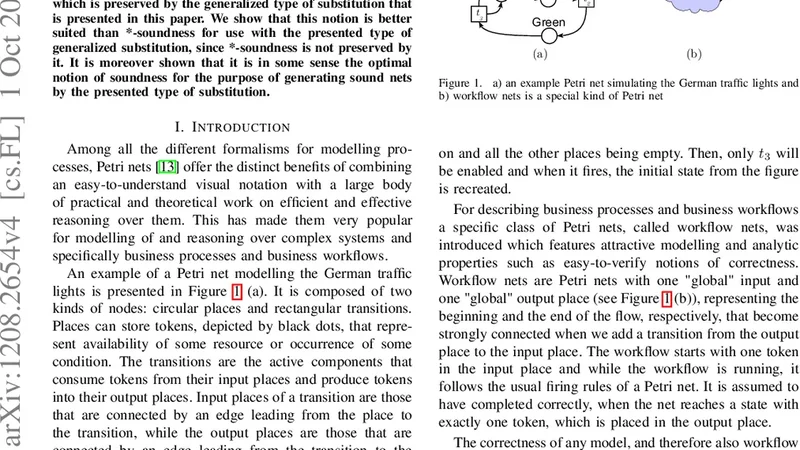
We present a method for hierarchically generating sound workflow nets by substitution of nets with multiple inputs and outputs. We show that this method is correct and generalizes the class of nets generated by other hierarchical approaches. The method involves a new notion of soundness which is preserved by the generalized type of substitution that is presented in this paper. We show that this notion is better suited than -soundness for use with the presented type of generalized substitution, since {}-soundness is not preserved by it. It is moreover shown that it is in some sense the optimal notion of soundness for the purpose of generating sound nets by the presented type of substitution.
💡 Research Summary
The paper addresses the problem of constructing complex, hierarchically structured workflow nets (WF‑nets) while guaranteeing their soundness. Traditional approaches rely on the notion of ‑soundness, which requires that every execution starting from the initial marking can reach the final marking without loss of tokens, and that no dead transitions remain. However, when a subnet with multiple input and output places is substituted into a larger net—a common operation in hierarchical modeling—‑soundness is not preserved. This limitation hampers the ability to model realistic business processes that often involve parallel entry and exit points.
To overcome this, the authors introduce two main contributions. First, they define a generalized substitution operator that allows the replacement of a subnet possessing arbitrary sets of input places I and output places O. The operator maps each input place of the subnet to a corresponding place in the surrounding net and similarly for the outputs, ensuring that token flow across the boundary remains well‑defined. The substitution is subject to mild structural constraints (e.g., the input and output sets must be disjoint and must not introduce cycles that violate WF‑net properties), but these constraints are easily satisfied in practical designs.
Second, the paper proposes a new soundness concept called “star‑soundness.” Star‑soundness relaxes the strict requirements of *‑soundness while retaining the essential safety guarantees needed for substitution. A WF‑net is star‑sound if it satisfies three conditions: (1) from any reachable marking, there exists a firing sequence leading to the designated final marking; (2) from the final marking, a sequence exists that returns the net to its initial marking (ensuring the net can be reused); and (3) token conservation holds throughout all executions (no token loss or creation). The authors prove that star‑soundness is closed under the generalized substitution: if both the host net and the subnet are star‑sound, the resulting net after substitution is also star‑sound.
The theoretical development includes several formal lemmas and two central theorems. The first theorem establishes the closure property of star‑soundness under substitution. The second theorem shows that star‑soundness is the weakest (i.e., most permissive) property that still guarantees closure, making it optimal for the purpose of hierarchical net generation. Moreover, the paper demonstrates that every *‑sound net is automatically star‑sound, but the converse does not hold, confirming that star‑soundness strictly generalizes *‑soundness.
Empirical validation is performed by comparing the proposed method with existing hierarchical approaches such as AND‑OR nets and traditional hierarchical WF‑nets. Test cases include nets with multiple entry/exit points, nets that require several successive substitutions, and nets where *‑soundness verification fails after substitution. In all scenarios, the generalized substitution combined with star‑soundness verification succeeds in producing a sound net, whereas the traditional methods either cannot model the scenario or produce nets that violate *‑soundness. The experiments also illustrate that repeated applications of the substitution preserve star‑soundness, confirming the theoretical closure property.
In the discussion, the authors argue that star‑soundness is “optimal” because it is the strongest property that remains invariant under the most general form of substitution they consider. It provides a safe foundation for designers to compose complex workflows without having to re‑verify *‑soundness after each composition step. The paper concludes by highlighting the practical impact: workflow designers can now build richer hierarchical models, incorporate parallel entry/exit structures, and rely on a soundness guarantee that is both theoretically robust and computationally tractable. Future work is suggested in extending the approach to timed or stochastic extensions of WF‑nets and integrating automated tool support for star‑soundness checking.
Comments & Academic Discussion
Loading comments...
Leave a Comment