A Survey of Smart Data Pricing: Past Proposals, Current Plans, and Future Trends
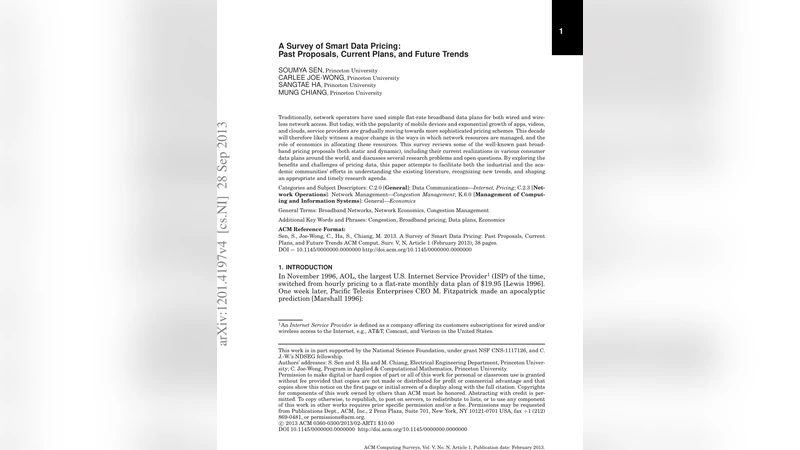
Traditionally, network operators have used simple flat-rate broadband data plans for both wired and wireless network access. But today, with the popularity of mobile devices and exponential growth of apps, videos, and clouds, service providers are gradually moving towards more sophisticated pricing schemes. This decade will therefore likely witness a major change in the ways in which network resources are managed, and the role of economics in allocating these resources. This survey reviews some of the well-known past broadband pricing proposals (both static and dynamic), including their current realizations in various consumer data plans around the world, and discusses several research problems and open questions. By exploring the benefits and challenges of pricing data, this paper attempts to facilitate both the industrial and the academic communities’ efforts in understanding the existing literature, recognizing new trends, and shaping an appropriate and timely research agenda.
💡 Research Summary
The paper provides a comprehensive survey of “smart data pricing” (SDP) – a set of economic mechanisms that aim to allocate network resources more efficiently than traditional flat‑rate or unlimited plans. It begins by describing the forces that have rendered simple pricing schemes inadequate: explosive growth in mobile device usage, bandwidth‑intensive applications such as high‑definition video and cloud services, and the rollout of 5G and the Internet of Things (IoT). These trends have increased traffic volatility, created frequent congestion, and squeezed operators’ profit margins, prompting a shift toward price‑driven traffic management.
The authors classify SDP into two broad families: static pricing and dynamic pricing. Static schemes are pre‑defined and include tiered pricing (different price levels for usage intervals), pure usage‑based billing (charging per megabyte), time‑of‑use tariffs (higher rates during peak hours), and data bundles (pre‑purchased data caps with overage fees). While easy to implement and transparent to consumers, static models cannot react to real‑time network conditions.
Dynamic schemes, by contrast, adjust prices in response to instantaneous network state, user behavior, and service characteristics. The survey details several representative mechanisms: congestion‑based pricing (raising the unit price when the network is heavily loaded to discourage additional demand), auction‑based allocation (users bid for bandwidth and the system allocates resources to the highest bidders), differential pricing across service types (e.g., video versus IoT traffic), and incentive‑driven scheduling (offering discounts for shifting traffic to off‑peak periods). These approaches can dramatically improve utilization and revenue but require sophisticated monitoring infrastructure, real‑time analytics, privacy‑preserving data collection, and user‑friendly interfaces to convey price volatility.
A substantial portion of the paper is devoted to real‑world implementations across the globe. In the United States, several ISPs have introduced “smart data” plans that impose overage charges after a baseline allowance and throttle speeds during peak periods. European operators, especially in the UK and Germany, have experimented with time‑of‑use tariffs and explicit “fair use” policies mandated by EU regulations, aiming to flatten demand curves. In Asia, the rollout of 5G has been accompanied by “flexible data plans” that combine usage caps, service‑type pricing, and family‑sharing pools; South Korea, for example, offers a data‑sharing model where a communal data bucket can be topped up automatically when exhausted. The authors present comparative tables that highlight price structures, underlying technologies, consumer satisfaction metrics, and regulatory contexts for each region.
The survey then identifies open research challenges. First, the accuracy of price signals: how precisely can dynamic prices reflect true congestion given measurement errors and user response delays? Second, modeling user price elasticity across heterogeneous services; existing studies often treat all traffic as a single commodity, ignoring the distinct willingness to pay for video streaming versus low‑latency gaming or IoT telemetry. Third, integrating multi‑service pricing: future networks will need to price not only data volume but also quality‑of‑service parameters such as latency, jitter, and reliability. Fourth, privacy and security: dynamic pricing relies on fine‑grained traffic monitoring, raising concerns about data leakage and compliance with regulations such as GDPR. Fifth, policy and regulatory frameworks: price discrimination must be balanced against fairness and competition concerns, and emerging legislation (e.g., the EU Digital Services Act) will shape permissible pricing practices. Finally, the authors point to the promise of machine‑learning‑driven prediction and optimization, where deep‑learning models forecast traffic patterns and reinforcement‑learning agents compute near‑optimal price vectors in real time; however, scalability and interpretability remain open issues.
Looking ahead, the paper envisions several trends. Integrated billing platforms will bundle data, voice, edge‑computing, and content services into a single “service bundle” priced holistically. AI‑powered pricing engines will become standardized, continuously learning from network telemetry and user behavior to adjust tariffs on the fly. Consumer‑centric dashboards will provide transparent, real‑time cost feedback and allow users to customize their plans dynamically. Finally, international standard‑setting bodies (ITU, IEEE) and regulators are expected to codify best‑practice guidelines for SDP, ensuring transparency, fairness, and privacy protection.
In conclusion, the authors argue that smart data pricing offers a compelling pathway to reconcile three critical objectives: higher network efficiency, sustainable operator revenues, and improved user experience. Yet, realizing this vision demands coordinated advances in measurement infrastructure, algorithm design, user interface engineering, and regulatory policy. The paper calls for joint academic‑industry pilots, extensive field trials, and the development of open standards to accelerate the transition from flat‑rate dominance to a nuanced, economically‑driven pricing ecosystem for next‑generation networks.