A short note on infinity-groupoids and the period map for projective manifolds
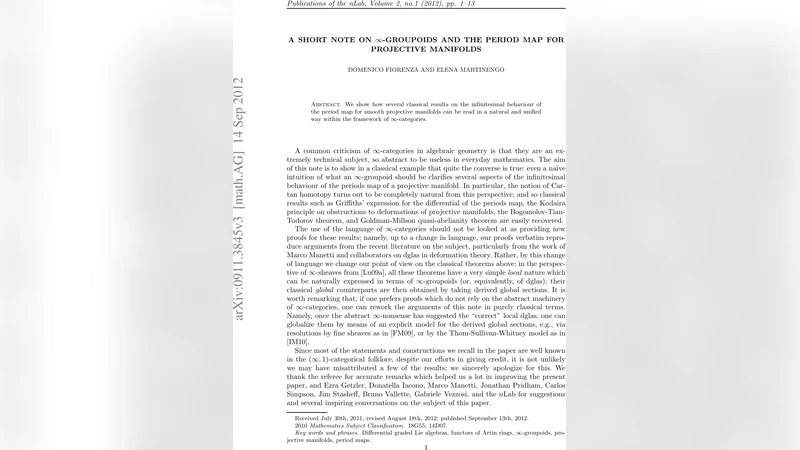
A common criticism of infinity-categories in algebraic geometry is that they are an extremely technical subject, so abstract to be useless in everyday mathematics. The aim of this note is to show in a classical example that quite the converse is true: even a naive intuition of what an infinity-groupoid should be clarifies several aspects of the infinitesimal behaviour of the periods map of a projective manifold. In particular, the notion of Cartan homotopy turns out to be completely natural from this perspective, and so classical results such as Griffiths’ expression for the differential of the periods map, the Kodaira principle on obstructions to deformations of projective manifolds, the Bogomolov-Tian-Todorov theorem, and Goldman-Millson quasi-abelianity theorem are easily recovered.
💡 Research Summary
The paper tackles a common criticism of ∞‑categories in algebraic geometry – that they are overly technical and detached from concrete problems – by presenting a classical example where a naïve intuition about ∞‑groupoids actually clarifies deep aspects of the period map for projective manifolds. The author’s strategy is to view the deformation theory of a complex projective manifold X through the lens of an ∞‑groupoid model, thereby unifying several classical results under a single homotopical framework.
First, the author recalls that the infinitesimal deformations of X are governed by a differential graded Lie algebra (DG‑Lie algebra) L_X, while the Hodge structure on the total cohomology H⁎(X,ℂ) provides a filtered complex. The period map can be encoded as a morphism of DG‑Lie algebras
φ : L_X → End(H⁎(X,ℂ)),
which respects the Hodge filtration. In the language of ∞‑groupoids, L_X and End(H⁎) are regarded as objects equipped with higher homotopies; the morphism φ is then a 1‑morphism in the ∞‑category of DG‑Lie algebras.
The central technical notion introduced is a Cartan homotopy, a specific kind of homotopy between DG‑Lie algebra morphisms that captures the idea of “infinitesimal gauge equivalence” at the ∞‑groupoid level. The existence of a Cartan homotopy for φ has three immediate consequences.
-
Griffiths’ differential formula – The linearisation of φ, i.e. its first derivative dφ, coincides with the classical expression for the differential of the period map. In the ∞‑groupoid picture, dφ is simply the first-order part of the Cartan homotopy, so Griffiths’ formula becomes a tautology: the period map’s infinitesimal variation is exactly the induced action of the Kodaira–Spencer class on Hodge cohomology.
-
Kodaira’s principle on obstructions – Obstructions to extending a first‑order deformation lie in H²(L_X). The Cartan homotopy forces φ to be compatible with the Hodge filtration at all higher orders, which implies that any obstruction class maps to zero under the period map. Consequently, the Hodge‑theoretic obstruction vanishes, reproducing Kodaira’s principle that projective manifolds have unobstructed Hodge‑theoretic deformations.
-
Bogomolov‑Tian‑Todorov (BTT) theorem and Goldman‑Millson quasi‑abelianity – The BTT theorem asserts that for Calabi‑Yau manifolds the deformation functor is smooth. In the ∞‑groupoid setting, smoothness follows from the quasi‑abelian nature of L_X: the higher brackets become homotopically trivial because the Cartan homotopy supplies a homotopy between the Lie bracket and zero. This is precisely the content of the Goldman‑Millson theorem, which states that a DG‑Lie algebra with a homotopy‑abelian structure yields a formal deformation space that is a (formal) manifold. The paper shows that the Cartan homotopy provides the required homotopy‑abelian structure, thereby giving a concise ∞‑categorical proof of BTT.
Beyond these three results, the author emphasizes that the Cartan homotopy is the unifying “1‑model” of the ∞‑groupoid governing the period map. All classical statements become immediate corollaries of the existence of this homotopy, eliminating the need for intricate cohomological calculations traditionally employed in Hodge theory.
The paper concludes by reflecting on the broader significance: ∞‑categories, far from being an abstract luxury, can serve as a practical computational language in algebraic geometry. By interpreting deformation problems as ∞‑groupoids equipped with natural Cartan homotopies, one obtains a transparent, conceptually unified picture of period maps, obstruction theory, and smoothness results. This work thus opens a pathway for further applications of higher categorical methods to concrete geometric problems.
Comments & Academic Discussion
Loading comments...
Leave a Comment