A Survey on Dynamic Spectrum Access Techniques for Cognitive Radio
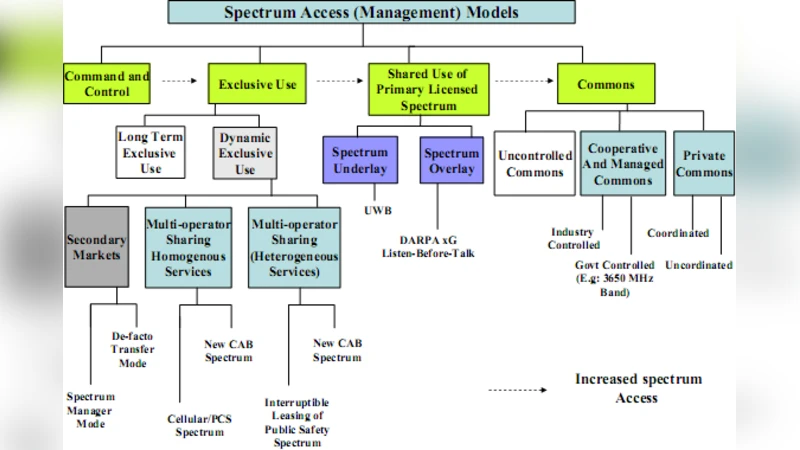
Cognitive radio (CR) is a new paradigm that utilizes the available spectrum band. The key characteristic of CR system is to sense the electromagnetic environment to adapt their operation and dynamically vary its radio operating parameters. The technique of dynamically accessing the unused spectrum band is known as Dynamic Spectrum Access (DSA). The dynamic spectrum access technology helps to minimize unused spectrum bands. In this paper, main functions of Cognitive Radio (CR) i.e. spectrum sensing, spectrum management, spectrum mobility and spectrum sharing are discussed. Then DSA models are discussed along with different methods of DSA such as Command and Control, Exclusive-Use, Shared Use of Primary Licensed User and Commons method. Game-theoretic approach using Bertrand game model, Markovian Queuing Model for spectrum allocation in centralized architecture and Fuzzy logic based method are also discussed and result are shown.
💡 Research Summary
The paper provides a comprehensive survey of Dynamic Spectrum Access (DSA) techniques within the Cognitive Radio (CR) paradigm. It begins by outlining the four fundamental functions of a CR system: spectrum sensing, spectrum management, spectrum mobility, and spectrum sharing. Spectrum sensing is described in detail, covering energy detection, matched filtering, and cooperative sensing, and the trade‑offs among detection probability, false alarm rate, and computational complexity are discussed. In the spectrum management stage, the authors propose a multi‑criteria decision‑making (MCDM) framework that evaluates candidate channels based on quality metrics, interference levels, and user Quality‑of‑Service (QoS) requirements, assigning weighted scores to enable real‑time channel selection.
Spectrum mobility is addressed through a hybrid approach that combines predictive models (e.g., mobility prediction, traffic forecasting) with real‑time reallocation algorithms, aiming to minimize service interruption, latency, and packet loss during handover to a new channel. The paper then classifies DSA into four distinct models: Command‑and‑Control, Exclusive‑Use, Shared Use of Primary Licensed User, and Commons. Each model is examined from policy and technical perspectives, highlighting advantages such as centralized control and interference protection, as well as disadvantages like reduced flexibility or potential congestion.
The core of the survey focuses on three methodological families for implementing DSA. First, a game‑theoretic approach using the Bertrand competition model is presented, where secondary users choose transmission power and price to maximize profit; the Nash equilibrium analysis provides insight into overall system efficiency. Second, a Markovian queuing model is employed for centralized spectrum allocation, characterizing arrival rate (λ) and service rate (μ) to derive channel occupancy probabilities, average waiting times, and system saturation levels, thereby guiding the dimensioning of channel pools and allocation policies. Third, a fuzzy‑logic based allocation scheme is introduced to handle uncertainty in inputs such as channel quality, user demand, and interference constraints. By defining fuzzy rules and inference mechanisms, the method outperforms traditional threshold‑based allocation in both accuracy and spectrum utilization, as demonstrated by simulation results.
The authors also discuss practical challenges and future research directions. They emphasize the need for machine‑learning and deep‑learning techniques to improve sensing accuracy and predict spectrum availability, the integration of distributed cooperative sensing with blockchain‑enabled trust management for enhanced security, and the development of energy‑efficient DSA protocols for low‑power devices. Finally, the paper calls for large‑scale field trials to bridge the gap between theoretical models and real‑world performance, suggesting that such experiments will be essential for standardization and commercial deployment. In summary, the survey systematically reviews the theoretical foundations, modeling tools, and algorithmic solutions for DSA, offering a valuable reference for researchers and engineers working to make more efficient use of the increasingly congested radio spectrum.