Connections on non-abelian Gerbes and their Holonomy
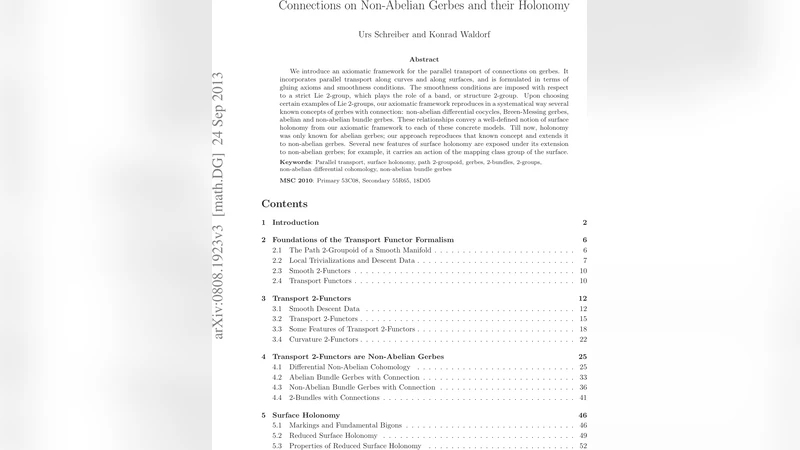
We introduce an axiomatic framework for the parallel transport of connections on gerbes. It incorporates parallel transport along curves and along surfaces, and is formulated in terms of gluing axioms and smoothness conditions. The smoothness conditions are imposed with respect to a strict Lie 2-group, which plays the role of a band, or structure 2-group. Upon choosing certain examples of Lie 2-groups, our axiomatic framework reproduces in a systematical way several known concepts of gerbes with connection: non-abelian differential cocycles, Breen-Messing gerbes, abelian and non-abelian bundle gerbes. These relationships convey a well-defined notion of surface holonomy from our axiomatic framework to each of these concrete models. Till now, holonomy was only known for abelian gerbes; our approach reproduces that known concept and extends it to non-abelian gerbes. Several new features of surface holonomy are exposed under its extension to non-abelian gerbes; for example, it carries an action of the mapping class group of the surface.
💡 Research Summary
The paper presents a comprehensive axiomatic framework for defining parallel transport of connections on gerbes that works simultaneously along one‑dimensional paths and two‑dimensional surfaces. The authors choose a strict Lie 2‑group as the “band” (structure 2‑group) and formulate a set of gluing axioms together with smoothness conditions that any connection must satisfy. The central objects are two layers of transition data: a 1‑morphism governing transport along curves (the usual connection) and a 2‑morphism governing transport across surfaces. The gluing axioms prescribe how these data must match on overlapping patches and on the boundaries where curves meet surfaces, guaranteeing a globally consistent transport.
Smoothness is imposed by requiring that both the 1‑ and 2‑morphisms vary smoothly with respect to the underlying strict Lie 2‑group. This condition is equivalent to the notion of a non‑abelian differential cocycle and reproduces the Breen‑Messing description of gerbes with connection. By specializing the strict Lie 2‑group, the authors recover several known models:
- Non‑abelian differential cocycles – the 2‑morphism becomes a differential 2‑form valued in the Lie algebra of the 2‑group, while the 1‑morphism coincides with the usual 1‑form connection. The axioms reduce exactly to those of Breen‑Messing gerbes.
- Breen‑Messing gerbes – the framework reproduces the original definition of a gerbe with connection, confirming that the axioms are not merely abstract but capture the established theory.
- Abelian bundle gerbes – when the band is the abelian Lie 2‑group U(1) → U(1), the 2‑morphism collapses to the familiar surface holonomy (a U(1) phase) and the framework yields the classical abelian surface holonomy.
- Non‑abelian bundle gerbes – choosing a non‑abelian Lie group such as SU(2) as the band produces a genuinely non‑abelian surface holonomy. This is new: prior to this work holonomy for gerbes was only defined in the abelian case.
The most striking contribution is the definition of surface holonomy for non‑abelian gerbes. Unlike the abelian case, where holonomy assigns a single phase to a closed surface, the non‑abelian holonomy is a 2‑morphism that carries an action of the mapping class group of the surface. In other words, diffeomorphisms of the surface act on the holonomy by non‑commutative composition, revealing a richer algebraic structure. This feature aligns naturally with higher gauge theory, where 2‑form gauge fields (the “B‑field”) and their curvatures appear, and suggests a direct application to physical models involving non‑abelian 2‑form potentials.
From a categorical viewpoint, the construction can be interpreted as a functor from the path‑2‑groupoid of the base manifold to the strict Lie 2‑group. The 1‑morphism corresponds to the image of 1‑paths, while the 2‑morphism corresponds to the image of homotopies (surfaces) between paths. The smoothness conditions ensure that this functor is a smooth 2‑functor, i.e., a higher connection in the sense of Baez‑Schreiber. Consequently, the paper provides a concrete bridge between abstract higher‑categorical notions of connections and concrete differential‑geometric models of gerbes.
The authors conclude with several avenues for future research: extending the framework to weak (rather than strict) Lie 2‑groups, exploring quantization of the non‑abelian surface holonomy, and investigating relations with higher modular forms and topological quantum field theories. By delivering a unified, axiomatic description of gerbe connections and by extending surface holonomy beyond the abelian realm, the paper opens a new chapter in the study of higher gauge geometry and its applications in mathematics and theoretical physics.
Comments & Academic Discussion
Loading comments...
Leave a Comment