On the classifying space for proper actions of groups with cyclic torsion
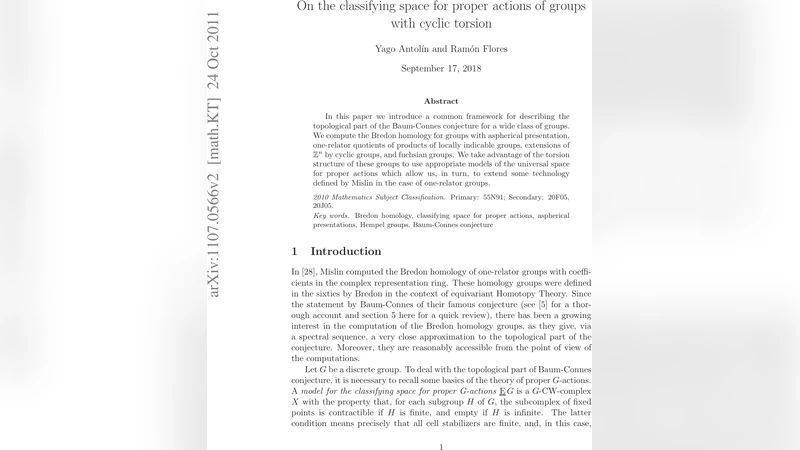
In this paper we introduce a common framework for describing the topological part of the Baum-Connes conjecture for a wide class of groups. We compute the Bredon homology for groups with aspherical presentation, one-relator quotients of products of locally indicable groups, extensions of $\mathbb{Z}^n$ by cyclic groups, and fuchsian groups. We take advantage of the torsion structure of these groups to use appropriate models of the universal space for proper actions which allow us, in turn, to extend some technology defined by Mislin in the case of one-relator groups.
💡 Research Summary
The paper introduces a unified framework for handling the topological side of the Baum–Connes conjecture for a broad family of groups whose torsion is cyclic. The authors define a class of groups, denoted (G_{cct}), characterized by the existence of a finite family of maximal malnormal cyclic subgroups ({G_\lambda}{\lambda\in\Lambda}) such that every non‑trivial finite torsion element of the group lies in exactly one conjugate of a unique (G\lambda). This condition (C) captures the essential torsion structure needed for the constructions that follow.
Given a group (G) satisfying (C), the authors construct a model for the universal space for proper actions (E_G) with a zero‑dimensional singular part. The construction uses the left (G)-set (X={gG_\lambda\mid g\in G,\lambda\in\Lambda}) and forms the join (C=X\ast E) where (E) is any model for (E_G). For any finite subgroup (H\le G), the fixed point set (C^H) is a single vertex, hence contractible and 0‑dimensional. Consequently, (C) is a proper (G)-CW complex whose singular subcomplex ((C){\text{sing}}) is 0‑dimensional. This simple structure makes the computation of Bredon homology (\underline{H}*^G(\underline{\mathbb Z})) tractable: the chain complex collapses to a short exact sequence involving the permutation modules (\mathbb Z
Comments & Academic Discussion
Loading comments...
Leave a Comment