Sliding Windows with Limited Storage
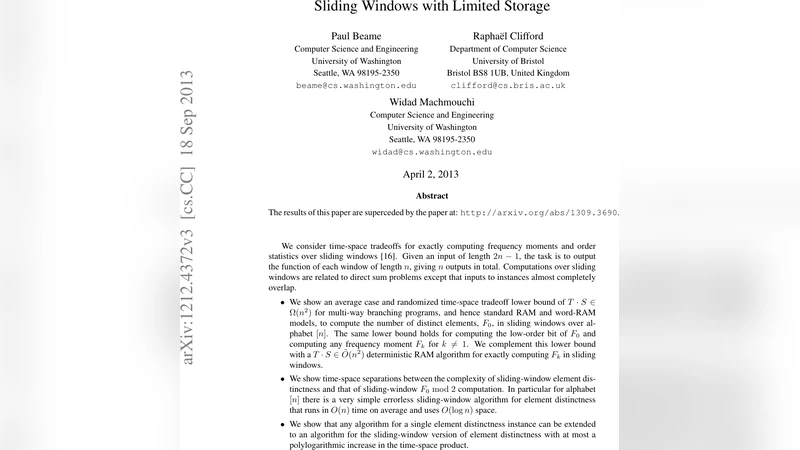
We consider time-space tradeoffs for exactly computing frequency moments and order statistics over sliding windows. Given an input of length 2n-1, the task is to output the function of each window of length n, giving n outputs in total. Computations over sliding windows are related to direct sum problems except that inputs to instances almost completely overlap. We show an average case and randomized time-space tradeoff lower bound of TS in Omega(n^2) for multi-way branching programs, and hence standard RAM and word-RAM models, to compute the number of distinct elements, F_0, in sliding windows over alphabet [n]. The same lower bound holds for computing the low-order bit of F_0 and computing any frequency moment F_k for k not equal to 1. We complement this lower bound with a TS in \tilde O(n^2) deterministic RAM algorithm for exactly computing F_k in sliding windows. We show time-space separations between the complexity of sliding-window element distinctness and that of sliding-window $F_0\bmod 2$ computation. In particular for alphabet [n] there is a very simple errorless sliding-window algorithm for element distinctness that runs in O(n) time on average and uses O(log{n}) space. We show that any algorithm for a single element distinctness instance can be extended to an algorithm for the sliding-window version of element distinctness with at most a polylogarithmic increase in the time-space product. Finally, we show that the sliding-window computation of order statistics such as the maximum and minimum can be computed with only a logarithmic increase in time, but that a TS in Omega(n^2) lower bound holds for sliding-window computation of order statistics such as the median, a nearly linear increase in time when space is small.
💡 Research Summary
The paper investigates the fundamental time‑space trade‑offs for exact computation of frequency moments and order statistics over sliding windows. The setting is as follows: given an input sequence of length 2n − 1, one must output a function value for each of the n overlapping windows of length n, thus producing n answers. Because consecutive windows share almost the entire input, the problem is closely related to direct‑sum problems, yet the heavy overlap makes standard direct‑sum techniques insufficient.
Main lower‑bound results.
Using the multi‑way branching program model, the authors prove an average‑case and randomized lower bound of TS ∈ Ω(n²) for computing the number of distinct elements (F₀) in each window when the alphabet is