Wardowski implicit contractions in metric spaces
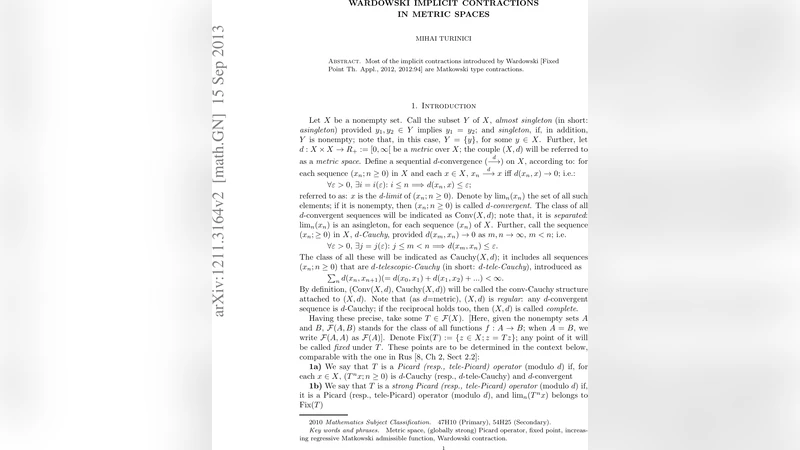
Most of the implicit contractions introduced by Wardowski [Fixed Point Th. Appl., 2012, 2012:94] are Matkowski type contractions.
💡 Research Summary
The paper revisits the implicit contraction framework introduced by Wardowski in 2012 and demonstrates that, in essentially all cases, these implicit contractions are equivalent to the well‑known Matkowski‑type contractions. The authors begin by recalling the classical Banach contraction principle and its generalisation due to Matkowski, which replaces the linear Lipschitz constant with a non‑decreasing function g satisfying g(t)
d(Tx,Ty) ≤ ψ(d(x,y))·φ(d(x,y)).
The central observation of the paper is that the product h(t)=ψ(t)·φ(t) automatically satisfies the Matkowski conditions. The authors prove this by splitting the analysis into two regimes. For small t, the vanishing property of φ forces h(t) to be strictly less than t by a factor (1−δ). For large t, the boundedness of φ together with ψ(t)<t yields a uniform constant c<1 such that h(t)≤c·t. Continuity of h and the fact that h(0)=0 are immediate from the assumptions on ψ and φ. Consequently, h is a Matkowski function, and the implicit contraction reduces to the standard Matkowski contraction d(Tx,Ty) ≤ h(d(x,y)).
Having established this equivalence, the paper re‑derives Wardowski’s fixed‑point theorems using the classical Matkowski proof technique. A Picard iteration {x_n} is constructed, and the inequality with h guarantees that the successive distances form a decreasing sequence converging to zero. In a complete metric space the resulting Cauchy sequence converges to a point x* satisfying Tx*=x*, and uniqueness follows from the strict inequality h(t)<t. The authors emphasize that no additional hypotheses on ψ or φ are required beyond those already imposed, so the original proofs can be streamlined considerably.
To illustrate the point, several examples from the literature are examined. The pair ψ(t)=t/(1+t) and φ(t)=e^{‑t} yields h(t)=t·e^{‑t}/(1+t), which clearly satisfies h(t)
In the concluding discussion the authors argue that the apparent extra flexibility offered by the two‑function formulation does not translate into new existence or uniqueness results; instead it complicates the analytical framework. They suggest that future research might be more fruitful by exploring genuinely broader settings—such as ordered metric spaces, partial metrics, or non‑symmetric distance functions—rather than refining the already equivalent implicit‑contraction scheme. Overall, the paper clarifies the relationship between Wardowski’s implicit contractions and Matkowski contractions, thereby simplifying the theoretical foundation of fixed‑point results in metric spaces.
Comments & Academic Discussion
Loading comments...
Leave a Comment