The Revised and Uniform Fundamental Groups and Universal Covers of Geodesic Spaces
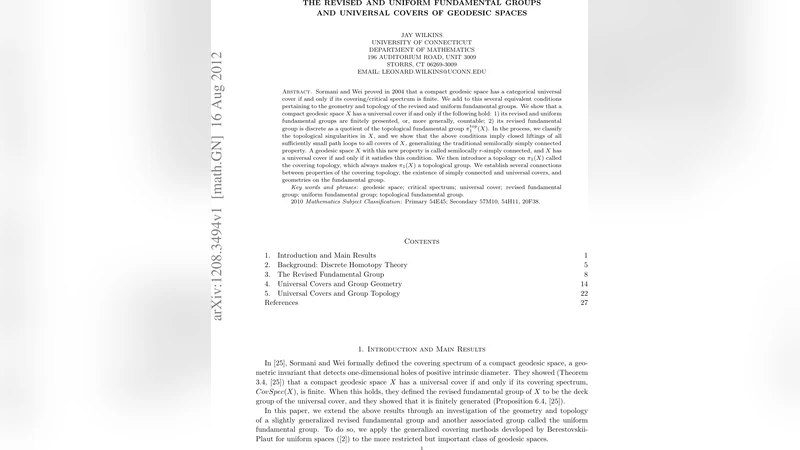
Sormani and Wei proved in 2004 that a compact geodesic space has a categorical universal cover if and only if its covering/critical spectrum is finite. We add to this several equivalent conditions pertaining to the geometry and topology of the revised and uniform fundamental groups. We show that a compact geodesic space X has a universal cover if and only if the following hold: 1) its revised and uniform fundamental groups are finitely presented, or, more generally, countable; 2) its revised fundamental group is discrete as a quotient of the topological fundamental group. In the process, we classify the topological singularities in X, and we show that the above conditions imply closed liftings of all sufficiently small path loops to all covers of X, generalizing the traditional semilocally simply connected property. A geodesic space with this new property is called semilocally r-simply connected, and X has a universal cover if and only if it satisfies this condition. We then introduce a topology on the fundamental group called the covering topology, with respect to which the fundamental group is always a topological group. We establish several connections between properties of the covering topology, the existence of simply connected and universal covers, and geometries on the fundamental group.
💡 Research Summary
The paper revisits the classical result of Sormani and Wei (2004) that a compact geodesic space X admits a categorical universal cover precisely when its covering (or critical) spectrum is finite, and it enriches this characterization by introducing several new algebraic and topological conditions involving two refined versions of the fundamental group. The authors define the revised fundamental group π₁ʳ(X) as the quotient of the topological fundamental group π₁^{top}(X) by the normal subgroup generated by all loops that lift closed to every ε‑cover, and the uniform fundamental group π₁ᵤ(X) as the inverse limit of the fundamental groups of all ε‑covers. Both groups capture, in a more intrinsic way, the “small‑scale” homotopy information that the critical spectrum encodes.
The first major theorem shows that the following statements are equivalent for a compact geodesic space X:
- The covering spectrum of X is finite (hence X has a universal cover).
- π₁ʳ(X) and π₁ᵤ(X) are countable.
- π₁ʳ(X) and π₁ᵤ(X) admit finite presentations (a stronger condition that automatically implies countability).
- π₁ʳ(X) is discrete when regarded as a quotient of the topological group π₁^{top}(X).
Thus, finiteness of the covering spectrum can be replaced by purely algebraic constraints on the revised or uniform fundamental groups. In particular, countability or finite presentability of these groups rules out the existence of infinitely many distinct “critical” scales, which would otherwise prevent the formation of a single universal covering space.
A central conceptual contribution is the introduction of semilocally r‑simply connected spaces. Classical semilocally simply connected spaces require that every sufficiently small loop be null‑homotopic in X; the new condition relaxes this to the requirement that every sufficiently small loop lifts closed to all covering spaces of X. Equivalently, there exists a neighborhood U of each point such that any loop in U maps to the identity element of π₁ʳ(X). The authors prove that a compact geodesic space is semilocally r‑simply connected if and only if it possesses a universal cover. Consequently, the traditional semilocal simple‑connectedness is sufficient but not necessary for universal covering; the r‑version captures a broader class of spaces, including many fractal‑type or non‑manifold examples where small loops are non‑trivial but still behave well with respect to all covers.
The paper then equips the fundamental group with a new covering topology. This topology is generated by taking all open normal subgroups of π₁^{top}(X) (i.e., kernels of the natural projections onto the deck groups of the ε‑covers) as a basis of neighborhoods of the identity. With this topology, π₁ becomes a topological group for any geodesic space, regardless of local simple‑connectedness. The authors explore several consequences:
- If the covering topology on π₁ is discrete, then π₁ʳ is discrete as a quotient, and X is semilocally r‑simply connected, guaranteeing a universal cover.
- When the covering topology is complete (as a metric group), every regular cover of X is itself a complete metric space, linking completeness of the group to geometric completeness of the covers.
- The covering topology refines the classical whisker topology; the two coincide precisely when the space is semilocally simply connected, while they differ in spaces with “topological singularities” that the authors classify in detail.
Throughout, the authors provide concrete examples—such as the Hawaiian earring, certain fractal surfaces, and spaces with wild branching—to illustrate how the revised and uniform fundamental groups detect phenomena invisible to the ordinary π₁, and how the covering topology distinguishes spaces that share the same algebraic fundamental group but differ in their covering behavior.
In summary, the paper establishes a robust set of equivalent criteria for the existence of a universal cover in compact geodesic spaces: finiteness of the covering spectrum, countability or finite presentability of π₁ʳ and π₁ᵤ, discreteness of π₁ʳ as a quotient, and the semilocally r‑simply connected property. It also introduces the covering topology on the fundamental group, showing that this topology encodes precisely the same information as the existence of simply connected and universal covers, and it connects these ideas to geometric properties of the covering spaces themselves. The work thus bridges the gap between coarse geometric invariants (spectra) and fine algebraic/topological structures, providing new tools for researchers studying spaces with intricate local topology.
Comments & Academic Discussion
Loading comments...
Leave a Comment