An In-Depth Analysis of Stochastic Kronecker Graphs
Graph analysis is playing an increasingly important role in science and industry. Due to numerous limitations in sharing real-world graphs, models for generating massive graphs are critical for developing better algorithms. In this paper, we analyze the stochastic Kronecker graph model (SKG), which is the foundation of the Graph500 supercomputer benchmark due to its favorable properties and easy parallelization. Our goal is to provide a deeper understanding of the parameters and properties of this model so that its functionality as a benchmark is increased. We develop a rigorous mathematical analysis that shows this model cannot generate a power-law distribution or even a lognormal distribution. However, we formalize an enhanced version of the SKG model that uses random noise for smoothing. We prove both in theory and in practice that this enhancement leads to a lognormal distribution. Additionally, we provide a precise analysis of isolated vertices, showing that the graphs that are produced by SKG might be quite different than intended. For example, between 50% and 75% of the vertices in the Graph500 benchmarks will be isolated. Finally, we show that this model tends to produce extremely small core numbers (compared to most social networks and other real graphs) for common parameter choices.
💡 Research Summary
The paper presents a comprehensive theoretical and empirical study of the Stochastic Kronecker Graph (SKG) model, which underlies the Graph500 super‑computer benchmark. The authors first formalize the standard SKG generation process: a 2 × 2 probability matrix T (t₁,…,t₄) with positive entries summing to one, a recursion depth ℓ such that the number of vertices n = 2^ℓ, and m edge insertions performed by recursively selecting quadrants of the adjacency matrix according to T. This construction is highly parallelizable, making it attractive for massive graph generation.
Degree distribution
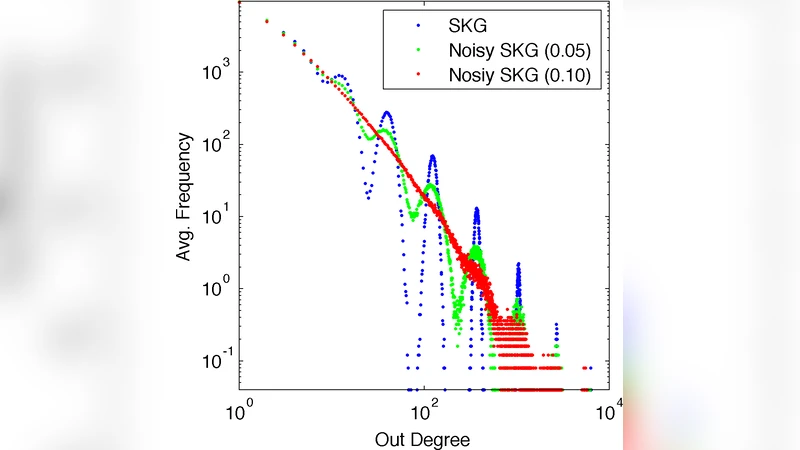
Contrary to earlier claims that SKG yields a power‑law or log‑normal degree distribution, the authors derive the exact multinomial expression for the degree of a vertex and show that, asymptotically, the expected number of vertices of degree k oscillates between a log‑normal envelope and an exponential tail. The distribution is not monotone; instead it exhibits pronounced “wiggles” on log‑log plots. The authors provide a closed‑form approximation that captures this behavior and prove that the oscillations become more frequent as ℓ grows, making the SKG degree profile fundamentally different from real‑world networks, which are typically smooth and strictly decreasing.
Noisy SKG (NSKG)
To smooth out the oscillations, the paper introduces a simple noise injection scheme. At each recursion level a small independent perturbation ε_ℓ ∈
Comments & Academic Discussion
Loading comments...
Leave a Comment