Temporal Link Prediction using Matrix and Tensor Factorizations
The data in many disciplines such as social networks, web analysis, etc. is link-based, and the link structure can be exploited for many different data mining tasks. In this paper, we consider the problem of temporal link prediction: Given link data for times 1 through T, can we predict the links at time T+1? If our data has underlying periodic structure, can we predict out even further in time, i.e., links at time T+2, T+3, etc.? In this paper, we consider bipartite graphs that evolve over time and consider matrix- and tensor-based methods for predicting future links. We present a weight-based method for collapsing multi-year data into a single matrix. We show how the well-known Katz method for link prediction can be extended to bipartite graphs and, moreover, approximated in a scalable way using a truncated singular value decomposition. Using a CANDECOMP/PARAFAC tensor decomposition of the data, we illustrate the usefulness of exploiting the natural three-dimensional structure of temporal link data. Through several numerical experiments, we demonstrate that both matrix- and tensor-based techniques are effective for temporal link prediction despite the inherent difficulty of the problem. Additionally, we show that tensor-based techniques are particularly effective for temporal data with varying periodic patterns.
💡 Research Summary
The paper tackles the challenging problem of temporal link prediction in evolving bipartite graphs, where the goal is to forecast future edges given a sequence of adjacency matrices for times 1 through T. Recognizing that many real‑world systems (social networks, e‑commerce, citation networks) exhibit both bipartite structure and temporal dynamics, the authors develop two complementary families of methods: a matrix‑based approach that collapses the time dimension into a single weighted matrix, and a tensor‑based approach that preserves the three‑dimensional nature of the data.
Matrix‑based method.
The authors first introduce a time‑weighting scheme: each snapshot A_t receives a weight w_t (typically decreasing with age) and the weighted sum (\bar A = \sum_{t=1}^T w_t A_t) serves as a compact representation of the whole history. On this aggregated matrix they extend the classic Katz similarity, originally defined for unipartite graphs as ((I - \beta A)^{-1} - I). For bipartite graphs the similarity is computed via alternating products of the two incidence blocks, effectively counting all paths that start on the left side, alternate across the bipartition, and return to the left side. Direct inversion is infeasible for large graphs, so the authors approximate ((I - \beta \bar A)^{-1}) using a truncated singular value decomposition (SVD): (\bar A \approx U_k \Sigma_k V_k^\top). By keeping only the top‑k singular values, they obtain a low‑rank approximation of the Katz scores that can be evaluated in O(k·(M+N)) time, where M and N are the numbers of left‑ and right‑hand nodes. This yields a scalable, memory‑efficient predictor that can be updated quickly as new snapshots arrive.
Tensor‑based method.
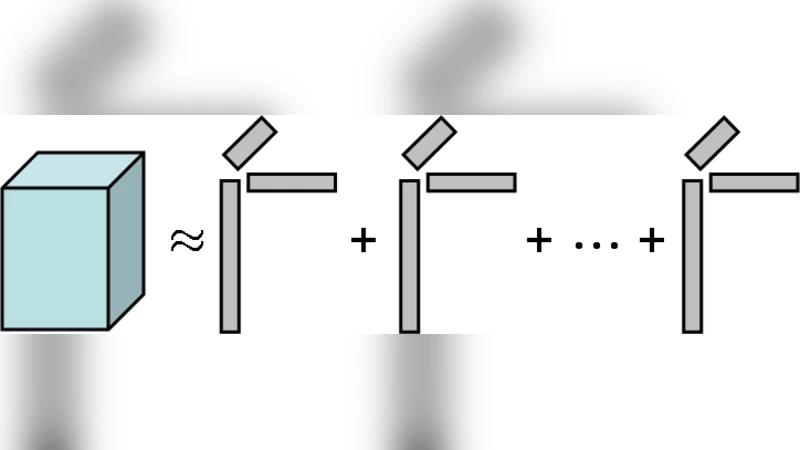
To exploit the inherent three‑way structure, the authors construct a third‑order tensor (\mathcal{X} \in \mathbb{R}^{M \times N \times T}) whose frontal slices are the adjacency matrices at each time step. They apply a CANDECOMP/PARAFAC (CP) decomposition, expressing the tensor as a sum of R rank‑1 components: (\mathcal{X} \approx \sum_{r=1}^R a_r \circ b_r \circ c_r). The factor matrices (A =
Comments & Academic Discussion
Loading comments...
Leave a Comment