Hamiltonian statistical mechanics
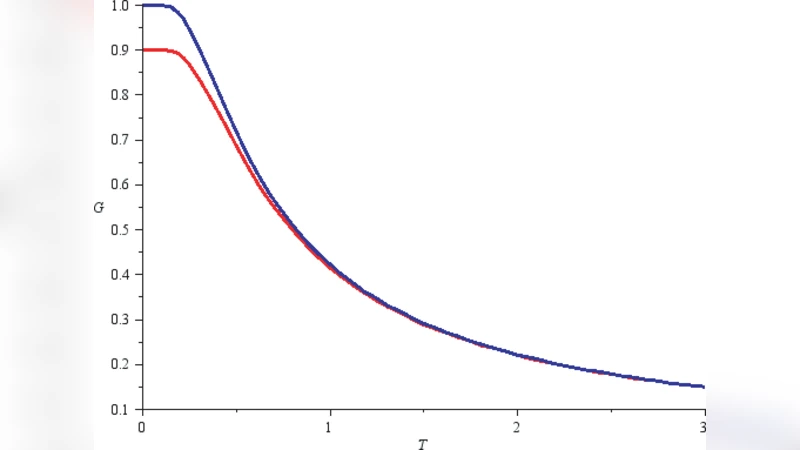
A framework for statistical-mechanical analysis of quantum Hamiltonians is introduced. The approach is based upon a gradient flow equation in the space of Hamiltonians such that the eigenvectors of the initial Hamiltonian evolve toward those of the reference Hamiltonian. The nonlinear double-bracket equation governing the flow is such that the eigenvalues of the initial Hamiltonian remain unperturbed. The space of Hamiltonians is foliated by compact invariant subspaces, which permits the construction of statistical distributions over the Hamiltonians. In two dimensions, an explicit dynamical model is introduced, wherein the density function on the space of Hamiltonians approaches an equilibrium state characterised by the canonical ensemble. This is used to compute quenched and annealed averages of quantum observables.
💡 Research Summary
The paper introduces a novel framework called “Hamiltonian statistical mechanics,” in which the Hamiltonian itself is treated as a stochastic variable rather than a fixed operator. The authors construct a gradient‑flow dynamics on the space of Hermitian matrices that drives an initial Hamiltonian (H_{0}) toward a reference Hamiltonian (G) while preserving the eigenvalues of (H_{0}). The evolution is governed by a double‑bracket equation
\
Comments & Academic Discussion
Loading comments...
Leave a Comment