Thermodynamical description of hadron-quark phase transition and its implications on compact-star phenomena
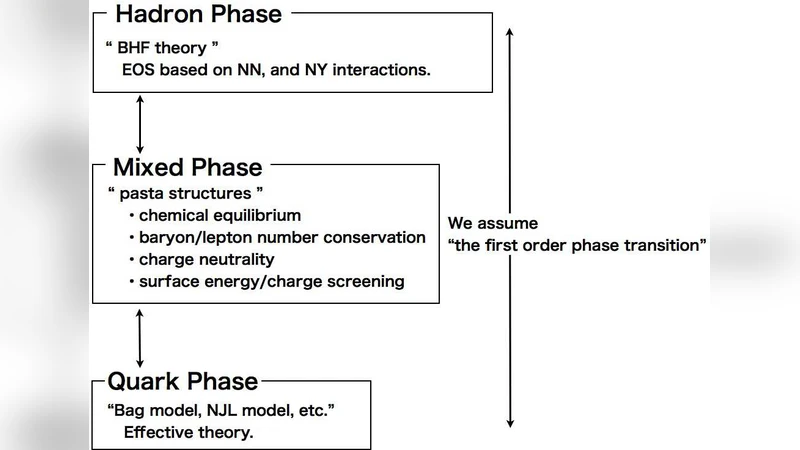
One of the most promising possibilities may be the appearance of quark matter in astrophysical phenomena in the light of recent progress in observations. The mechanism of deconfinement is not well understood, but the thermodynamical aspects of the hadron-quark (HQ) phase transition have been extensively studied in recent years. Then the mixed phase of hadron and quark matter becomes important; the proper treatment is needed to describe the HQ phase transition and derive the equation of state (EOS) for the HQ matter, based on the Gibbs conditions for phase equilibrium. We here adopt a EOS based on the baryon-baryon interactions including hyperons for the hadron phase, while we use rather simple EOS within the MIT bag model in the quark phase. For quark matter we further try to improve the previous EOS by considering other effective models of QCD. One of the interesting consequences may be the appearance of the inhomogeneous structures called “pasta”, which are brought about by the surface and the Coulomb interaction effects. We present here a comprehensive review of our recent works about the HQ phase transition in various astrophysical situations: cold catalyzed matter, hot matter and neutrino-trapped matter. We show how the pasta structure becomes unstable by the charge screening of the Coulomb interaction, thermal effect or the neutrino trapping effect. Such inhomogeneous structure may affect astrophysical phenomena through its elasticity or thermal properties. Here we also discuss some implications on supernova explosion, gravitational wave and cooling of compact stars.
💡 Research Summary
This paper provides a comprehensive thermodynamic treatment of the hadron‑quark (HQ) phase transition and explores its astrophysical consequences for compact stars. The authors construct the equation of state (EOS) for the hadronic phase using modern baryon‑baryon interaction models that explicitly include hyperons, thereby capturing the stiffening and composition changes expected at supranuclear densities. For the quark phase they adopt the MIT bag model as a baseline but also examine more sophisticated QCD‑inspired effective theories such as the Nambu–Jona‑Lasinio (NJL) model and extensions that incorporate color‑charge interactions. By enforcing the full set of Gibbs conditions—equality of pressure, temperature, and all relevant chemical potentials, together with charge neutrality and β‑equilibrium—the study derives a self‑consistent mixed‑phase EOS that bridges the two regimes.
A central focus is the emergence of non‑uniform “pasta” structures in the mixed phase. The competition between surface tension and Coulomb energy leads to a sequence of geometries (droplets, rods, slabs, tubes, and bubbles) as the baryon density increases. The authors demonstrate that charge screening, quantified by the Debye length, can dramatically reduce the Coulomb contribution, destabilizing the pasta when the screening length becomes comparable to the size of the structures. Thermal effects are also examined: at temperatures of order 1–10 MeV the thermal pressure overtakes surface tension, causing the pasta to melt into a uniform mixture. Neutrino trapping, relevant in proto‑neutron stars, fixes the lepton fraction and modifies the electron‑proton ratio, which in turn lengthens the screening length and suppresses pasta formation.
The paper then connects these microphysical findings to macroscopic phenomena. The presence of pasta enhances the shear modulus of the stellar interior by orders of magnitude, altering the spectrum of torsional oscillations and potentially imprinting characteristic frequencies on gravitational‑wave signals from neutron‑star quakes or binary inspirals. Moreover, the heterogeneous thermal conductivity and specific heat associated with pasta layers affect heat transport, leading to observable deviations in the cooling curves of young neutron stars. The authors argue that a transient pasta phase during a core‑collapse supernova could provide an additional pressure boost and latent‑heat release, thereby influencing shock revival and the overall explosion dynamics. Finally, the rapid deconfinement transition itself may generate a burst of neutrinos and a distinct gravitational‑wave signature, offering a multimessenger probe of the HQ transition.
In summary, the work advances the theoretical description of the hadron‑quark transition by integrating realistic hadronic and quark EOSs, rigorously applying Gibbs equilibrium, and elucidating the conditions under which pasta structures appear or disappear. It highlights how these microscopic structures can leave measurable imprints on supernova explosions, gravitational‑wave spectra, and neutron‑star thermal evolution, thereby providing concrete targets for current and future astrophysical observations.