On Polynomial Multiplication in Chebyshev Basis
In a recent paper Lima, Panario and Wang have provided a new method to multiply polynomials in Chebyshev basis which aims at reducing the total number of multiplication when polynomials have small deg
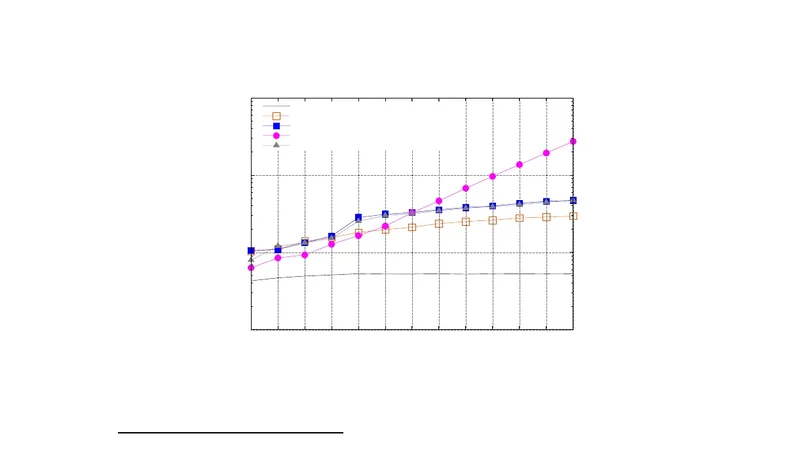
In a recent paper Lima, Panario and Wang have provided a new method to multiply polynomials in Chebyshev basis which aims at reducing the total number of multiplication when polynomials have small degree. Their idea is to use Karatsuba’s multiplication scheme to improve upon the naive method but without being able to get rid of its quadratic complexity. In this paper, we extend their result by providing a reduction scheme which allows to multiply polynomial in Chebyshev basis by using algorithms from the monomial basis case and therefore get the same asymptotic complexity estimate. Our reduction allows to use any of these algorithms without converting polynomials input to monomial basis which therefore provide a more direct reduction scheme then the one using conversions. We also demonstrate that our reduction is efficient in practice, and even outperform the performance of the best known algorithm for Chebyshev basis when polynomials have large degree. Finally, we demonstrate a linear time equivalence between the polynomial multiplication problem under monomial basis and under Chebyshev basis.
💡 Research Summary
The paper addresses the problem of multiplying polynomials expressed in the Chebyshev basis, a task that appears in many areas such as approximation theory, spectral methods, and signal processing. Earlier work by Lima, Panario, and Wang introduced a Karatsuba‑style algorithm that reduces the number of scalar multiplications for low‑degree inputs, but the overall asymptotic complexity remains quadratic (O(n²)). Another line of research relies on converting Chebyshev coefficients to the monomial basis, applying a fast convolution (FFT, NTT, etc.), and converting the result back. Although this yields an O(n log n) algorithm, the conversion steps add non‑trivial overhead and complicate implementation.
The authors propose a new “direct reduction” scheme that bypasses explicit basis conversion while still allowing any state‑of‑the‑art monomial‑basis multiplication algorithm to be used unchanged. The key observation is the product formula for Chebyshev polynomials:
T_i(x)·T_j(x) = ½
📜 Original Paper Content
🚀 Synchronizing high-quality layout from 1TB storage...