The quest for a universal density functional: The accuracy of density functionals across a broad spectrum of databases in chemistry and physics
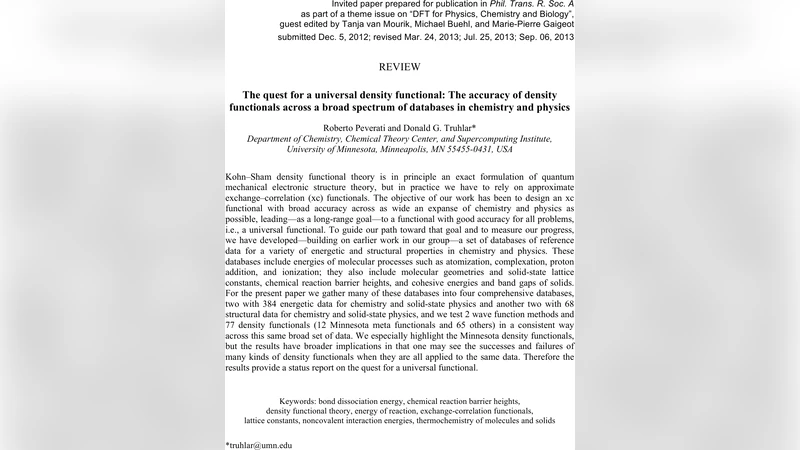
Kohn-Sham density functional theory is in principle an exact formulation of quantum mechanical electronic structure theory, but in practice we have to rely on approximate exchange-correlation (xc) functionals. The objective of our work has been to design an xc functional with broad accuracy across as wide an expanse of chemistry and physics as possible, leading-as a long-range goal-to a functional with good accuracy for all problems, i.e., a universal functional. To guide our path toward that goal and to measure our progress, we have developed-building on earlier work in our group-a set of databases of reference data for a variety of energetic and structural properties in chemistry and physics. These databases include energies of molecular processes such as atomization, complexation, proton addition, and ionization; they also include molecular geometries and solid-state lattice constants, chemical reaction barrier heights, and cohesive energies and band gaps of solids. For the present paper we gather many of these databases into four comprehensive databases, two with 384 energetic data for chemistry and solid-state physics and another two with 68 structural data for chemistry and solid-state physics, and we test 2 wave function methods and 77 density functionals (12 Minnesota meta functionals and 65 others) in a consistent way across this same broad set of data. We especially highlight the Minnesota density functionals, but the results have broader implications in that one may see the successes and failures of many kinds of density functionals when they are all applied to the same data. Therefore the results provide a status report on the quest for a universal functional.
💡 Research Summary
The paper presents a comprehensive benchmarking effort aimed at assessing the progress toward a universal exchange‑correlation (xc) functional within Kohn‑Sham density‑functional theory (DFT). Recognizing that DFT is, in principle, an exact reformulation of the many‑electron Schrödinger equation but that practical applications rely on approximate xc functionals, the authors set out to evaluate a broad spectrum of functionals across an extensive set of reference data that spans both chemistry and solid‑state physics.
To this end, the authors first constructed four large, internally consistent databases. Two of them contain energetic information (384 data points) – covering molecular atomization, complexation, proton addition, ionization, reaction barrier heights, cohesive energies, and solid‑state band gaps – while the other two comprise structural data (68 points) – including optimized molecular geometries, bond lengths and angles, and lattice constants of crystals. All reference values were taken from high‑quality experimental measurements or from high‑level wave‑function methods such as CCSD(T) and quantum Monte Carlo, ensuring a “gold‑standard” baseline.
The benchmarking set includes 77 density‑functional approximations (DFAs) and two wave‑function methods (MP2 and CCSD(T)). The DFAs consist of 65 widely used functionals (GGA, meta‑GGA, hybrid, and range‑separated hybrids) plus 12 Minnesota meta‑GGAs, which the authors highlight because of their reputation for broad applicability. All calculations were performed with a unified protocol: the same basis set (def2‑TZVP or equivalent), identical convergence criteria, and consistent treatment of dispersion (where applicable). This uniformity eliminates methodological bias and allows a fair, side‑by‑side comparison of every functional on every data point.
Statistical analysis was carried out using mean absolute error (MAE), mean absolute percentage error (MAPE), root‑mean‑square error (RMSE), and error‑distribution plots for each functional across the four databases and within each sub‑category (e.g., molecular thermochemistry, reaction barriers, solid‑state lattice constants). The results reveal a nuanced landscape. The Minnesota family (M06‑L, M06‑2X, MN15, etc.) generally delivers low MAEs for molecular thermochemistry and geometry, excelling in non‑covalent interactions and hydrogen‑bonded systems. However, it tends to overestimate band gaps and cohesive energies in solids, indicating a systematic bias toward stronger localization. Traditional GGA and hybrid functionals such as PBE, B3LYP, and PBE0 show robust performance for solid‑state lattice constants and metallic bonding but suffer large errors for reaction barriers and weak intermolecular forces. Range‑separated hybrids (ωB97X‑D, CAM‑B3LYP) improve the description of long‑range dispersion but still exhibit uneven accuracy across the full dataset. Meta‑GGAs and hybrid meta‑GGAs (e.g., M06‑2X, ωB97M‑V) achieve high overall accuracy but often rely on extensive empirical parameterization, raising concerns about transferability to systems outside the training set. The wave‑function methods, as expected, produce the smallest errors but at a dramatically higher computational cost, limiting their practical use for large‑scale screening.
From these observations the authors conclude that no single functional currently offers uniformly high accuracy across the entire chemical‑physical spectrum. The trade‑offs observed—between locality and non‑locality, between computational efficiency and correlation completeness—reflect fundamental challenges in xc functional design. The paper therefore serves as a status report: it quantifies where existing functionals succeed, where they fail, and how far the community is from the long‑term goal of a truly universal functional.
Looking forward, the authors propose several avenues for progress. First, expanding the benchmark databases to include additional properties such as excited‑state energies, optical spectra, and low‑dimensional materials would provide a more stringent test of functional versatility. Second, the systematic patterns of over‑ and under‑estimation identified here suggest that new parameterization strategies—potentially guided by machine‑learning techniques—could be devised to balance competing error sources. Third, hybrid approaches that combine DFT with higher‑level methods (e.g., DFT+U, GW‑corrected DFT, or double‑hybrid schemes) may bridge the gap between accuracy and cost for specific classes of problems. Finally, the authors emphasize the importance of community‑wide adoption of standardized benchmark protocols, as exemplified by their own methodology, to ensure that future functional developments can be objectively compared and iteratively improved.
In summary, this work provides a meticulously curated, cross‑disciplinary benchmark set and a thorough comparative analysis of a large suite of DFAs. It highlights both the achievements and the limitations of current functionals, offering a clear roadmap for the continued quest toward a universal density functional that can reliably tackle the full breadth of chemical and physical problems.