HYPERDIRE: HYPERgeometric functions DIfferential REduction: MATHEMATICA based packages for differential reduction of generalized hypergeometric functions pFq, F1,F2,F3,F4
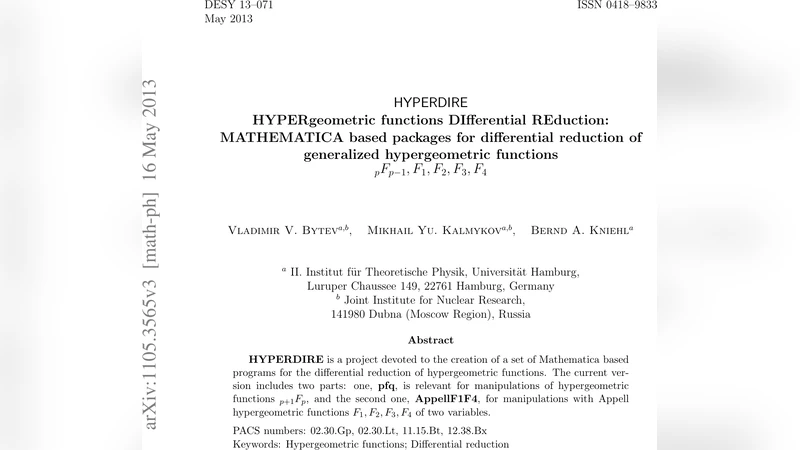
HYPERDIRE is a project devoted to the creation of a set of Mathematica based programs for the differential reduction of hypergeometric functions. The current version includes two parts: one, pfq, is relevant for manipulations of hypergeometric functions_{p+1}F_p, and the second one, AppellF1F4, for manipulations with Appell hypergeometric functions F_1,F_2,F_3,F_4 of two variables.
💡 Research Summary
The paper presents HYPERDIRE, a Mathematica‑based software suite designed to perform differential reduction of Horn‑type hypergeometric functions. The system consists of two modules: pfq, which handles generalized hypergeometric functions pFq (in particular p+1 F_p), and AppellF1F4, which treats the two‑variable Appell functions F₁, F₂, F₃, F₄. The core idea is to use step‑up and step‑down differential operators that shift the upper and lower parameters of a hypergeometric function by ±1. By composing these elementary operators, any integer shift of the parameters can be achieved, thereby reducing a given function to a linear combination of a small set of basis functions with simpler parameter sets.
For p+1 F_p, the authors start from the differential equation z∏{i=1}^{p+1}(θ+a_i) − θ∏{j=1}^{p}(θ+b_j−1)=0, where θ = z d/dz. From this they derive explicit formulas for the step‑up operators B⁺{a_i} and step‑down operators B⁻{a_i}, as well as the corresponding operators for the lower parameters H⁺{b_j} and H⁻{b_j}. These operators involve rational functions of the parameters and the variable z, together with polynomials P(p) that encode the combinatorial structure of the series coefficients. The package automatically constructs the required products of operators, expands them, and expresses the shifted function as
p+1 F_p(a+ m; b+ n; z) = S(a,b,z)
Comments & Academic Discussion
Loading comments...
Leave a Comment