Generalized Formulation of Weighted Optimal Guidance Laws with Impact Angle Constraint
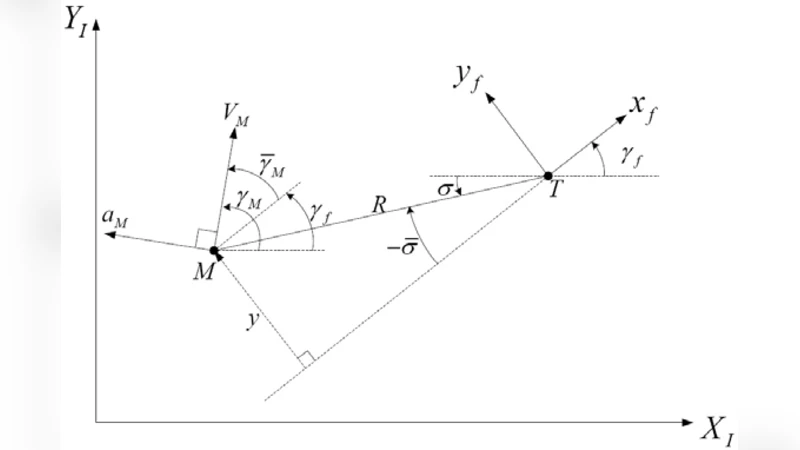
The purpose of this paper is to investigate the generalized formulation of weighted optimal guidance laws with impact angle constraint. From the generalized formulation, we explicitly find the feasible set of weighting functions that lead to analytical forms of weighted optimal guidance laws. This result has potential significance because it can provide additional degrees of freedom in designing a guidance law that accomplishes the specified guidance objective.
💡 Research Summary
The paper addresses a longstanding challenge in missile and projectile guidance: how to enforce a precise impact‑angle constraint while still achieving optimal trajectory performance. Traditional optimal guidance formulations have largely focused on minimizing terminal position error, treating impact‑angle constraints as additional nonlinear constraints that require iterative numerical solutions. Such approaches are computationally intensive, lack closed‑form expressions, and offer limited flexibility for designers who must balance competing mission objectives such as fuel consumption, maneuverability, and robustness to disturbances.
In response, the authors develop a generalized weighted‑optimal‑guidance framework that incorporates the impact‑angle constraint directly into the cost functional. The system dynamics are linearized to a planar point‑mass model, and the performance index is defined as
J = ∫₀ᵀ w(t)·u²(t) dt,
where u(t) is the control acceleration and w(t) is a time‑varying weighting function. The impact‑angle requirement is expressed as a terminal constraint θ(T) = θ_d. By applying the calculus of variations together with Lagrange multipliers, the authors derive the Euler‑Lagrange equations and obtain a set of necessary conditions that link the optimal control law to the weighting function and the co‑state vector λ(t). The optimal control takes the familiar feedback form
u*(t) = –