A meta-analysis of state-of-the-art electoral prediction from Twitter data
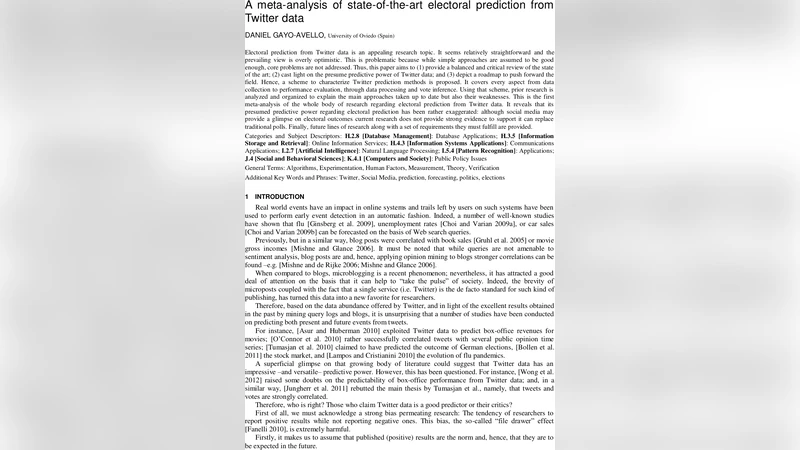
Electoral prediction from Twitter data is an appealing research topic. It seems relatively straightforward and the prevailing view is overly optimistic. This is problematic because while simple approaches are assumed to be good enough, core problems are not addressed. Thus, this paper aims to (1) provide a balanced and critical review of the state of the art; (2) cast light on the presume predictive power of Twitter data; and (3) depict a roadmap to push forward the field. Hence, a scheme to characterize Twitter prediction methods is proposed. It covers every aspect from data collection to performance evaluation, through data processing and vote inference. Using that scheme, prior research is analyzed and organized to explain the main approaches taken up to date but also their weaknesses. This is the first meta-analysis of the whole body of research regarding electoral prediction from Twitter data. It reveals that its presumed predictive power regarding electoral prediction has been rather exaggerated: although social media may provide a glimpse on electoral outcomes current research does not provide strong evidence to support it can replace traditional polls. Finally, future lines of research along with a set of requirements they must fulfill are provided.
💡 Research Summary
This paper presents the first comprehensive meta‑analysis of research that attempts to predict electoral outcomes using Twitter data. Recognizing the allure of social media as a low‑cost, real‑time source of public opinion, the authors set out to (1) provide a balanced, critical review of the state‑of‑the‑art methods, (2) assess the actual predictive power of Twitter, and (3) outline a roadmap for future work. To achieve this, they devise a four‑stage analytical scheme that covers the entire pipeline: data collection, data preprocessing, vote inference, and performance evaluation.
In the data‑collection stage, prior studies have employed keyword‑based streaming, hashtag filtering, user‑follow network sampling, and geographic or language constraints. While each approach yields large volumes of tweets, the authors highlight systematic sampling biases: reliance on specific hashtags excludes non‑participating users, follow‑network sampling over‑represents politically active or extreme accounts, and language filters can miss multilingual discourse. Consequently, the resulting tweet corpus rarely mirrors the demographic composition of the electorate.
The preprocessing stage typically involves text normalization, spam and bot removal, sentiment analysis, and topic modeling. The paper points out that bot detection remains imperfect; many automated accounts slip through filters and can artificially inflate support for a candidate. Sentiment tools, whether lexicon‑based or neural, struggle with sarcasm, idiomatic political language, and the nuanced expression of voter intent, leading to noisy sentiment scores that do not reliably map onto voting behavior.
Vote‑inference models range from the naïve “tweet count = vote share” heuristic to sophisticated machine‑learning pipelines. Linear regression, support vector machines, random forests, and deep learning architectures such as LSTMs and BERT have all been tried. However, the authors find that most models are heavily tuned to historical election data, resulting in overfitting and poor generalization to new contests. Moreover, the implicit assumption that a user’s tweet sentiment or volume directly reflects their ballot choice is rarely validated, and the literature provides scant evidence that this assumption holds across different political systems or election types.
Performance evaluation is another weak point. Studies report a variety of metrics—RMSE, MAE, accuracy, F1‑score—often without a common baseline. Some compare Twitter‑derived predictions to traditional poll results, but the comparisons are inconsistent, and cost‑benefit analyses are superficial. The lack of standardized evaluation hampers cross‑study comparisons and obscures whether any method truly outperforms conventional polling.
Synthesizing these observations, the authors argue that the perceived predictive power of Twitter has been overstated. While Twitter can offer early signals or “glimpses” of electoral trends, the current body of work does not provide robust, reproducible evidence that it can replace or even reliably augment traditional opinion polls. The paper identifies three core shortcomings: (1) sampling bias and lack of representativeness, (2) insufficient handling of automated or malicious accounts, and (3) non‑standardized, often optimistic evaluation practices.
To move the field forward, the authors propose a research agenda that includes: (a) integrating multiple social‑media platforms and offline data sources to improve representativeness; (b) developing more accurate, scalable bot and misinformation detection mechanisms; (c) applying demographic weighting and post‑stratification techniques to align Twitter samples with known electorate characteristics; (d) establishing a shared benchmark dataset and evaluation protocol to enable transparent, reproducible comparisons; and (e) exploring causal inference methods to better understand the relationship between online discourse and actual voting behavior.
In conclusion, the meta‑analysis underscores that, despite the excitement surrounding big‑data politics, Twitter alone cannot yet serve as a reliable predictor of election outcomes. It remains a valuable supplementary tool for researchers and journalists, but substantial methodological advances and rigorous validation are required before it can be considered a viable alternative to traditional polling.
Comments & Academic Discussion
Loading comments...
Leave a Comment