A Multiscale Sub-linear Time Fourier Algorithm for Noisy Data
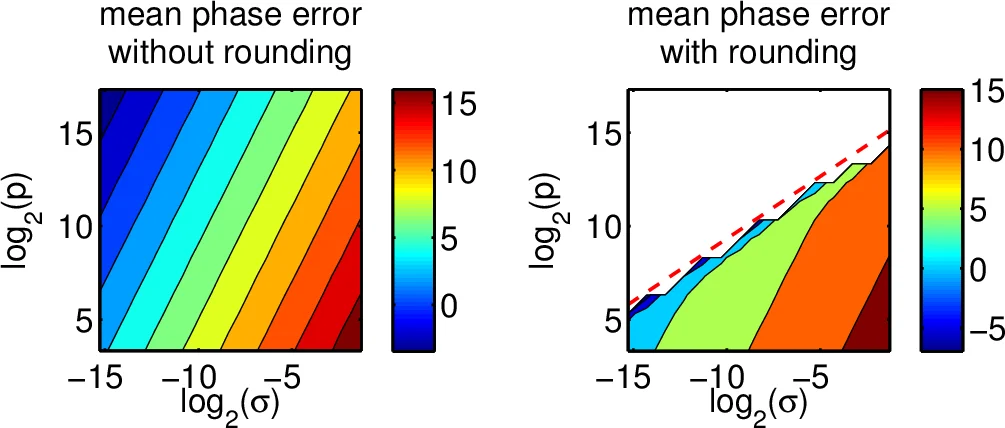
We extend the recent sparse Fourier transform algorithm of (Lawlor, Christlieb, and Wang, 2013) to the noisy setting, in which a signal of bandwidth N is given as a superposition of k « N frequencies and additive noise. We present two such extensions, the second of which exhibits a novel form of error-correction in its frequency estimation not unlike that of the beta-encoders in analog-to-digital conversion (Daubechies et al, 2006). The algorithm runs in time O(k log(k) log(N/k)) on average, provided the noise is not overwhelming. The error-correction property allows the algorithm to outperform FFTW, a highly optimized software package for computing the full discrete Fourier transform, over a wide range of sparsity and noise values, and is to the best of our knowledge novel in the sparse Fourier transform context.
💡 Research Summary
The paper addresses the problem of computing the Fourier transform of signals that are sparse in the frequency domain when the measurements are corrupted by additive noise. Building on the deterministic sub‑linear sparse Fourier transform (SFT) algorithm introduced by Lawlor, Christlieb, and Wang (2013), the authors propose two extensions that make the method robust to noise while preserving its average‑case runtime of O(k log k log(N/k)), where N is the bandwidth and k ≪ N is the sparsity level.
The first extension is a modest modification of the original algorithm. The original SFT samples the signal at two sets of equally spaced points: one set Sₚ of length p and a second set Sₚ,ε shifted by a small time offset ε. In the noiseless case the ratio of the corresponding DFT coefficients Bₚ,ε
Comments & Academic Discussion
Loading comments...
Leave a Comment