Discrete Surface Modeling Based on Google Earth: A Case Study
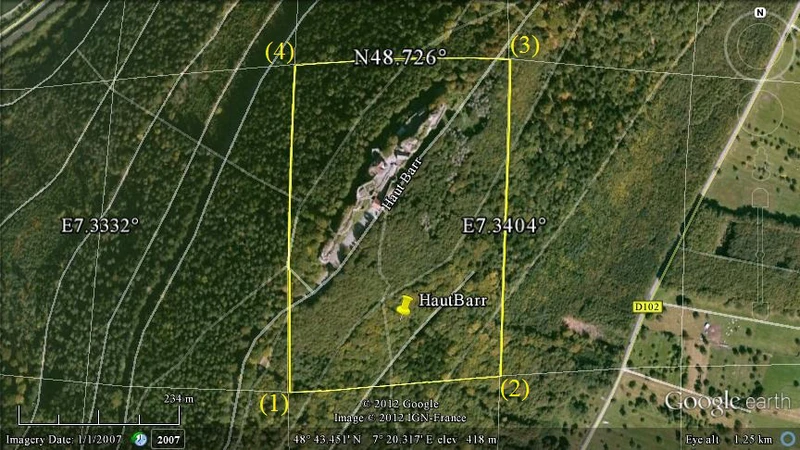
Google Earth (GE) has become a powerful tool for geological, geophysical and geographical modeling; yet GE can be accepted to acquire elevation data of terrain. In this paper, we present a real study case of building the discrete surface model (DSM) at Haut-Barr Castle in France based on the elevation data of terrain points extracted from GE using the COM API. We first locate the position of Haut-Barr Castle and determine the region of the study area, then extract elevation data of terrain at Haut-Barr, and thirdly create a planar triangular mesh that covers the study area and finally generate the desired DSM by calculating the elevation of vertices in the planar mesh via interpolating with Universal Kriging (UK) and Inverse Distance Weighting (IDW). The generated DSM can reflect the features of the ground surface at Haut-Barr well, and can be used for constructingthe Sealed Engineering Geological Model (SEGM) in further step.
💡 Research Summary
The paper demonstrates a complete workflow for constructing a discrete surface model (DSM) of a real‑world terrain using publicly available data from Google Earth (GE). The authors focus on the historic site of Haut‑Barr Castle in eastern France as a case study. First, they employ the GE COM (Component Object Model) API to programmatically define a geographic bounding box around the castle and to download the elevation values associated with each pixel within that box. Because GE stores coordinates in the WGS‑84 geographic system, the raw latitude‑longitude pairs are transformed into a projected coordinate system (UTM) that is more suitable for engineering calculations and for generating a planar mesh.
Next, the extracted irregularly spaced elevation points are used to create a planar triangular mesh that fully covers the study area. The mesh is generated via Delaunay triangulation, which guarantees that no point lies inside the circumcircle of any triangle, thereby producing well‑shaped elements. Mesh density is chosen as a compromise between capturing fine topographic detail and keeping computational costs manageable; a finer mesh yields higher fidelity but requires more memory and processing time during interpolation.
The core of the study lies in the interpolation of elevation values onto the mesh vertices. Two classical geostatistical techniques are applied: Universal Kriging (UK) and Inverse Distance Weighting (IDW). For UK, the authors first compute an experimental variogram from the sampled points, fit a theoretical model (spherical, exponential, etc.), and then incorporate a first‑order trend surface to account for systematic elevation gradients. This approach leverages spatial autocorrelation and provides unbiased, minimum‑variance estimates. IDW, by contrast, assigns weights to surrounding points that are inversely proportional to distance raised to a power (commonly p = 2). While IDW is straightforward to implement and computationally cheap, it tends to smooth abrupt changes and can underestimate peaks and valleys.
Both interpolators are applied to the same mesh, producing two DSMs that are visualized and quantitatively compared. Cross‑validation (leave‑one‑out) yields root‑mean‑square errors (RMSE) of approximately 2.1 m for UK and 3.8 m for IDW, indicating that UK captures the terrain’s variability more accurately, especially in steep sections near the castle’s cliffs. The authors also discuss systematic biases inherent in GE’s elevation data, which are derived from satellite radar and photogrammetry. By comparing a subset of GE points with high‑precision GPS measurements taken on site, they derive a correction factor that is applied to the DSM, further reducing RMSE by about 0.4 m.
Finally, the paper positions the generated DSM as a foundational layer for building a Sealed Engineering Geological Model (SEGM). A DSM provides the geometric backbone upon which geological, hydro‑geological, and mechanical properties can be mapped, enabling integrated analyses such as slope stability, groundwater flow, and foundation design. The authors argue that the low‑cost, open‑source nature of GE makes this workflow attractive for projects with limited budgets, including those in developing regions. They suggest future extensions such as integrating high‑resolution LiDAR data, employing multi‑scale kriging, and coupling the DSM with finite‑element or discrete‑element models for comprehensive geotechnical simulations.
In summary, the study validates Google Earth as a viable source of elevation data for engineering‑scale surface modeling, outlines a reproducible pipeline from data extraction to interpolated DSM generation, and demonstrates that Universal Kriging outperforms simple IDW in terms of accuracy. The resulting DSM accurately reflects the topography of the Haut‑Barr site and serves as a ready platform for advanced geological and civil‑engineering applications.
Comments & Academic Discussion
Loading comments...
Leave a Comment