For compressible fluids under shock wave reaction, we have proposed two Multiple-Relaxation-Time (MRT) Lattice Boltzmann (LB) models [F. Chen, et al, EPL \textbf{90} (2010) 54003; Phys. Lett. A \textbf{375} (2011) 2129.]. In this paper, we construct a new MRT Lattice Boltzmann model which is not only for the shocked compressible fluids, but also for the unshocked compressible fluids. To make the model work for unshocked compressible fluids, a key step is to modify the collision operators of energy flux so that the viscous coefficient in momentum equation is consistent with that in energy equation even in the unshocked system. The unnecessity of the modification for systems under strong shock is analyzed. The model is validated by some well-known benchmark tests, including (i) thermal Couette flow, (ii) Riemann problem, (iii) Richtmyer-Meshkov instability. The first system is unshocked and the latter two are shocked. In all the three systems, the Prandtl numbers effects are checked. Satisfying agreements are obtained between new model results and analytical ones or other numerical results.
Deep Dive into Prandtl number effects in MRT Lattice Boltzmann models for shocked and unshocked compressible fluids.
For compressible fluids under shock wave reaction, we have proposed two Multiple-Relaxation-Time (MRT) Lattice Boltzmann (LB) models [F. Chen, et al, EPL \textbf{90} (2010) 54003; Phys. Lett. A \textbf{375} (2011) 2129.]. In this paper, we construct a new MRT Lattice Boltzmann model which is not only for the shocked compressible fluids, but also for the unshocked compressible fluids. To make the model work for unshocked compressible fluids, a key step is to modify the collision operators of energy flux so that the viscous coefficient in momentum equation is consistent with that in energy equation even in the unshocked system. The unnecessity of the modification for systems under strong shock is analyzed. The model is validated by some well-known benchmark tests, including (i) thermal Couette flow, (ii) Riemann problem, (iii) Richtmyer-Meshkov instability. The first system is unshocked and the latter two are shocked. In all the three systems, the Prandtl numbers effects are checked. Sat
In recent years, the Lattice Boltzmann (LB) method has attracted much attention as a powerful tool in direct numerical simulation of fluid flows [1][2][3]. Unlike traditional computational fluid dynamics methods which solve macroscopic governing equations, the LB method employs the discrete Boltzmann equation which describes the fluid on the mesoscale level.
This kinetic nature provides the LB method with essential physics.
However, there are also some limitations that restrict the applications of traditional LB method, such as the numerical stability problem, the fixed Prandtl number, and so on. The stability problem has been partly addressed by a number of techniques, such as the entropic method [4,5], flux-limiter [6] and dissipation [7,8] techniques. Besides these techniques, an effective method is the Multiple Relaxation Time (MRT) LB method [9][10][11], which employs multiple relaxation parameters in the collision step, instead of the commonly used Single Relaxation Time (SRT) collision. The flexibility gained from the MRT collision can be used to improve the stability property and overcome the fixed Prandtl number problem.
To the authors’ knowledge, most of the existing MRT LB models work only for isothermal system [12][13][14][15], to cite but a few. To simulate system with temperature field, Luo, et al. [16] suggested a hybrid thermal MRT LB model, in which the mass and momentum equations are solved by the MRT model, whereas the diffusion-advection equation for the temperature is solved by Finite Difference (FD) technique or other means. Guo, et al. [17] proposed a coupling MRT LB model for thermal flows with viscous heat dissipation and compression work. Mezrhab, et al. [18] proposed a double MRT LB method, where MRT-D2Q9 model and the MRT-D2Q5 model are used to solve the flow and the temperature fields, respectively.
Besides the models mentioned above, we have proposed two MRT finite difference Lattice Boltzmann models for compressible fluids under shock in previous work [19,20]. Numerical experiments showed that compressible flows with strong shocks can be well simulated by these models. In this paper, we further propose a new MRT Lattice Boltzmann model, which is not only for the shocked compressible fluids, but also for the unshocked compressible fluids. The rest of the paper is organized as follows: In Sec. II, we present the MRT LB model. The von Neumann stability analysis is given in Section III. Simulation results are presented and analyzed in Section IV. Section V makes the conclusion.
In the MRT LB method, the evolution of the distribution function f i is governed by the following equation
where v iα is the discrete particle velocity, i = 1,. . . ,N, N is the number of discrete velocities, the subscript α indicates x or y. The variable t is time, x α is the spatial coordinate. The
is the diagonal relaxation matrix, f i and fi are the particle distribution function in the velocity space and the kinetic moment space respectively, fi = m ij f j , m ij is an element of the transformation matrix M. Obviously, the mapping between moment space and velocity space is defined by the linear transformation
, where the bold-face symbols denote N-dimensional column vectors, e.g.,
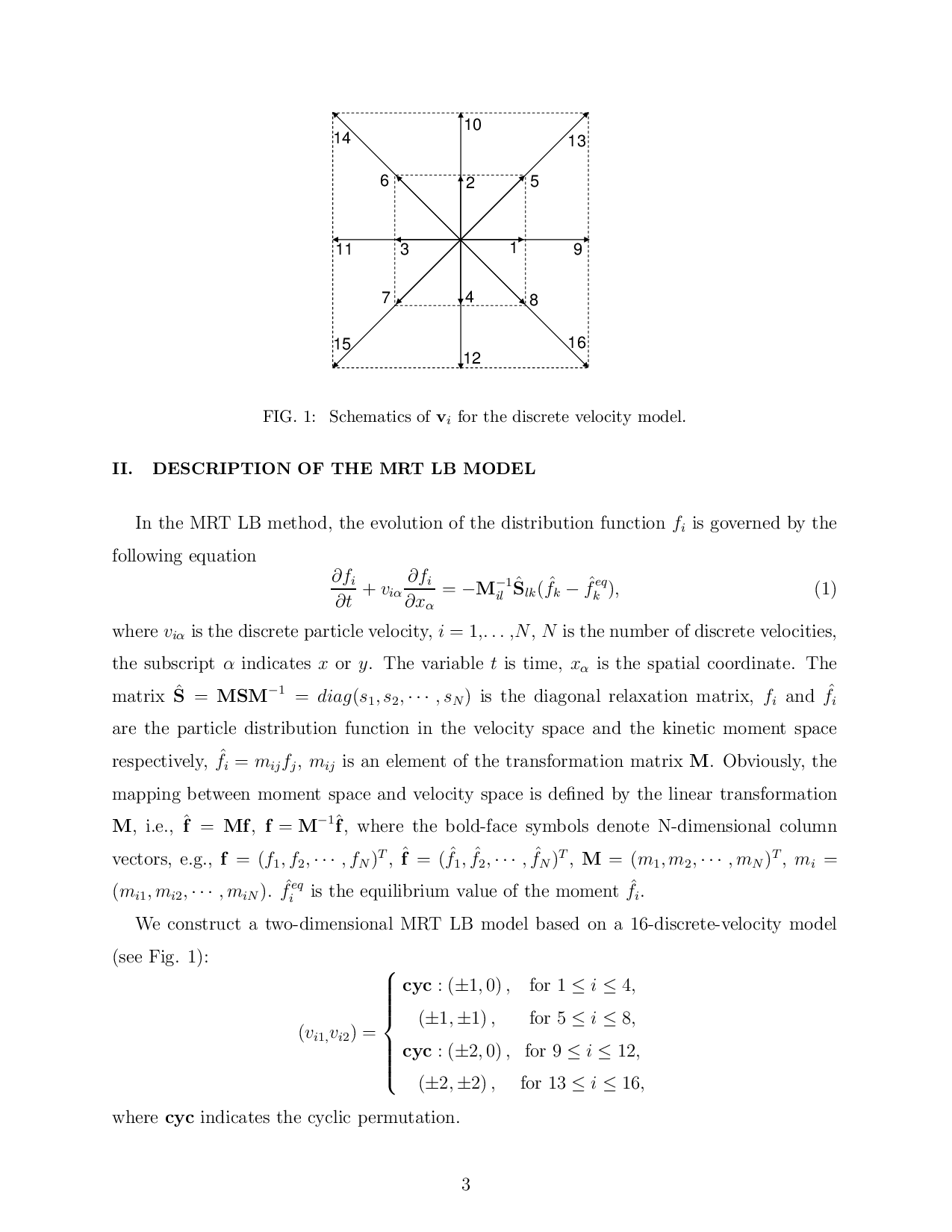
. f eq i is the equilibrium value of the moment fi . We construct a two-dimensional MRT LB model based on a 16-discrete-velocity model (see Fig. 1):
where cyc indicates the cyclic permutation.
The transformation matrix M is constructed according to the irreducible representation bases of SO(2) group, and it can be expressed as follows:
where
,
, -1, 0, 0, 0, 0, 4, -4, 4, -4, 0, 0, 0, 0), m 6 = (0, 0, 0, 0, 1, -1, 1, -1, 0, 0, 0, 0, 4, -4, 4, -4),
,
, m 13 = (1, -1, 1, -1, 0, 0, 0, 0, 16, -16, 16, -16, 0, 0, 0, 0), m 14 = (0, 0, 0, 0, 2, -2, 2, -2, 0, 0, 0, 0, 32, -32, 32, -32), m 15 = (1, 0, -1, 0, -4, 4, 4, -4, 32, 0, -32, 0, -128, 128, 128, -128), m 16 = (0, -1, 0, 1, 4, 4, -4, -4, 0, -32, 0, 32, 128, 128, -128, -128).
For two-dimensional compressible models, we have four conserved moments, density ρ, momentums j x , j y , and energy e. They are denoted by f1 , f2 , f3 and f4 , respectively.
Specifically, f1 = ρ, f2 = j x , f3 = j y , f4 = e = ρ(T + u 2 /2). Using the Chapman-Enskog expansion [13,14,21] on the two sides of LB equation, the Navier-Stokes (NS) equations for compressible fluids can be derived. The equilibria of the nonconserved moments can be chosen as
f eq 6 = j x j y /ρ, (2b)
f eq 8 = (e + ρRT )j y /ρ, (2d)
The recovered NS equations are as follows:
where
It should be pointed out that, the viscous coefficient in the energy equation (4c) is not consistent with that in the momentum equation (4b). Motivated by the idea of Guo et al.
[17], the collision operators of the moments related to the energy flux are modified:
With this modification, we are able to get the following thermohydrodynamic equations:
This modification method is also suitable for our previous MRT models [19,20]. The d
…(Full text truncated)…
This content is AI-processed based on ArXiv data.