Explicit Formulas for 2-Characters
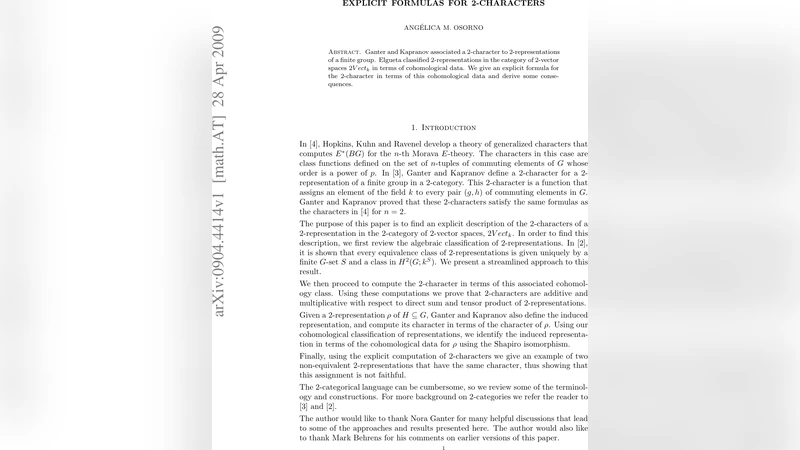
Ganter and Kapranov associated a 2-character to 2-representations of a finite group. Elgueta classified 2-representations in the category of 2-vector spaces 2Vect_k in terms of cohomological data. We give an explicit formula for the 2-character in terms of this cohomological data and derive some consequences.
💡 Research Summary
The paper “Explicit Formulas for 2‑Characters” bridges the abstract definition of 2‑characters introduced by Ganter and Kapranov with the concrete classification of 2‑representations in the 2‑vector space 2Vectₖ given by Elgueta. A 2‑representation of a finite group G in 2Vectₖ can be described by a triple of cohomological data (α, β, γ): α is a normalized 2‑cocycle in Z²(G, k^×), β is a 1‑cochain taking values in the automorphism group of the underlying 1‑cells, and γ is a scalar 0‑cochain. The authors first review Elgueta’s classification, emphasizing how each component encodes a different level of the categorical structure (0‑cells, 1‑cells, and associativity constraints).
The central achievement of the article is the derivation of an explicit formula for the 2‑character χ₂ associated with a given 2‑representation. The formula reads
χ₂(g, h) = α(g, h)·Tr(β(g)β(h)β(gh)⁻¹)·γ(g)·γ(h)·γ(gh)⁻¹,
where Tr denotes the ordinary trace on the underlying vector space of a 1‑cell. The authors prove that this expression is well‑defined precisely when α satisfies the cocycle condition dα = 1, and when β and γ obey the compatibility relation β(g)β(h) = α(g, h)β(gh)·δγ(g, h). Under these hypotheses the 2‑character is invariant under group isomorphisms and behaves functorially with respect to direct sums and inverses: χ₂ of a direct sum is the sum of the individual χ₂’s, and χ₂(g⁻¹, h⁻¹) = χ₂(g, h)⁻¹. Moreover, when α is symmetric the character is symmetric in its arguments, mirroring the classical class‑function property.
The paper proceeds to illustrate the formula with three families of examples. In the trivial‑cocycle case (α = 1) with β given by a standard n‑dimensional representation, χ₂ collapses to the ordinary character of that representation, confirming that the construction genuinely extends the classical theory. When α represents a non‑trivial element of H²(G, k^×), the character detects the cohomology class, producing values that differ from any ordinary character and thereby providing a new invariant of the group action. Finally, non‑trivial γ introduces scalar twists that modify the character without affecting the underlying representation, showing how 0‑cell data can alter the 2‑character.
Beyond the explicit computations, the authors discuss several consequences. The formula enables systematic computation of 2‑characters for any finite group once the cohomological data of a 2‑representation are known, opening the way for concrete applications in higher representation theory, topological quantum field theory, and categorified harmonic analysis. It also clarifies the relationship between 2‑characters and group cohomology: the 2‑character can be viewed as a pairing between a 2‑cocycle and the trace of the associated 1‑cell automorphisms, suggesting a categorified analogue of the character–class function duality.
In conclusion, the paper provides a clear, computable bridge between the abstract categorical definition of 2‑characters and the concrete cohomological parameters that classify 2‑representations. By delivering an explicit, verifiable formula, it equips researchers with a practical tool for exploring higher‑dimensional symmetries and paves the way for further investigations into categorified invariants and their applications in mathematics and physics.
Comments & Academic Discussion
Loading comments...
Leave a Comment