Fluctuation-Induced Phenomena in Nanoscale Systems: Harnessing the Power of Noise
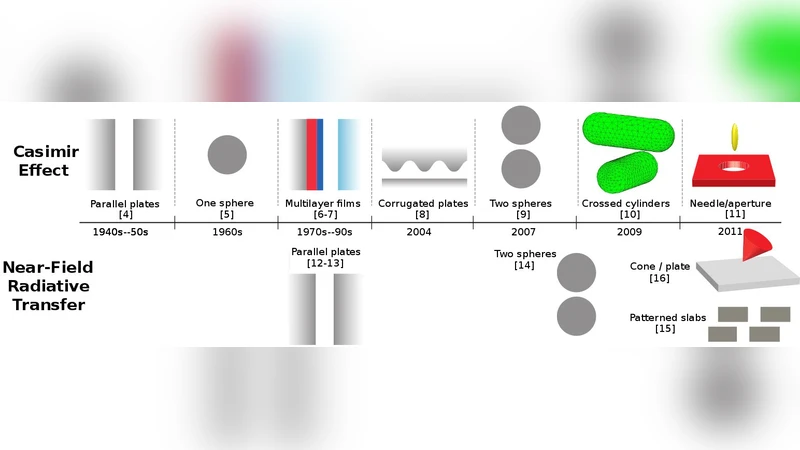
The famous Johnson-Nyquist formula relating noise current to conductance has a microscopic generalization relating noise current density to microscopic conductivity, with corollary relations governing noise in the components of the electromagnetic fields. These relations, known collectively in physics as fluctuation-dissipation relations, form the basis of the modern understanding of fluctuation-induced phenomena, a field of burgeoning importance in experimental physics and nanotechnology. In this review, we survey recent progress in computational techniques for modeling fluctuation-induced phenomena, focusing on two cases of particular interest: near-field radiative heat transfer and Casimir forces. In each case we review the basic physics of the phenomenon, discuss semi-analytical and numerical algorithms for theoretical analysis, and present recent predictions for novel phenomena in complex material and geometric configurations.
💡 Research Summary
The paper provides a comprehensive review of fluctuation‑induced phenomena in nanoscale systems, focusing on how the fluctuation‑dissipation theorem (FDT) extends the classic Johnson‑Nyquist relation to a microscopic description of current‑density noise and, consequently, to the statistical properties of the electromagnetic field. By expressing the current‑density correlation function in terms of the spatially non‑local conductivity tensor, the authors show that both electric‑field and magnetic‑field fluctuations can be derived directly from material response functions. This formalism underpins the modern understanding of two flagship nanoscale effects: near‑field radiative heat transfer (NFRHT) and Casimir forces.
In the NFRHT section, the review explains that at sub‑wavelength separations (tens of nanometers) the heat flux is dominated by evanescent surface modes such as surface phonon‑polaritons and surface plasmon‑polaritons. Using the FDT‑derived fluctuating current sources, the heat transfer can be written in a Landauer‑like form involving transmission matrices that encode multiple scattering between bodies. The authors survey three main computational strategies: (i) semi‑analytical scattering‑matrix methods that treat planar or multilayered geometries, (ii) boundary‑element methods (BEM) that solve the full dyadic Green’s function for arbitrarily shaped objects, and (iii) the fluctuating‑surface‑current (FSC) approach, which recasts the problem into surface‑integral equations amenable to fast solvers. They highlight recent advances that incorporate anisotropic, non‑reciprocal, and hyperbolic materials, enabling predictions of thermal rectification, heat‑flux steering, and even thermal diodes based on graphene/h‑BN heterostructures.
The Casimir‑force portion begins with Lifshitz theory for planar slabs and then moves to more general geometries where the force is obtained from the electromagnetic stress tensor integrated over a surface surrounding one of the bodies. The review details how the same fluctuating current formalism leads to a trace‑log expression for the Casimir energy, which can be evaluated using (a) matrix‑determinant techniques for multiple scattering, (b) BEM‑based stress‑tensor calculations, and (c) hybrid methods that combine modal expansions with surface‑integral equations. Special attention is given to non‑reciprocal media (e.g., magneto‑optical materials) and two‑dimensional anisotropic crystals, where the current‑density correlation tensor becomes asymmetric, giving rise to directional heat transfer and repulsive Casimir forces at specific separations. Recent numerical studies cited in the review predict distance‑dependent force sign changes in superconductor–metal configurations and torque‑inducing Casimir effects in chiral metamaterials.
Beyond the technical exposition, the authors discuss emerging research directions. They argue that incorporating quantum‑fluctuation effects beyond thermal equilibrium, developing non‑equilibrium Green’s‑function frameworks, and leveraging machine‑learning‑driven surrogate models for rapid geometry optimization will be crucial for designing “noise‑engineered” nanodevices. Potential applications include contactless actuation in MEMS/NEMS, on‑chip thermal management via radiative diodes, and quantum information platforms that exploit controlled vacuum fluctuations. In summary, the paper positions the fluctuation‑dissipation theorem as the unifying principle that, when coupled with state‑of‑the‑art computational electromagnetics, enables accurate prediction and purposeful exploitation of noise‑driven forces and energy flows at the nanoscale.