Turing Machines and Understanding Computational Complexity
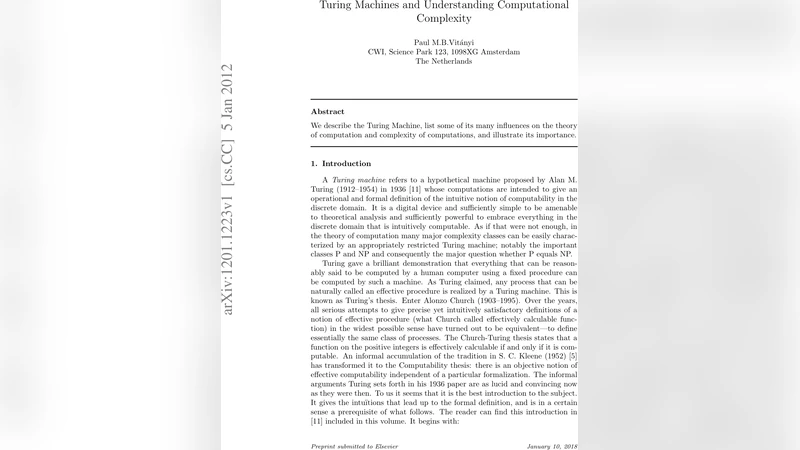
We describe the Turing Machine, list some of its many influences on the theory of computation and complexity of computations, and illustrate its importance.
💡 Research Summary
The paper “Turing Machines and Understanding Computational Complexity” offers a comprehensive, mathematically rigorous exposition of the Turing machine (TM) and demonstrates how this abstract model underpins virtually every major concept in theoretical computer science, from decidability to the modern hierarchy of complexity classes. It begins with a formal definition of a deterministic TM as a 7‑tuple (Q, Σ, Γ, δ, q₀, B, F), where Q is a finite set of states, Σ the input alphabet, Γ the tape alphabet (including the blank symbol B), δ the transition function Q × Γ → Q × Γ × {L,R, S}, q₀ the start state, and F the set of accepting states. The authors carefully contrast this with the nondeterministic TM (NDTM), whose transition relation allows multiple possible moves from a given configuration, and they explain why nondeterminism does not increase the class of languages that can be recognized but can dramatically affect resource bounds.
The next section situates the TM within the broader landscape of computability theory. By invoking the Church‑Turing thesis, the paper argues that any effectively calculable function can be realized by a TM, establishing the notion of “Turing completeness.” The authors revisit Alan Turing’s original proof of the undecidability of the Halting Problem, using a diagonalization argument that directly leverages the self‑reference capability of TMs. This result, together with reductions to other canonical undecidable problems (e.g., Post’s Correspondence Problem), illustrates how the TM provides a universal language for proving impossibility results.
Having laid the groundwork for what can be computed, the paper turns to how efficiently it can be computed. Time complexity T(n) is defined as the maximum number of transition steps a TM makes on any input of length n, while space complexity S(n) counts the number of tape cells visited. These definitions give rise to the classic complexity classes: P (polynomial‑time deterministic), NP (polynomial‑time nondeterministic), PSPACE (polynomial‑space deterministic), and EXPTIME (exponential‑time deterministic). The authors meticulously derive the inclusion chain P ⊆ NP ⊆ PSPACE ⊆ EXPTIME and discuss the strictness of each inclusion using the time‑hierarchy theorem (which shows that for any time‑constructible functions f and g with f(n) = o(g(n)/log g(n)), there exists a language decidable in O(g(n)) time but not in O(f(n)) time) and the space‑hierarchy theorem (analogous for space bounds).
A central pillar of the discussion is the universal Turing machine (UTM). By encoding the description of any TM and its input onto a single tape, the UTM can simulate the behavior of that TM step‑by‑step. The paper emphasizes that the existence of a UTM formalizes the modern software paradigm: programs are data, compilers are translators, and self‑replicating code becomes a natural consequence of the model. This universality also underlies the concept of “Turing reductions,” which are used throughout complexity theory to compare problem hardness.
The most celebrated open question in the field, the P versus NP problem, receives a dedicated treatment. The authors explain that NP can be characterized either as the set of languages for which a nondeterministic TM decides membership in polynomial time, or equivalently as the set of languages possessing polynomial‑size certificates verifiable by a deterministic TM in polynomial time. They then introduce the notion of NP‑completeness, describing the Cook‑Levin theorem that SAT (Boolean satisfiability) is NP‑complete, and illustrating polynomial‑time many‑one reductions from SAT to classic problems such as CLIQUE, Hamiltonian Path, and 3‑Coloring. The paper stresses that if any NP‑complete problem were shown to belong to P, the entire class NP would collapse to P, thereby resolving the P = NP question.
Beyond decision problems, the authors explore the implications of TM‑based complexity for algorithm design and practical computing. They argue that asymptotic analysis of algorithms—big‑O notation, worst‑case versus average‑case behavior—originates from the TM resource model, providing a language‑independent benchmark for comparing implementations across hardware platforms. Moreover, the paper highlights applications in cryptography (where hardness assumptions are often phrased as “no polynomial‑time TM can solve X”), optimization (e.g., approximation algorithms for NP‑hard problems), and emerging areas such as quantum computation, where the quantum analogue of the TM (the quantum Turing machine) inherits many of the same structural properties.
In the concluding section, the authors synthesize the narrative: the Turing machine is not merely a historical curiosity but a living, unifying framework that continues to shape our understanding of what can be computed, how efficiently it can be done, and where the frontiers of computational difficulty lie. By tracing the evolution from Turing’s 1936 paper to contemporary complexity theory, the article demonstrates that every major breakthrough—undecidability proofs, the development of complexity hierarchies, the formulation of the P vs NP problem, and the design of universal computers—rests on the simple yet profound abstraction of a finite control interacting with an infinite tape. This enduring relevance underscores why Turing’s model remains the cornerstone of theoretical computer science nearly a century after its inception.