Excluded Forest Minors and the ErdH{o}s-Posa Property
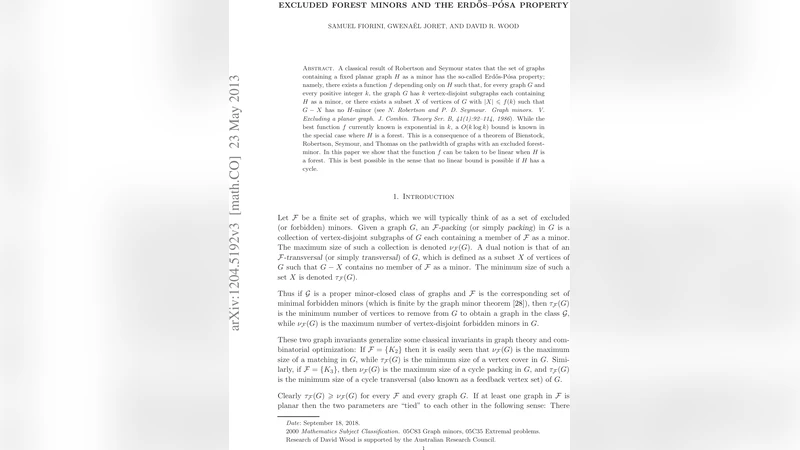
A classical result of Robertson and Seymour states that the set of graphs containing a fixed planar graph $H$ as a minor has the so-called Erd\H{o}s-P'osa property; namely, there exists a function $f$ depending only on $H$ such that, for every graph $G$ and every positive integer $k$, the graph $G$ has $k$ vertex-disjoint subgraphs each containing $H$ as a minor, or there exists a subset $X$ of vertices of $G$ with $|X| \leq f(k)$ such that $G - X$ has no $H$-minor. While the best function $f$ currently known is exponential in $k$, a $O(k \log k)$ bound is known in the special case where $H$ is a forest. This is a consequence of a theorem of Bienstock, Robertson, Seymour, and Thomas on the pathwidth of graphs with an excluded forest-minor. In this paper we show that the function $f$ can be taken to be linear when $H$ is a forest. This is best possible in the sense that no linear bound is possible if $H$ has a cycle.
💡 Research Summary
The paper investigates the Erdős‑Pósa property for graph minors when the excluded minor is a forest. The classical Erdős‑Pósa theorem, proved by Robertson and Seymour, guarantees that for any fixed planar graph (H) there exists a function (f(k)) such that every graph (G) either contains (k) vertex‑disjoint subgraphs each having an (H)-minor, or there is a vertex set (X) with (|X|\le f(k)) whose removal destroys all (H)-minors. The best known bound for a general planar (H) is exponential in (k); for forests the bound improves to (O(k\log k)) thanks to a theorem of Bienstock, Robertson, Seymour, and Thomas linking excluded forest‑minors to bounded pathwidth.
The main contribution of this work is to show that when (H) is a forest the function (f) can be taken linear in (k). Formally, for every fixed forest (H) there exists a constant (c_H) such that for any graph (G) and any integer (k\ge 1) either:
- (G) contains (k) pairwise vertex‑disjoint subgraphs each containing (H) as a minor, or
- there is a vertex set (X\subseteq V(G)) with (|X|\le c_H k) whose removal leaves a graph with no (H)-minor.
The proof proceeds in two complementary parts. First, the authors strengthen the known relationship between pathwidth and excluded minors: they prove that if a graph has pathwidth at least (\alpha_H k) (for a constant (\alpha_H) depending only on (H)), then it necessarily contains (k) vertex‑disjoint (H)-minors. This is achieved by constructing a collection of “well‑linked” substructures inside a large‑width path decomposition and showing that each can be contracted to a copy of the forest.
Second, they handle the case of small pathwidth. When (\operatorname{pw}(G)\le \beta_H k) (with (\beta_H) another constant), the graph admits a tree‑decomposition whose bags have size (O(k)). Using this decomposition they design a hitting‑set algorithm: by a careful bottom‑up dynamic programming over the tree, they select a set of vertices intersecting every possible (H)-minor. The size of this hitting set is bounded by (\gamma_H k) for a constant (\gamma_H) depending only on the forest. The constants (\alpha_H,\beta_H,\gamma_H) are all independent of the input graph, establishing the linear bound.
An important corollary is an explicit polynomial‑time algorithm: given (G) and (k), one can either exhibit (k) disjoint (H)-minors or produce a vertex set of size at most (c_H k) whose removal eliminates all (H)-minors. The algorithm runs in time polynomial in (|V(G)|) and uses known fixed‑parameter tractable procedures for computing pathwidth and tree‑decompositions.
The authors also argue optimality. For any graph (H) containing a cycle, previous work shows that any Erdős‑Pósa function must be at least (\Omega(k\log k)). Hence the linear bound is exclusive to forest minors and cannot be extended to more general planar minors.
In the discussion, the paper outlines several directions for future research. One line is to identify other minor‑closed families (for example, graphs of bounded treewidth or bounded genus) where a linear Erdős‑Pósa function might hold. Another is to explore practical applications, such as network reliability or graph editing, where a small hitting set for a forbidden forest structure can be computed efficiently. Finally, the authors suggest that the refined pathwidth‑minor relationship could inspire new parameterized algorithms for problems that are otherwise hard on general graphs.
Overall, the paper settles a long‑standing gap in the theory of Erdős‑Pósa properties by proving that excluded forest minors admit a tight linear bound, thereby sharpening our understanding of the interplay between graph structure, minor containment, and combinatorial packing‑covering dualities.