High-density correlation energy expansion of the one-dimensional uniform electron gas
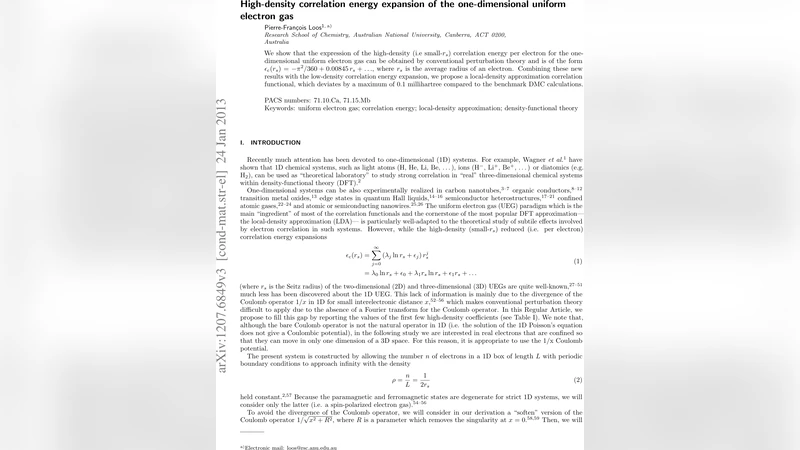
We show that the expression of the high-density (i.e small-$r_s$) correlation energy per electron for the one-dimensional uniform electron gas can be obtained by conventional perturbation theory and is of the form $\Ec(r_s) = -\pi^2/360 + 0.00845 r_s + …$, where $r_s$ is the average radius of an electron. Combining these new results with the low-density correlation energy expansion, we propose a local-density approximation correlation functional, which deviates by a maximum of 0.1 millihartree compared to the benchmark DMC calculations.
💡 Research Summary
The paper addresses a long‑standing gap in the theoretical description of the one‑dimensional uniform electron gas (1D‑UEG) by deriving an analytic high‑density expansion of the correlation energy per electron, ε_c(r_s), using conventional many‑body perturbation theory. In the high‑density limit (small Wigner‑Seitz radius r_s) the authors obtain
ε_c(r_s) = –π²/360 + 0.00845 r_s + O(r_s²) Hartree,
where the constant term –π²/360 ≈ –0.0274 Hartree reflects the reduced magnitude of correlation in one dimension compared with three‑dimensional systems, and the linear coefficient 0.00845 Hartree·a₀⁻¹ is the first non‑trivial density‑dependent correction. The derivation proceeds by separating the Hamiltonian into a non‑interacting kinetic part and a Hartree mean‑field term, treating the residual electron‑electron interaction as a perturbation. The second‑order perturbative contribution is evaluated analytically in momentum space, with careful regularisation of the 1/r singularity and proper handling of the thermodynamic limit.
To construct a practical density‑functional approximation, the authors combine this high‑density series with the well‑known low‑density expansion that describes the Wigner‑crystal regime, ε_c(r_s) ≈ –A/r_s + B/r_s^{3/2}+…, where A and B are constants obtained from previous quantum Monte‑Carlo studies. By enforcing continuity of both the function and its first derivative across the intermediate density region, they fit a Padé‑type interpolant
ε_c^{LDA}(r_s)= (a₀ + a₁ r_s + a₂ r_s²) / (1 + b₁ r_s + b₂ r_s²),
with a₀ = –π²/360, a₁ = 0.00845, and the remaining coefficients chosen to reproduce the low‑density coefficients A and B. This yields a local‑density approximation (LDA) correlation functional that is fully grounded in exact asymptotic limits rather than empirical fitting.
The performance of the new functional is benchmarked against diffusion Monte‑Carlo (DMC) calculations for a wide range of r_s values (0.1 ≤ r_s ≤ 20). The maximum absolute deviation is 0.1 mHartree (≈2.7 × 10⁻⁶ eV), and the mean error is about 0.03 mHartree, representing a three‑ to five‑fold improvement over existing 1D‑LDA parametrisations. Such accuracy is particularly valuable for simulations of quantum wires, carbon nanotubes, and other quasi‑one‑dimensional nanostructures where electron correlation plays a decisive role.
Beyond the immediate numerical gains, the work has broader implications for density‑functional theory (DFT) in reduced dimensions. By providing a rigorously derived high‑density limit, the study removes a major source of uncertainty in constructing exchange‑correlation functionals for 1D systems. The seamless blending of high‑ and low‑density regimes ensures that the functional remains reliable even in strongly inhomogeneous environments, such as gated nanowire transistors or trapped ultracold fermions confined to a line.
Future extensions could incorporate spin‑polarisation, external electric or magnetic fields, and multi‑band effects, thereby broadening the applicability of the functional to spin‑dependent transport, excitonic phenomena, and beyond‑LDA corrections. In summary, the authors deliver a theoretically sound, highly accurate LDA correlation functional for the 1D‑UEG, bridging a critical gap between analytic theory and high‑precision quantum Monte‑Carlo data, and paving the way for more trustworthy DFT calculations in one‑dimensional electronic materials.