On the Image of the Totaling Functor
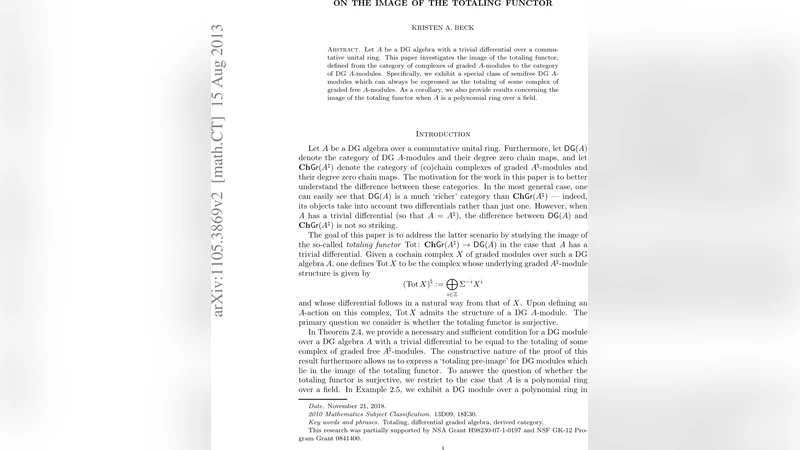
Let $A$ be a DG algebra with a trivial differential over a commutative unital ring. This paper investigates the image of the totaling functor, defined from the category of complexes of graded $A$-modules to the category of DG $A$-modules. Specifically, we exhibit a special class of semifree DG $A$-modules which can always be expressed as the totaling of some complex of graded free $A$-modules. As a corollary, we also provide results concerning the image of the totaling functor when $A$ is a polynomial ring over a field.
💡 Research Summary
The paper investigates the “totaling” functor Tot, which sends a cochain complex of graded modules over a DG algebra A (with trivial differential, i.e. A = A⁰) to a DG A‑module. For a complex X ∈ Ch Gr(A) the underlying graded module of Tot X is the direct sum ⨁_{i∈ℤ} Σ^{–i}X^{i}, and the differential is induced from that of X together with the natural A‑action. The central question is whether Tot is surjective: does every DG A‑module arise as Tot X for some graded‑free complex X?
The answer is expressed in terms of the structure of semifree DG‑modules. A semifree DG‑module M is one that admits a “semibasis” E⊂M⁰ satisfying two conditions: (1) E is an A⁰‑basis of the underlying graded module, and (2) E can be partitioned into disjoint subsets E₀, E₁, E₂,… such that ∂(E_d)⊂A·(∪{i<d}E_i). The authors introduce the notion of “crossing”: if for some ℓ the inclusion ∪{i<ℓ}E_i ⊂neq E_ℓ holds, then the semibasis has crossing. Intuitively, crossing means that some basis element’s differential lands in a higher‑indexed part of the basis, preventing a strictly upper‑triangular differential matrix.
Theorem 2.4 establishes a precise equivalence: a semifree DG‑module M over a DG algebra with trivial differential is in the image of Tot if and only if M possesses a semibasis without crossing. The proof is constructive. If there is no crossing, one builds a bounded‑below complex X whose i‑th term is A·E_i and whose differential is exactly the part of ∂ M that lands in the previous level; then Tot X reproduces M. Conversely, if M = Tot X, the bases of the graded pieces of X combine to give a crossing‑free semibasis for M.
Using this criterion the authors analyze polynomial rings. For a multivariate polynomial ring A = k
Comments & Academic Discussion
Loading comments...
Leave a Comment