Hirota equation and the quantum plane
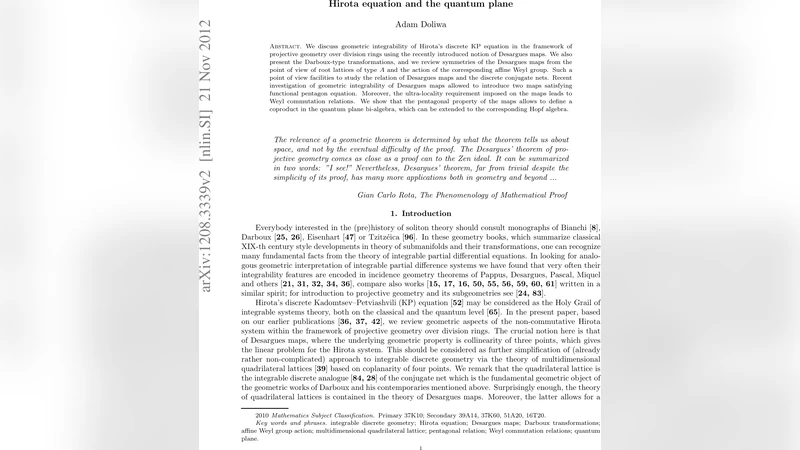
We discuss geometric integrability of Hirota’s discrete KP equation in the framework of projective geometry over division rings using the recently introduced notion of Desargues maps. We also present the Darboux-type transformations, and we review symmetries of the Desargues maps from the point of view of root lattices of type A and the action of the corresponding affine Weyl group. Such a point of view facilities to study the relation of Desargues maps and the discrete conjugate nets. Recent investigation of geometric integrability of Desargues maps allowed to introduce two maps satisfying functional pentagon equation. Moreover, the ultra-locality requirement imposed on the maps leads to Weyl commutation relations. We show that the pentagonal property of the maps allows to define a coproduct in the quantum plane bi-algebra, which can be extended to the corresponding Hopf algebra.
💡 Research Summary
The paper investigates the geometric integrability of Hirota’s discrete KP equation by embedding it in the framework of projective geometry over division rings and by employing the recently introduced concept of Desargues maps. A Desargues map is a configuration of points on a lattice that satisfies the classical Desargues theorem; such maps are naturally indexed by the A‑type root lattice and inherit the action of the affine Weyl group of type A. The authors first recast Hirota’s equation as a compatibility condition for these maps, showing that the nonlinear difference relations are equivalent to the preservation of the Desargues configuration under lattice shifts.
Next, they construct Darboux‑type transformations for Desargues maps. These transformations generate new solutions from given ones and are shown to be precisely the elementary reflections and translations of the affine Weyl group. Consequently, the symmetry group of the discrete system is identified with the affine Weyl group, and the associated root‑lattice structure provides a convenient algebraic language for describing the transformations.
The paper then relates Desargues maps to discrete conjugate nets, emphasizing that both structures encode planar quadrilateral compatibility but differ in the emphasis on point‑collinearity versus face‑planarity. By bridging the two viewpoints, the authors demonstrate that Hirota’s equation can be interpreted both as a discrete conjugate net condition and as a Desargues‑map invariance condition.
A central contribution is the introduction of two functional maps that satisfy the pentagon equation, a higher‑dimensional analogue of the Yang–Baxter equation. These maps act on the variables attached to lattice edges and obey a functional identity of the form
(R_{12}R_{13}R_{23}=R_{23}R_{12}).
Imposing an ultra‑locality requirement—namely that variables attached to distinct lattice sites commute—forces the variables to obey Weyl commutation relations (xy = q, yx) with a non‑zero scalar parameter (q). This is precisely the defining relation of the quantum plane, a basic example of a non‑commutative algebra.
Using the pentagon‑satisfying maps, the authors define a coproduct on the quantum plane algebra. The coproduct (\Delta) respects the pentagon identity, guaranteeing coassociativity ((\Delta\otimes\mathrm{id})\Delta = (\mathrm{id}\otimes\Delta)\Delta). By adding an appropriate counit and antipode, the structure is extended to a full Hopf algebra. Thus the paper provides a concrete route from a classical integrable lattice equation to a quantum group‑like algebraic structure.
In the concluding discussion, the authors highlight that their work unifies three seemingly disparate areas: discrete integrable systems (via Hirota’s equation), projective geometry (through Desargues maps and root‑lattice symmetries), and quantum algebra (through Weyl commutation, pentagon equations, and Hopf algebra structures). This synthesis suggests new avenues for studying quantum integrable models, for constructing quantum analogues of classical geometric transformations, and for exploring the role of affine Weyl groups in non‑commutative geometry. The paper thus opens a promising interdisciplinary pathway linking discrete geometry, algebraic combinatorics, and quantum algebra.