On the regular representation of an (essentially) finite 2-group
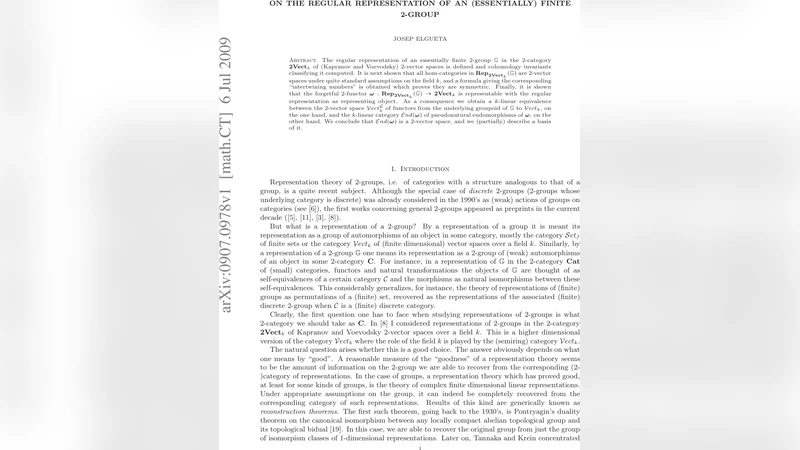
The regular representation of an essentially finite 2-group $\mathbb{G}$ in the 2-category $\mathbf{2Vect}k$ of (Kapranov and Voevodsky) 2-vector spaces is defined and cohomology invariants classifying it computed. It is next shown that all hom-categories in $\mathbf{Rep}{\mathbf{2Vect}k}(\mathbb{G})$ are 2-vector spaces under quite standard assumptions on the field $k$, and a formula giving the corresponding “intertwining numbers” is obtained which proves they are symmetric. Finally, it is shown that the forgetful 2-functor ${\boldmath$\omega$}:\mathbf{Rep}{\mathbf{2Vect}_k}(\mathbb{G})\To\mathbf{2Vect}_k$ is representable with the regular representation as representing object. As a consequence we obtain a $k$-linear equivalence between the 2-vector space $\mathbf{Vect}_k^{\mathcal{G}}$ of functors from the underlying groupoid of $\mathbb{G}$ to $\mathbf{Vect}_k$, on the one hand, and the $k$-linear category $\mathcal{E} nd({\boldmath$\omega$})$ of pseudonatural endomorphisms of ${\boldmath$\omega$}$, on the other hand. We conclude that $\mathcal{E} nd({\boldmath$\omega$})$ is a 2-vector space, and we (partially) describe a basis of it.
💡 Research Summary
The paper develops a comprehensive theory of the regular representation of an essentially finite 2‑group 𝔾 within the 2‑category 𝟚Vectₖ of Kapranov‑Voevodsky 2‑vector spaces. An essentially finite 2‑group is a group‑object in groupoids whose set of connected components π₀(𝔾) and all homotopy groups π₁(𝔾,x) are finite, while the second homotopy group π₂(𝔾) is a finite‑dimensional k‑vector space. The authors first recall the necessary background on 2‑groups and on 2‑vector spaces, emphasizing that 𝟚Vectₖ is a k‑linear 2‑category whose objects are finite direct sums of ordinary vector spaces, 1‑morphisms are k‑linear functors, and 2‑morphisms are natural transformations.
The regular representation ℛ: 𝔾 → 𝟚Vectₖ is defined by sending every object of 𝔾 to the one‑dimensional vector space k, every 1‑morphism to the identity linear map on k, and every 2‑morphism to the identity natural transformation. In this way ℛ becomes a free 2‑vector space equipped with a canonical 𝔾‑action; it plays the same universal role as the classical regular representation of a finite group. The authors prove that ℛ generates the entire 2‑representation category Rep_{𝟚Vectₖ}(𝔾) under finite direct sums and tensor products.
A central result is the classification of ℛ by cohomological invariants. The third cohomology group H³(𝔾, k^×) classifies equivalence classes of 2‑representations of 𝔾, and the paper computes this group explicitly using the 2‑Cochain complex associated with 𝔾. The regular representation corresponds to a specific 3‑cocycle α∈Z³(𝔾, k^×); two regular representations are equivalent precisely when their associated cocycles differ by a coboundary. Thus the cohomology class
Comments & Academic Discussion
Loading comments...
Leave a Comment