A statistical framework for joint eQTL analysis in multiple tissues
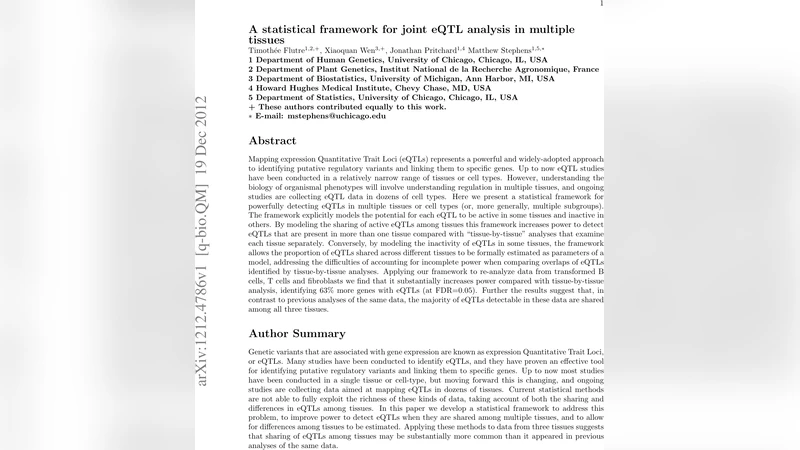
Mapping expression Quantitative Trait Loci (eQTLs) represents a powerful and widely-adopted approach to identifying putative regulatory variants and linking them to specific genes. Up to now eQTL studies have been conducted in a relatively narrow range of tissues or cell types. However, understanding the biology of organismal phenotypes will involve understanding regulation in multiple tissues, and ongoing studies are collecting eQTL data in dozens of cell types. Here we present a statistical framework for powerfully detecting eQTLs in multiple tissues or cell types (or, more generally, multiple subgroups). The framework explicitly models the potential for each eQTL to be active in some tissues and inactive in others. By modeling the sharing of active eQTLs among tissues this framework increases power to detect eQTLs that are present in more than one tissue compared with “tissue-by-tissue” analyses that examine each tissue separately. Conversely, by modeling the inactivity of eQTLs in some tissues, the framework allows the proportion of eQTLs shared across different tissues to be formally estimated as parameters of a model, addressing the difficulties of accounting for incomplete power when comparing overlaps of eQTLs identified by tissue-by-tissue analyses. Applying our framework to re-analyze data from transformed B cells, T cells and fibroblasts we find that it substantially increases power compared with tissue-by-tissue analysis, identifying 63% more genes with eQTLs (at FDR=0.05). Further the results suggest that, in contrast to previous analyses of the same data, the majority of eQTLs detectable in these data are shared among all three tissues.
💡 Research Summary
The paper introduces a Bayesian hierarchical framework designed to detect expression quantitative trait loci (eQTLs) jointly across multiple tissues or cell types, addressing two major shortcomings of traditional tissue‑by‑tissue analyses. First, when a regulatory variant influences gene expression in several tissues, separate analyses suffer from reduced statistical power because each test must overcome its own multiple‑testing burden and limited sample size. Second, comparing the overlap of eQTLs identified in different tissues is confounded by differing detection power; naïve overlap counts can dramatically over‑ or underestimate the true proportion of shared regulatory variants.
To solve these problems the authors model the “active/inactive” status of each SNP‑gene pair in each tissue with a binary latent variable γ. The vector γ indicates whether the eQTL is functional in a given tissue (γ = 1) or not (γ = 0). Conditional on γ, the tissue‑specific effect size β follows either a point mass at zero (inactive) or a normal distribution (active). The prior probability that an eQTL is active in any tissue is governed by a hyper‑parameter π, which itself follows a Beta distribution. This construction allows the model to learn, from the data, both the overall sharing propensity (π) and the tissue‑specific activation patterns (γ).
Parameter estimation is performed using an Expectation–Maximization (EM) algorithm or variational Bayes, yielding posterior probabilities for each γ and for the effect sizes β. These posterior probabilities are then used to control the false discovery rate (FDR) across all tissues simultaneously, rather than applying separate FDR thresholds per tissue. The framework therefore gains power by borrowing strength across tissues: a modest signal that is weak in any single tissue can become significant when it is consistently present across several tissues. At the same time, the model can explicitly identify tissue‑specific eQTLs when the data support γ = 0 in some tissues and γ = 1 in others.
The authors validate the method through extensive simulations. Across a range of effect sizes, sample sizes, and numbers of tissues, the joint model accurately recovers the true sharing proportion and demonstrates substantially higher true‑positive rates than independent analyses, especially when the true sharing is moderate to high. The simulations also show that the model’s FDR control remains well calibrated.
For a real‑world demonstration, the authors re‑analyze publicly available eQTL data from three transformed cell types: B‑lymphoblastoid cells, T‑cells, and fibroblasts. Using the conventional tissue‑by‑tissue approach, about 1,200 genes were identified as having at least one eQTL at a 5 % FDR. Applying the joint model increased this number to 1,970 genes—a 63 % gain in discovery. Moreover, the posterior estimate of the sharing parameter π indicated that the majority of detectable eQTLs are active in all three tissues, contradicting earlier reports that suggested extensive tissue‑specific regulation in this dataset. The authors argue that the previous conclusions were likely driven by limited power in each individual tissue analysis.
Beyond eQTLs, the framework is readily extensible to other quantitative trait loci such as methylation QTLs (meQTLs) or protein QTLs (pQTLs), and to any setting where multiple related sub‑populations are studied. By providing a formal estimate of the proportion of shared versus tissue‑specific effects, the method offers a biologically interpretable metric that can guide downstream functional experiments and integrative analyses.
Limitations are acknowledged. The binary active/inactive assumption may oversimplify scenarios where effect sizes vary continuously across tissues. Additionally, computational cost grows with the number of tissues, although the authors note that the EM implementation scales linearly and can be parallelized. Future work could incorporate continuous effect‑size priors or hierarchical sparsity structures to capture more nuanced sharing patterns.
In summary, this paper delivers a statistically rigorous, computationally tractable solution for multi‑tissue eQTL mapping. By jointly modeling activation states and sharing probabilities, it substantially boosts discovery power, yields unbiased estimates of cross‑tissue sharing, and sets a new standard for integrative genomics studies that aim to link genetic variation to gene regulation across the diverse cellular landscape of an organism.
Comments & Academic Discussion
Loading comments...
Leave a Comment