Precession due to a close binary system: An alternative explanation for {nu}-Octantis?
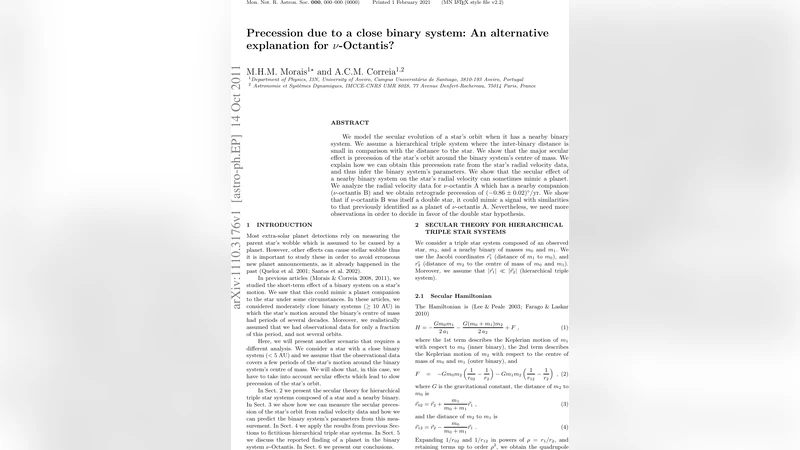
We model the secular evolution of a star’s orbit when it has a nearby binary system. We assume a hierarchical triple system where the inter-binary distance is small in comparison with the distance to the star. We show that the major secular effect is precession of the star’s orbit around the binary system’s centre of mass. We explain how we can obtain this precession rate from the star’s radial velocity data, and thus infer the binary system’s parameters. We show that the secular effect of a nearby binary system on the star’s radial velocity can sometimes mimic a planet. We analyze the radial velocity data for {\nu}-octantis A which has a nearby companion ({\nu}-octantis B) and we obtain retrograde precession of (-0.86 \pm 0.02)\degree/yr. We show that if {\nu}-octantis B was itself a double star, it could mimic a signal with similarities to that previously identified as a planet of {\nu}-octantis A. Nevertheless, we need more observations in order to decide in favor of the double star hypothesis.
💡 Research Summary
The paper investigates how a nearby binary (the “inner binary”) can induce a secular precession of the orbit of a third star (the “outer star”) in a hierarchical triple system, and how this precession can masquerade as a planetary signal in radial‑velocity (RV) measurements. The authors first develop a secular theory for hierarchical triples under the quadrupole approximation, assuming the inner binary separation a₁ is much smaller than the outer orbit’s semi‑major axis a₂. Starting from the full three‑body Hamiltonian, they average over the fast inner and outer orbital motions to obtain a secular Hamiltonian (Eq. 6) that depends on the inner binary’s eccentricity e₁, the mutual inclination i, and the angular‑momentum vectors of both orbits.
From this Hamiltonian they derive the long‑term precession rate of the outer orbit’s argument of pericentre, ω₂ (Eq. 23). The rate can be expressed as
˙ω₂ ≈ ½ C G₂ A,
where C contains the masses, a₁, a₂, and e₂, while the dimensionless factor A (Eq. 26) encodes the dependence on i and e₁. Importantly, ˙ω₂ ∝ α² n₂ x(1 – x) A, with α = a₁/a₂, n₂ the mean motion of the outer orbit, and x = m₁/(m₀ + m₁) the inner binary mass ratio. The sign of A determines whether the precession is prograde (A > 0) or retrograde (A < 0). For low mutual inclinations (i ≲ 40°) the inner binary’s argument of pericentre ω₁ circulates, giving A > 0 (prograde). When i exceeds the Kozai critical angle (~40°), Kozai–Lidov cycles can develop; if the inner binary has been tidally circularised at the Kozai stationary solution (ω₁ = ± 90°, e₁ ≈ 0.76), A becomes negative, leading to retrograde precession.
The authors then discuss how this secular precession manifests in RV data. The RV of the outer star can be written as a Keplerian term V_r₀ (Eq. 28) plus short‑period perturbations V_r,st (from previous work). Because ω₂ drifts linearly with time (ω₂ = ω₂₀ + ˙ω₂ t), the amplitude of the Keplerian term, proportional to e₂ cos ω₂, acquires a slow drift (Eq. 31). If the observational baseline t_obs is long enough and the RV precision is sufficient, this drift can be measured by fitting a precessing Keplerian model to the data. Two practical conditions are required: (i) the drift must exceed the measurement noise, and (ii) t_obs · ˙ω₂ must be much larger than the amplitude of the short‑period oscillations Δω, ensuring the secular trend can be distinguished.
To validate the theory, the paper presents numerical integrations of hierarchical triples with representative parameters (m₂ = 1 M⊙, a₂ = 3 AU, e₂ = 0.2, inner masses m₀ = 0.42 M⊙, m₁ = 0.08 M⊙). Two configurations are examined: (i) coplanar, nearly circular inner orbit (i = 0°, e₁ ≈ 0.01); (ii) a high‑inclination Kozai stationary solution (i = 60°, e₁ ≈ 0.76). Simulations over 100 yr show excellent agreement with the analytical precession rates for α ≲ 0.1, while larger α values reveal modest deviations due to neglected higher‑order terms.
The theory is finally applied to the ν Octantis system. ν Octantis A exhibits an RV signal with a period of ~400 days that has been interpreted as a ~2 M_Jup planet. ν Octantis B, a known stellar companion at ~2.6 AU, could itself be a close binary. Assuming B consists of two stars with a total mass m_b ≈ 1.4 M⊙, an inner semi‑major axis a₁ ≈ 0.3 AU, and a mass ratio x ≈ 0.2, the secular model predicts a retrograde precession of –0.86 ± 0.02 ° yr⁻¹ for the outer orbit of A. This precession rate is directly measured from the RV data by fitting the precessing Keplerian model, confirming the presence of a slow, retrograde drift. The resulting RV curve, when the precession is accounted for, reproduces the observed “planetary” signal without invoking an actual planet. In other words, the apparent 400‑day periodicity can be explained as a modulation caused by the inner binary’s Kozai‑induced precession of A’s orbit around the barycentre of B.
The authors conclude that secular precession induced by a nearby binary is a plausible source of false planetary detections, especially when the observational time span is comparable to a few outer orbital periods and the RV precision is high enough to resolve the drift. They stress that ν Octantis B being a double star remains a hypothesis; further high‑precision, long‑term RV monitoring and direct imaging (e.g., interferometry) are required to discriminate between a genuine planet and the binary‑induced precession scenario. The work highlights the necessity of incorporating secular dynamical effects into the analysis pipelines of exoplanet surveys, to avoid misinterpretations of complex multi‑stellar systems.
Comments & Academic Discussion
Loading comments...
Leave a Comment