The Computable Universe Hypothesis
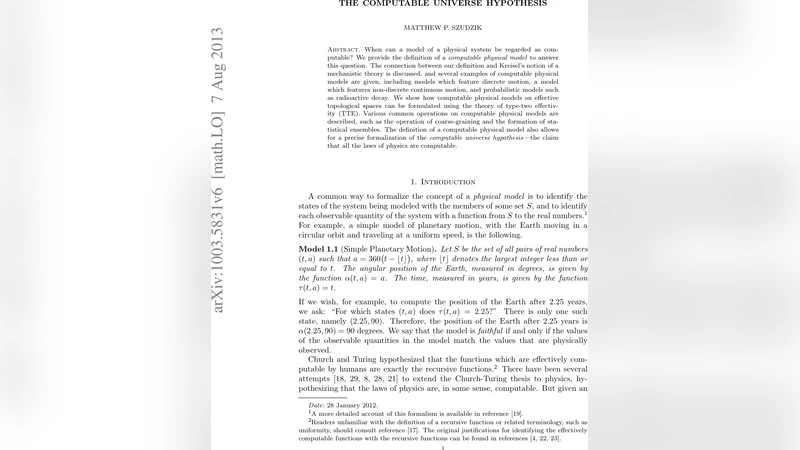
When can a model of a physical system be regarded as computable? We provide the definition of a computable physical model to answer this question. The connection between our definition and Kreisel’s notion of a mechanistic theory is discussed, and several examples of computable physical models are given, including models which feature discrete motion, a model which features non-discrete continuous motion, and probabilistic models such as radioactive decay. We show how computable physical models on effective topological spaces can be formulated using the theory of type-two effectivity (TTE). Various common operations on computable physical models are described, such as the operation of coarse-graining and the formation of statistical ensembles. The definition of a computable physical model also allows for a precise formalization of the computable universe hypothesis–the claim that all the laws of physics are computable.
💡 Research Summary
The paper tackles the foundational question of when a physical model can be deemed “computable.” It begins by noting that traditional physical modeling identifies a system’s states with a set S and each observable quantity with a real‑valued function φ on S. However, recursive (effectively computable) functions are defined only on non‑negative integers, not on real numbers, creating a mismatch between the mathematical description of physics and the theory of computation. The authors argue that this mismatch is superficial because any laboratory measurement yields only finitely many digits of precision; therefore, all observable quantities can be encoded as non‑negative integers (or tuples of integers) without loss of generality. They illustrate encoding schemes: Cantor’s pairing function for ordered pairs, prime‑exponent encodings for rational numbers, and a signed‑integer encoding for arbitrary integers.
With this encoding in place, they propose Definition 2.1: a computable physical model consists of (1) a recursive set S of state codes and (2) a total recursive function φ for each observable, mapping a state code to an integer value. In this framework, predictions are always algorithmically obtainable because both the state space and the observable functions are effectively computable. This definition refines and strengthens Kreisel’s earlier “mechanistic” criterion, which required every observable real number to be recursively related to the data. Kreisel’s condition often fails for realistic models because of discontinuities or the need for infinite precision; the new definition sidesteps these issues by allowing overlapping intervals or oracle‑based approximations that preserve computability even at points of discontinuity.
The paper then presents three concrete families of models to demonstrate the breadth of the definition.
-
Discrete Planetary Motion (Model 3.1) – Time and angular position are quantized into intervals of 0.1 years and 0.1 degrees, respectively, with overlapping intervals to model measurement error. The state set consists of integer pairs encoding these intervals, and the observable functions simply extract the appropriate components. This model is faithful to observations because the overlap exceeds the maximal eccentricity‑induced deviation of Earth’s orbit.
-
Non‑Discrete Continuous Planetary Motion (Model 4.1) – Here the intervals shrink with a parameter n, allowing arbitrarily fine approximations of real‑valued time and angle. An “oracle” function oₓ produces a nested sequence of rational intervals converging to a real number x; if oₓ is recursive, x is called a recursive real. The model shows how a continuous‑time, continuous‑space physical system can be captured by a computable model using recursive approximations rather than exact real numbers.
-
Probabilistic Model (Radioactive Decay) – The decay process is described by a recursive function giving the probability of decay in each discrete time step. Operations such as coarse‑graining, forming statistical ensembles, and computing expectation values are all defined as recursive transformations on the underlying state set, demonstrating that stochastic physics also fits the framework.
To connect these examples with broader computability theory, the authors invoke Type‑Two Effectivity (TTE). TTE provides a rigorous notion of computability for functions on infinite objects (e.g., real numbers, continuous functions) by treating them as oracles that supply increasingly accurate approximations. By formulating the models on effective topological spaces, the paper shows that the usual continuous mathematics of physics can be recast in a TTE‑compatible way, preserving computability without abandoning the familiar analytical structure.
Finally, the authors formalize the Computable Universe Hypothesis: the universe possesses a recursive set U of global states, and every observable quantity is a total recursive function on U. A “distinguishable system” is defined by a characteristic observable that is 1 exactly when the system exists in a given universal state and 0 otherwise. Because the set of states where the characteristic is 1 is itself recursive, any such system can be modeled within the computable‑physical‑model framework. This hypothesis thus encapsulates the claim that all laws of physics are algorithmically describable.
In summary, the paper makes several key contributions:
- It provides a precise, mathematically rigorous definition of a computable physical model that bridges the gap between physical theory and recursion theory.
- It demonstrates that both deterministic (discrete and continuous) and stochastic physical phenomena can be captured within this definition.
- It shows how Kreisel’s earlier mechanistic criterion can be refined and why the new definition avoids its pitfalls.
- It integrates Type‑Two Effectivity to handle continuous spaces, thereby extending the framework to realistic physical models.
- It formalizes the computable universe hypothesis, offering a solid foundation for the philosophical claim that the universe is fundamentally algorithmic.
Overall, the work offers a unifying computational lens through which to view physical law, opening pathways for rigorous analysis of the limits of simulation, the nature of physical randomness, and the ultimate feasibility of a fully algorithmic description of reality.
Comments & Academic Discussion
Loading comments...
Leave a Comment