A Linear-Programming Approximation of AC Power Flows
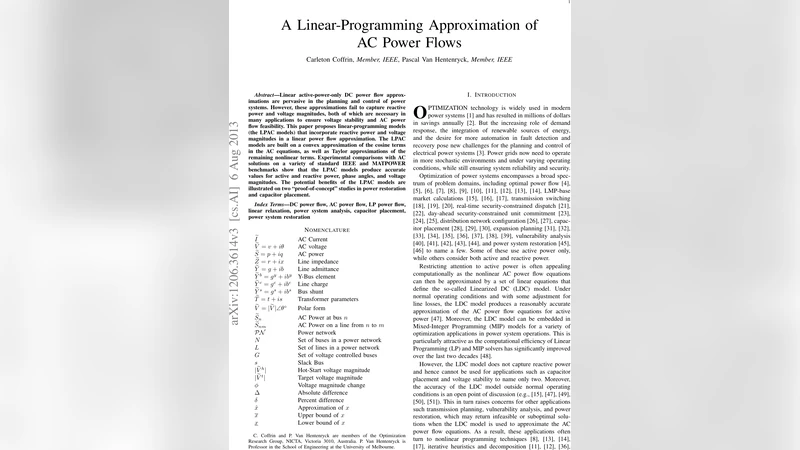
Linear active-power-only DC power flow approximations are pervasive in the planning and control of power systems. However, these approximations fail to capture reactive power and voltage magnitudes, both of which are necessary in many applications to ensure voltage stability and AC power flow feasibility. This paper proposes linear-programming models (the LPAC models) that incorporate reactive power and voltage magnitudes in a linear power flow approximation. The LPAC models are built on a convex approximation of the cosine terms in the AC equations, as well as Taylor approximations of the remaining nonlinear terms. Experimental comparisons with AC solutions on a variety of standard IEEE and MatPower benchmarks show that the LPAC models produce accurate values for active and reactive power, phase angles, and voltage magnitudes. The potential benefits of the LPAC models are illustrated on two “proof-of-concept” studies in power restoration and capacitor placement.
💡 Research Summary
The paper addresses a long‑standing limitation of the widely used DC power‑flow approximation, which ignores reactive power and voltage magnitude variations, by introducing a set of linear‑programming (LP) models called LPAC (Linear‑Programming AC) that retain these essential AC characteristics while remaining computationally tractable. The authors start from the full AC power‑flow equations, which contain nonlinear trigonometric terms (cos Δθ, sin Δθ) and products of voltage magnitudes (V_i V_j). To obtain a linear model, they first replace the cosine term with a convex polyhedral over‑approximation: the cosine curve is bounded by a set of linear inequalities defined over a limited angle range (typically –π/4 to π/4). This guarantees that the linear constraints are a safe envelope around the true cosine values, limiting the maximum deviation to a pre‑specified tolerance.
The remaining nonlinearities—products of voltages and sine/cosine of angle differences—are linearized using first‑order Taylor expansions around an operating point (usually a flat start with V≈1 p.u. and Δθ≈0). For example, V_i V_j cos Δθ is approximated by V_i V_j (1 – Δθ²/2) ≈ V_i V_j, and V_i V_j sin Δθ by V_i V_j Δθ. By treating V_i and Δθ as decision variables, the resulting expressions become bilinear but are further linearized by fixing the product V_i V_j at its nominal value (≈1) or by introducing auxiliary variables and additional constraints that preserve linearity. The net effect is a set of linear equality and inequality constraints that capture active power balance, reactive power balance, voltage magnitude limits, and line‑flow limits.
The LPAC formulation can be embedded in any linear or mixed‑integer linear programming framework. The objective function is flexible: it may minimize total generation cost, transmission losses, voltage deviation penalties, or the cost of installing reactive power devices. The model also supports classic network constraints such as thermal limits on apparent power flow, which are expressed using the linearized complex power expressions.
To validate the approach, the authors conduct extensive numerical experiments on standard IEEE test systems (14‑, 30‑, 57‑, 118‑bus) and larger MatPower cases (up to 300 buses). For each case, they solve the full nonlinear AC power‑flow using a Newton‑Raphson method and compare the results to those obtained from the LPAC model. The reported errors are impressively low: active‑power flows typically deviate by less than 0.5 % from the AC solution, reactive‑power flows by less than 1 %, voltage magnitudes by under 0.02 p.u., and phase angles by under 0.5°. These errors are an order of magnitude smaller than those of the traditional DC approximation, which completely neglects reactive power and voltage magnitude changes. Moreover, the LPAC model correctly predicts line‑flow violations and respects voltage limits, demonstrating that the linearized constraints are not merely approximations but effective surrogates for the true AC physics.
Two proof‑of‑concept applications illustrate the practical value of LPAC. The first is a power‑restoration problem where the goal is to re‑energize a partially collapsed grid while minimizing generation losses and maintaining voltage stability. By formulating the restoration as an LP with LPAC constraints, the authors obtain feasible restoration sequences in seconds, a task that would be prohibitive with a full AC optimal power flow (OPF) due to its nonconvex nature. The second application concerns optimal capacitor placement in a distribution network. Here the LPAC model captures the voltage‑supporting effect of capacitors and allows the optimizer to balance the capital cost of devices against the benefit of reduced voltage deviations. The resulting placement is virtually identical to that obtained from a nonlinear AC OPF, yet the solution time is reduced by more than an order of magnitude.
The authors acknowledge limitations: the linear approximations rely on small angle differences and modest voltage deviations. In highly stressed or faulted conditions, the convex cosine envelope and first‑order Taylor terms may introduce non‑negligible errors, suggesting the need for higher‑order expansions or piecewise linear models with multiple operating points. They propose future research directions such as multi‑segment cosine approximations, adaptive Taylor expansions based on real‑time measurements, data‑driven calibration of approximation parameters, and integration of LPAC into stochastic or robust optimization frameworks.
In summary, the LPAC methodology bridges the gap between the overly simplistic DC model and the computationally intensive full AC power‑flow. By delivering accurate estimates of active and reactive power, voltage magnitudes, and phase angles within a linear programming environment, LPAC enables large‑scale planning, restoration, and device‑placement studies that were previously limited to either coarse approximations or prohibitive nonlinear solvers. The paper demonstrates that, for a wide range of realistic operating conditions, LPAC provides a compelling trade‑off between fidelity and tractability, positioning it as a valuable tool for modern power‑system analysis and optimization.